


惯性聚合 高效追踪和阅读你感兴趣的博客、新闻、科技资讯
阅读原文 在惯性聚合中打开

推荐订阅源

N
Netflix TechBlog - Medium
IT之家
IT之家
博客园_首页
Hugging Face - Blog
Hugging Face - Blog
钛媒体:引领未来商业与生活新知
钛媒体:引领未来商业与生活新知
美团技术团队
小众软件
小众软件
博客园 - 叶小钗
WordPress大学
WordPress大学
OSCHINA 社区最新新闻
OSCHINA 社区最新新闻
博客园 - 三生石上(FineUI控件)
罗磊的独立博客
博客园 - Franky
freeCodeCamp Programming Tutorials: Python, JavaScript, Git & More
Last Week in AI
Last Week in AI
奇客Solidot–传递最新科技情报
奇客Solidot–传递最新科技情报
有赞技术团队
有赞技术团队
T
Tailwind CSS Blog
宝玉的分享
宝玉的分享
博客园 - 【当耐特】
月光博客
月光博客
Cyber Security Advisories - MS-ISAC
酷 壳 – CoolShell
酷 壳 – CoolShell
人人都是产品经理
人人都是产品经理

Redis

Real-Time Fraud Detection: Latency, Features & Scale Context window in AI: why every token is a budget decision Connecting to Redis Cloud with AWS PrivateLink vs. VPC peering | Redis Redis Data Integration in Redis Cloud is now GA in AWS | Redis Why AI Misses Business Context & How Teams Fix It AI Reasoning Explained: Why Context Matters Semantic Layer vs Context Layer: Key Differences Redis array data type: How it works and when to use it Context Graphs vs. Vector Search: When RAG Falls Short What’s new in two – May 2026 edition Redis 8.8 performance improvements: Faster string, hash, streams, SCAN & more Redis 8.8: New array data structure & open source features How Conflict-free Replicated Data Types power active-active database replication Context Orchestration: What It Is & How It Works Context Compaction for AI Agents: A Complete Guide Prompt Bloat: Causes, Costs & Fixes for LLM Apps Agentic Retrieval Techniques: A Complete Guide Single-shot reliable consumers with XREADGROUP CLAIM in Redis 8.4 | Redis Long-Horizon AI Agents: Memory & State Infrastructure What is a context engine? What Is a Context Layer? AI Agent Infrastructure Context Retrieval for AI Agents: What It Is & Why It Matters Context Poisoning: How Bad Data Breaks Agent Reasoning Context is all you need: Introducing Redis Iris | Redis Context Engineering for AI: What It Is & How to Build It AI Shopping Assistants: How They Work & What to Build Endless Aisle Retail: Infrastructure & Real-Time Data LLM Speed Benchmarks: Metrics & Infrastructure Guide Context Pruning: Cut LLM Tokens Without Losing Quality What’s new in two – April 2026 edition
Dynamic endpoints: Migrate databases without changing you...
Redis · 2026-05-12 · via Redis

Most teams don’t move Redis databases often. But when they do, the complexity is rarely in Redis itself. It’s in coordinating endpoint changes across apps, services, and jobs.

Redis Cloud now supports dynamic endpoints, a stable hostname you can redirect between databases. Instead of changing the app configuration every time you move, you redirect once. It’s a controlled cutover from database A to database B, with your apps continuing to connect to the same endpoint. Dynamic endpoint redirection is currently available in public preview.

Customers can change their infrastructure without forcing coordinated app changes.

Why database moves become operationally expensive

Moves aren’t daily work, but they’re common enough in production:

  • Upgrading your database from Essentials to Pro
  • Switching to a different Redis solution, like moving from Redis on RAM to Redis Flex (RAM and Flash)
  • Standardizing or consolidating environments
  • Migrating your database to a different region or cloud provider (for example, AWS to GCP)
  • Handling disaster recovery scenarios

Some moves include data migration. Others involve redirecting traffic to a pre-provisioned database. In both cases, static endpoints are the constraint.

When apps connect directly to a database’s static endpoint:

  • Endpoints are scattered across services, jobs, environments, and config systems
  • Cutovers require coordinated redeploys across multiple owners
  • Changes often need to be synchronized “all at once.”

The move itself may be simple. Updating the clients is not.

What should be a controlled infrastructure change can quickly become a cross-team operational event.

What dynamic endpoints provide

Dynamic endpoints introduce a stable Redis Cloud hostname that can be redirected from one database to another. Instead of updating endpoints across multiple services and environments, you redirect the dynamic endpoint, allowing traffic to shift from the source database to the target.

Unlike a customer-managed DNS change or load balancer, dynamic endpoints are managed within Redis Cloud, so customers can keep the same app endpoint without operating an additional routing layer.

Redirection is explicit and controlled, and once apps adopt the dynamic endpoint, future moves do not require repeated endpoint changes. Dynamic endpoints handle traffic redirection only; data migration remains a separate operation.

For example, a company may need to move its Redis database to another region because of infrastructure realignment, proximity to dependent services, or disaster recovery planning. With dynamic endpoints, the app continues to use the same hostname while the backing database changes beneath it.
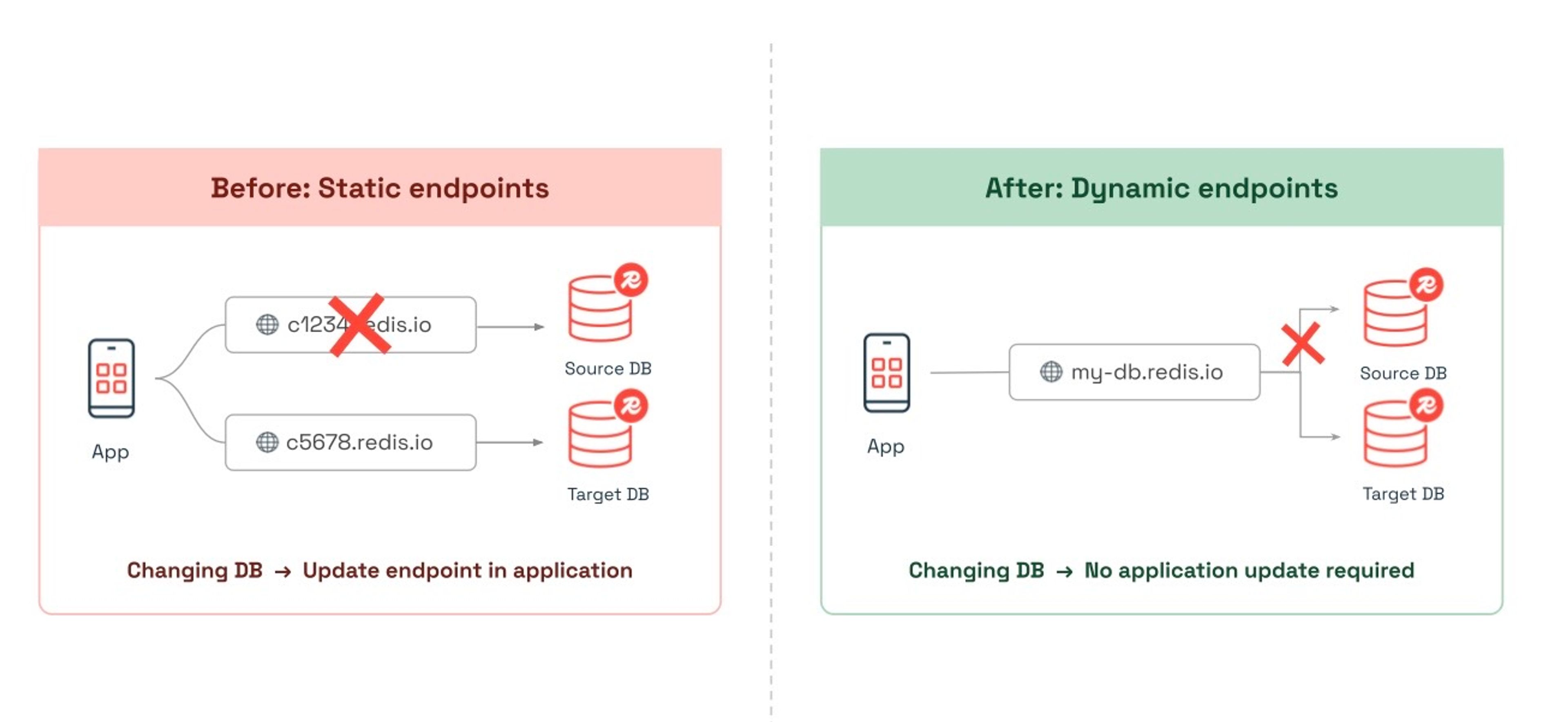
Dynamic endpoints

Example: Upgrade from Redis Cloud Essentials to Redis Cloud Pro with private connectivity

Scenario: Your app connects to an Essentials database via public access. You want to upgrade to Pro and have your app use private connectivity without having to repeat endpoint changes across all clients.

  1. Create the Pro database and set up private connectivity in your environment.
  2. Migrate data if required (for example, using replica-of)
    1. Optional: Based on your app requirements, pause writes for a strict cutover (if needed) and then stop replica-of
  3. Redirect the dynamic endpoint to the Pro database.
    1. In this example, you can choose to redirect the source’s public endpoint to be your target’s private endpoint.
  4. Monitor and validate until stable.

The app continues using the same hostname throughout the move; the infrastructure changes underneath it.

Learn more

Dynamic endpoint redirection is currently available in public preview for supported database moves within the same account, including transitions such as Essentials to Pro and Pro to Pro. During the initial rollout, access will begin with a portion of new accounts before gradually expanding to more new and existing accounts over the coming weeks.

Support depends on factors such as port compatibility, networking, and allow list configuration, and the source and target deployment types. Some combinations, such as Active-Active databases or Pro-to-Essentials moves, are not supported.

For detailed requirements, configuration constraints, and implementation guidance, read our official docs.