



惯性聚合 高效追踪和阅读你感兴趣的博客、新闻、科技资讯
阅读原文 在惯性聚合中打开

推荐订阅源

J
Java Code Geeks
月光博客
月光博客
aimingoo的专栏
aimingoo的专栏
Google DeepMind News
Recent Announcements
MyScale Blog
MyScale Blog
钛媒体:引领未来商业与生活新知
钛媒体:引领未来商业与生活新知
S
SegmentFault 最新的问题
Hugging Face - Blog
Hugging Face - Blog
Martin Fowler
Martin Fowler
WordPress大学
WordPress大学
F
Fortinet All Blogs
小众软件
小众软件
D
Docker
U
Unit 42
博客园 - 聂微东
freeCodeCamp Programming Tutorials: Python, JavaScript, Git & More
爱范儿
爱范儿
OSCHINA 社区最新新闻
OSCHINA 社区最新新闻
IT之家
IT之家
云风的 BLOG
云风的 BLOG
博客园 - 司徒正美
有赞技术团队
有赞技术团队
腾讯CDC

Towards AI

Building AI Agents in Rust — part 4 | Towards AI Building AI Agents in Rust — part 5 | Towards AI The Verified Identity Agent Bridge | Towards AI You Can’t Prompt Your Away Your LLM Problems | Towards AI The Free Agent Trap | Towards AI Your Agentic Loop Will Drift. Here Is the KL Divergence Equation That Measures How Far It Has Wandered From Its Original Instruction. | Towards AI Beyond Chat: Processing Images, PDFs, and Documents with the OpenAI Adapter in Oracle Integration Cloud | Towards AI Building AI Agents in Rust — part 3 | Towards AI Self-Hosting Airflow at Home: Automating Stock Price Data Collection | Towards AI The 76-Hour Frontier: How the Takedown of Claude Fable 5 Birthed the Military-Industrial-AI Complex | Towards AI I Trained a Markdown File to Boost GPT-5.5 by 23 Points — It Shouldn't Work | Towards AI We Replaced ChatGPT With a Local AI Server. Six Months of Honest Data. | Towards AI What Really Makes Cars Pollute? A Data Science Deep Dive into CO₂ Emissions | Towards AI Training GPT-2 From Scratch on a GTX1050 | Towards AI Principal Component Analysis (PCA): Theory, Mathematics, and Applications Build a Zero-Cost Web Automation Pipeline With OpenRouter, OpenClaw, and MediaUse I Gave Qwen3.7-Plus a Screenshot and It Found the Exact Pixel to Click for $0.40 Beyond the Prompt: Why Autonomous AI Agents Are Replacing the Chatbot Moonshot Cracked Claude Code’s Playbook with an MIT Terminal Agent and a $0.60 Model Connections, Roles, and Warehouses: Getting CoCo Desktop Production-Ready from Day One My First $5,000 Month Writing About AI Engineering on Medium Google Shrank Gemma 4 by 72% and Unsloth Fixed the 4-Bit Bug Nobody Else Caught on One 4090, and 4-Bit Shouldn’t Be This Good LangChain Explained: Understanding Models, Prompts, Chains, Memory, Indexes, and Agents TOON: Beyond JSON for LLMs Claude Code Casual, Pro, Elite: The Three Working Personas of Claude Code Mastery MiniMax M3 Decodes 1M Tokens 15x Faster — and It Shouldn’t Be This Cheap Using Amazon SQS for AI Agent Orchestration I Ran a 1.5B-Active Model on My Laptop That Embarrassed a 26B by 46 Points How to Build a Self-Improving Company with AI Part 3 — Implementation/Engine-Level: Choosing the Runtime That Gives You These for Free
QWEN 3.7 Max Worked For 35 Hrs Straight And The Results W...
Editorial Team · 2026-05-29 · via Towards AI

Free: 6-day Agentic AI Engineering Email Guide.
Learnings from Towards AI's hands-on work with real clients.

QWEN 3.7 Max Worked For 35 Hrs Straight And The Results Were Mind-blowing

Last Updated on May 29, 2026 by

Author(s): Mandar Karhade, MD. PhD.

Originally published on Towards AI.

When long-horizon tasks, exploratory freedom, some time, and the ability to self-improve are given to a good model, Great things happen.

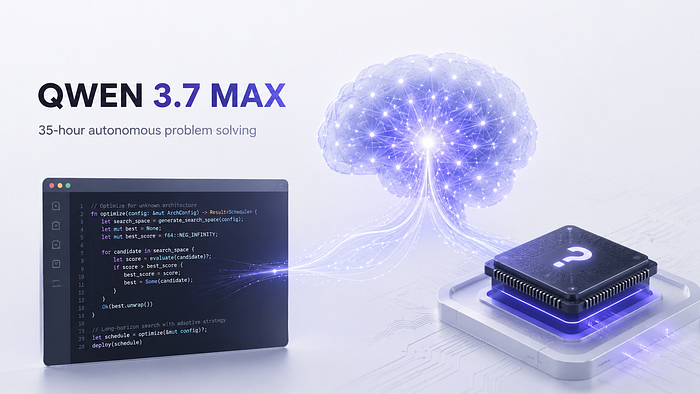
Qwen 3.7 max, it’s a big boy model. It is supposed to be fairly capable of running long-horizon tasks. In a recent experiment by Alibaba Group, this model was given a task of improving the performance of a software system on unknown hardware. The model was given an unlimited budget of time to improve the kernel. It made more than a thousand tool calls, ran hundreds of evaluations, and found incredible opportunities to speed up the kernel one step at a time.

QWEN 3.7 Max Worked For 35 Hrs Straight And The Results Were Mind-blowing

Openai Image 2

The article explains how long-horizon, recursive improvement works: instead of answering once, an AI is given a goal and a looping process (hypothesize, test, inspect, modify, repeat) so it can iteratively refine performance even in unfamiliar settings. It highlights that such success depends on tolerance for failure, information and behavioral persistence, and rapid iteration—capabilities that matter especially when documentation is sparse and hardware is unknown. The author contrasts this with human limitations shaped by specialization and narrow “tunnel vision,” arguing that AI can explore neglected gaps and even enable discoveries across domains like drugs, materials, protein engineering, and chip design. It also notes that this approach isn’t a silver bullet: uncontrolled long runs can waste energy, optimize wrong metrics, accumulate hidden errors, and be hard to audit, so safeguards like sandboxing, cost limits, permissions, checkpoints, logs, and intermittent human review are essential. Overall, the piece argues that Qwen 3.7 Max demonstrates the value of letting well-instrumented long-running experiments proceed.

Read the full blog for free on Medium.

Published via Towards AI


Towards AI Academy

We Build Enterprise-Grade AI. We'll Teach You to Master It Too.

15 engineers. 100,000+ students. Towards AI Academy teaches what actually survives production.

Start free — no commitment:

6-Day Agentic AI Engineering Email Guide — one practical lesson per day

Agents Architecture Cheatsheet — 3 years of architecture decisions in 6 pages

Our courses:

AI Engineering Certification — 90+ lessons from project selection to deployed product. The most comprehensive practical LLM course out there.

Agent Engineering Course — Hands on with production agent architectures, memory, routing, and eval frameworks — built from real enterprise engagements.

AI for Work — Understand, evaluate, and apply AI for complex work tasks.

Note: Article content contains the views of the contributing authors and not Towards AI.