




02 Sep 2018
The restic project runs the unit and integration tests for each pushed commit and each pull request. We’re using Travis CI for Linux and OS X, and AppVeyor for Windows. We’re very grateful that they provide their services free of charge for Open Source projects!
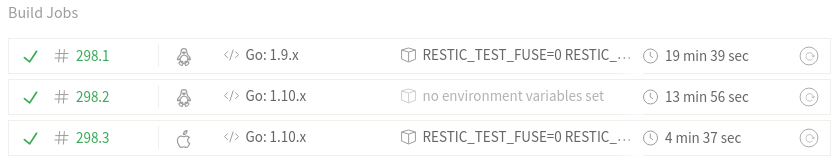
Our project not only runs the tests on Travis, but also compiles restic for each supported architecture, operating system, and version of Go. Go is known for its fast compilation times, but still, compilation takes its time. Roughly, for each version of Go, running all the tests takes between 13 and 25 minutes:
With the release of Go 1.10, a build cache was
introduced, which saves compiled
artifacts in a cache directory. On Linux, that’s usually located in
~/.cache/go-build. So when the same package (with the same build tags and
architecture and so on) is to be compiled again, the Go compiler can just use
the cached version.
Travis executes the tests in a fresh container each time they are run, but we
can tell it to keep the build cache
directory and extract it before the tests are run next time. The entry in the
configuration file .travis.yml looks like this:
cache:
  directories:
    - $HOME/.cache/go-build
    - $HOME/gopath/pkg/mod
This also caches another directory in the GOPATH called pkg/mod, which contains
information about released modules. This is a feature introduced with Go 1.11.
The directories listed above work for Linux, but the Go build cache directory is somewhere else on OS X, so we need to add the cache entries to our build matrix:
matrix:
  include:
    - os: linux
      go: "1.9.x"
      cache:
        directories:
          - $HOME/.cache/go-build
          - $HOME/gopath/pkg/mod

    - os: linux
      go: "1.10.x"
      cache:
        directories:
          - $HOME/.cache/go-build
          - $HOME/gopath/pkg/mod

    - os: linux
      go: "1.11.x"
      sudo: true
      cache:
        directories:
          - $HOME/.cache/go-build
          - $HOME/gopath/pkg/mod

    - os: osx
      go: "1.11.x"
      cache:
        directories:
          - $HOME/Library/Caches/go-build
          - $HOME/gopath/pkg/mod
After a successful build, Travis will then archive both directories, and extract them again for the next test run. Indeed, this speeds up running the tests a great deal (depending on how much code has changed):
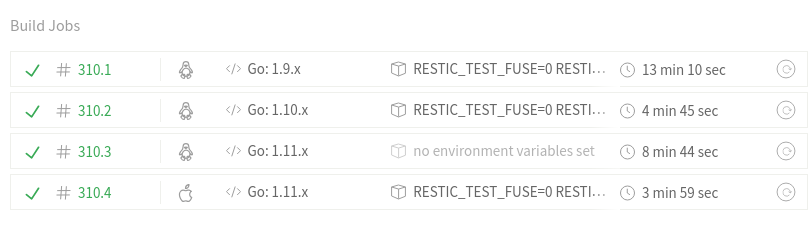
You can see in the screenshot above that the build time for Go 1.9 wasn’t reduced at all since it does not have the build cache feature.
AppVeyor also has a build cache
feature, it can be enabled by
specifying the list of directories to cache in the appveyor.yml like this:
cache:
  - '%LocalAppData%\go-build'
For restic, the build cache is not so relevant on AppVeyor, since we’re only using it to run our integration tests on Windows and don’t run any cross-compilation.
We hope that the build cache does not become too large, its size is limited for both Travis and AppVeyor. The Go compiler will delete files which haven’t been used recently, so we hope this is enough to keep the cache size small. We’ll keep you posted when we discover any problems with this approach.
Let us know what you think in the comments (which are hosted in our forum)!
此内容由惯性聚合(RSS阅读器)自动聚合整理,仅供阅读参考。 原文来自 — 版权归原作者所有。