
惯性聚合 高效追踪和阅读你感兴趣的博客、新闻、科技资讯
阅读原文 在惯性聚合中打开

推荐订阅源

J
Java Code Geeks
G
Google Developers Blog
有赞技术团队
有赞技术团队
Cyber Security Advisories - MS-ISAC
Blog — PlanetScale
Blog — PlanetScale
罗磊的独立博客
博客园 - 聂微东
V
Visual Studio Blog
博客园_首页
D
DataBreaches.Net
腾讯CDC
I
InfoQ
F
Fortinet All Blogs
量子位
奇客Solidot–传递最新科技情报
奇客Solidot–传递最新科技情报
酷 壳 – CoolShell
酷 壳 – CoolShell
博客园 - 【当耐特】
Google DeepMind News
人人都是产品经理
人人都是产品经理
云风的 BLOG
云风的 BLOG
月光博客
月光博客
Recent Announcements
MongoDB | Blog
MongoDB | Blog
C
Check Point Blog

Fortune | FORTUNE

One man can kill Bill Ackman’s $64 billion bid for Universal Music Group—and no one knows what he’ll do | Fortune Poppi’s cofounder pitched her startup on Shark Tank while 9 months pregnant and landed a $400,000 deal—now it's worth $2 billion | Fortune Teen boys are choosing AI girlfriends over real ones for 'maximum control, zero rejection'—experts say it could make them unemployable | Fortune A United American merger is by no means impossible given the president 'loves big deals' | Fortune Reed Hastings’s planned exit from $455 billion Netflix ‘had nothing to do with’ the failed deal for Warner Bros., says Ted Sarandos | Fortune Meet Joe McCann: The high-flying crypto trader held in Tanzania after sudden death of his influencer fiancée Ashly Robinson | Fortune Gen Z is carving a different path in the housing market by doing it alone | Fortune U.S. Catholic leaders criticize Trump for ‘disparaging words’ about the pope as Vatican clash risks alienating Catholic voters | Fortune China has ‘nearly erased’ America’s lead in AI—and the flow of tech experts moving to the U.S. is slowing to a trickle, Stanford report says | Fortune Self-made millionaire behind $5 billion Skims Emma Grede says it all began with a cold call to Kris Jenner: Emma Grede—the self-made millionaire behind the $5 billion Skims empire—says it all began with an audacious cold call to Kris Jenner: ‘The difference between me and someone else is, I made it happen’ | Fortune Americans have never been this gloomy about the economy. Wall Street has never cashed in harder | Fortune ‘The college grading system [is] almost meaningless’: People see the Ivy League as an easy A and with flawed admissions standards | Fortune The CEO of $8.5 billion Japanese car giant Nissan plays the drums in a band and hits the tennis courts to destress from the top job | Fortune New York governor's take on a millionaires tax: fancy pied-à-terre second apartments worth over $5 million | Fortune Pope Leo XIV: A ‘handful of tyrants’ are ravaging earth with war and exploitation | Fortune Trump has no plan to cut the $39 trillion national debt, but he does want to cut childcare. His budget director is scrambling to clarify | Fortune China's economy grows 5% in first quarter, surprising economists to the upside | Fortune Everyone was wondering what Trump wanted more: Warsh smoothly seated at the Fed, or for Powell to pay. We have our answer | Fortune Palantir exec: the biggest mistake retailers are making with AI? Trying to do it all with one agent | Fortune American YouTuber who calls himself a 'troll' sentenced to 6 months in Korean prison for literally dancing on wartime graves | Fortune BBC plans to cut up to 2,000 jobs to save 10% of annual budget | Fortune Canva debuts a new suite of agentic tools, as the design app quietly becomes one of the world’s most used AI services | Fortune Moody's CEO: AI has a trust problem – better models won’t fix it | Fortune Top New York surgeon: Americans have better data for choosing restaurants than surgeons. That has to change | Fortune The Iran war’s fertilizer shock is hammering American farmers, and 70% can’t afford what they need for this year’s growing season | Fortune Education experts to Mamdani: Why are you foisting AI on our kids? | Fortune This CEO pirated video games as a teen and became a hacker for the Air Force. Now he’s built a $3 billion cyber firm | Fortune Teacher, blame thyself: Yale report savages Ivy League schools for destroying American trust in higher education | Fortune Fed chair nominee Kevin Warsh is worth more than $100 million and has stakes in SpaceX and Polymarket | Fortune From wool sneakers to GPUs: Allbirds’ desperate AI pivot and 600% stock surge, explained | Fortune
Interest on the national debt is eating a record 19% of f...
Nick Lichtenberg · 2026-05-28 · via Fortune | FORTUNE

The federal government already spends more on debt interest than on Medicaid, national defense, or all non-defense discretionary programs combined. Now, with the 30-year Treasury yield surging past 5.19% — its highest level in almost 20 years — a leading fiscal watchdog is warning that what was already a crisis could turn into something far worse.

According to the Committee for a Responsible Federal Budget (CRFB), interest costs consumed a record 3.25% of GDP and roughly 19% of all federal revenue in fiscal year 2025. If Treasury yields remain elevated at current levels — roughly 55 basis points above Congressional Budget Office projections across the yield curve — interest costs would grow 2.5-fold, climbing from $880 billion today to $2.5 trillion by 2036. That would push debt interest’s share of federal revenue to almost 30% — nearly triple its historical average over the past half-century.

A compounding spiral

The numbers are staggering in their own right. But CRFB warns the real danger lies in the mechanics behind them. When the average interest rate on the national debt exceeds the economic growth rate — what economists call r>g — debt can begin rising rapidly and uncontrollably. Under the elevated-rate scenario, that gap would reach 75 basis points by 2036, making it increasingly difficult for even responsible fiscal policy to stop the spiral. The combination of high debt levels and a large gap between r and g can lead to a debt spiral — where rising interest costs boost debt, rising debt boosts interest rates, and rising rates boost interest costs further.
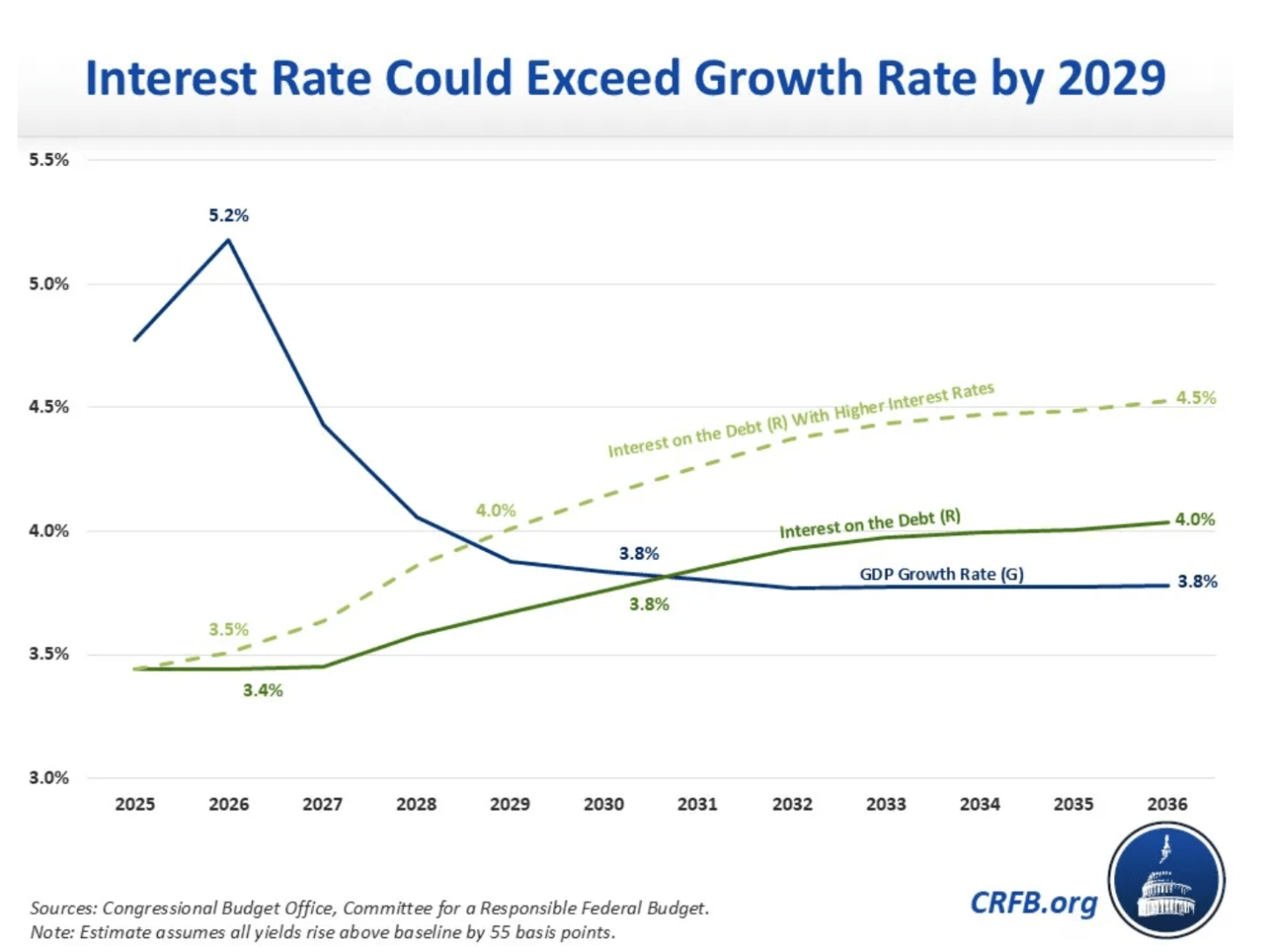
The bond market has been climbing for weeks, with the 30-year Treasury now sitting at 5.198%. Part of the pressure comes from the Strait of Hormuz closure, which rattled energy markets and stoked inflation fears. About two-thirds of investors surveyed by Bank of America Research now believe the 30-year yield could break 6% within the year.

There’s also a wilder card in play: Kevin Warsh. Trump’s pick to chair the Federal Reserve is, in the words of University of Virginia economics professor Eric Leeper, an unknown quantity — and markets are pricing in the uncertainty. “It’s not so much that people have no confidence in Warsh,” Leeper previously told Fortune. “It’s that they’re not sure what they’re getting”.

A recent Treasury auction of 30-year T-bills at a 5% rate drew only “middling” demand, according to the Financial Times — a weak signal from investors who fear inflation will slowly erode their returns over the long end.

The fiscal consequences extend well beyond the government’s own ledger. Higher Treasury yields push up interest rates across the economy, including mortgages, car loans, and business financing. A 55-basis-point increase in mortgage rates would add almost $200 per month to a $500,000 30-year mortgage — and nearly $65,000 in lifetime costs. For a million-dollar mortgage, the same rate shock adds $350 per month and nearly $130,000 over the life of the loan.

By 2027, under the high-rate scenario, interest costs would overtake Medicare spending to become the second-largest government program — eclipsed only by Social Security. By 2036, the government would be spending nearly as much on interest as on Social Security’s entire retirement program.

CRFB’s prescription is blunt: lawmakers must work to bring interest rates down and prevent high rates from crowding out other priorities or sparking a fiscal crisis. The most effective lever, the group argues, is deficit reduction — which can ease near-term inflationary pressure, take downward pressure off long-term yields by reducing economic crowding-out, and shrink the debt stock on which the government pays interest. “With debt approaching record levels,” CRFB writes, “there is little time to lose”.