





From the presidential inauguration to high-profile dinners to a documentary screening, Big Tech leaders have become a fixture at the White House. And it looks like it’s spreading to Capitol Hill as well—their representatives are expanding their influence in Washington by spending millions on lobbying Congress.
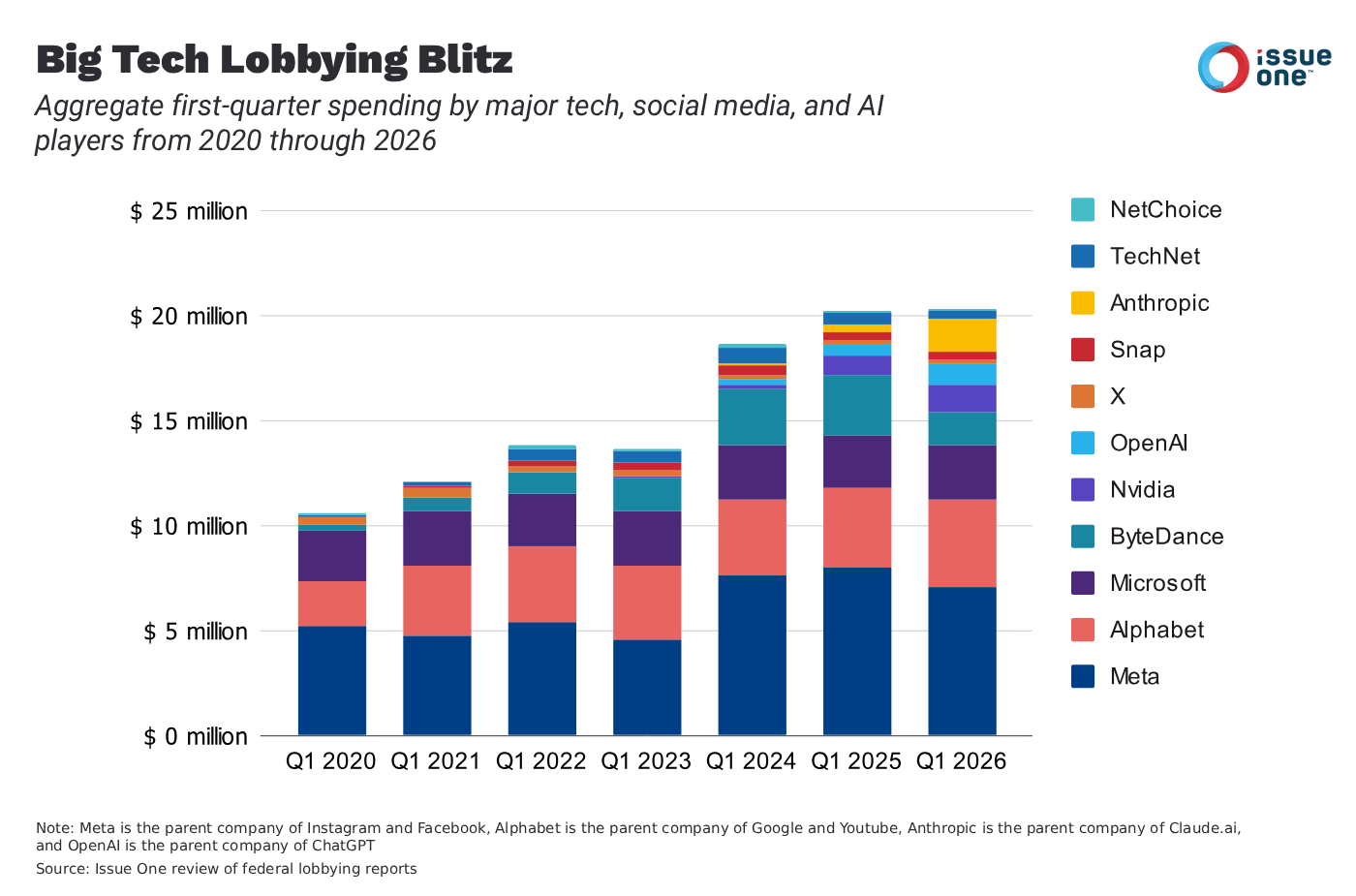
Big Tech companies, and especially emerging AI giants, are now spending more than ever on lobbying. In just the first three months of 2026, 11 top tech companies, including Alphabet, Microsoft, Anthropic, and OpenAI, spent $20 million on lobbying, according to an analysis of first-quarter lobbying reports by Issue One, a bipartisan political reform group.
That’s an average of $226,000 a day in the first 90 days alone.
Big Tech’s lobbying expenditures have nearly doubled since 2020, as concerns grow over how social media has reshaped American lives, and as AI companies look to shape regulations over the controversial technology.
Courtesy of Issue One
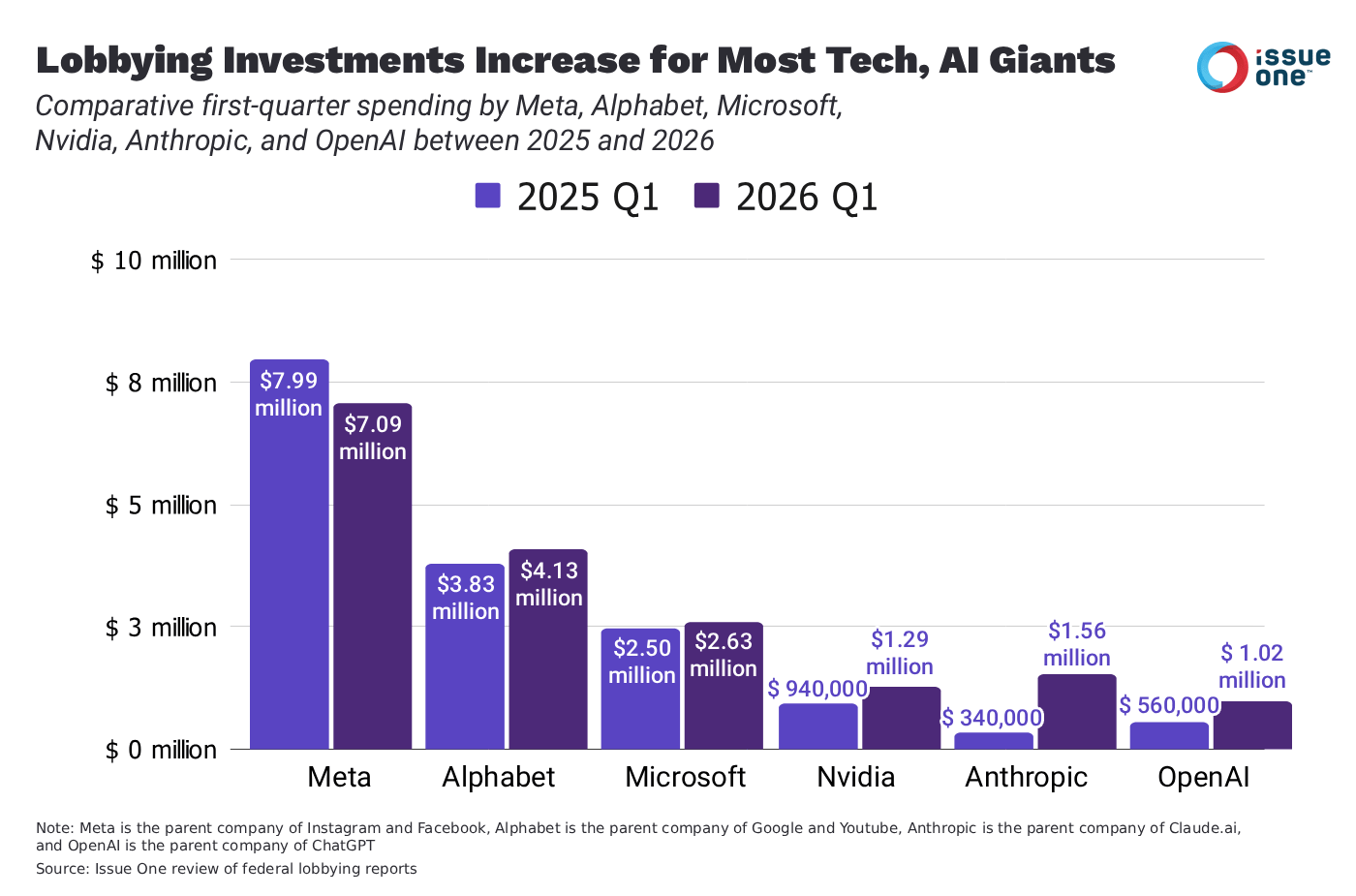
Meta spends the most money by far: Between January and March, the company invested $7.1 million, or nearly $80,000 a day, on federal lobbying. Still, when compared with its previous lobbying efforts, the company spent about $900,000 less than during Q1 last year. Alphabet, which files disclosures through its subsidiary companies like Google and YouTube, spent a total of $4.13 million during the first quarter, up about $400,000 from the same period in 2025.
AI-centered companies have been increasingly investing more in lobbying. Anthropic—whose first quarter was defined by its rocky relationship with the White House—more than quadrupled its congressional lobbying in the past year, spending $1.56 million last quarter, compared with $360,000 just a year prior. Likewise, OpenAI almost doubled its lobbying expenditures from $560,000 to $1.02 million in the same time period.
“Investing heavily in Washington influence operations is one way that these companies try to buy access and influence in Washington. Companies all across the economy, all sectors of the economy, want to have friends in Washington who will listen to their perspectives,” Michael Beckel, Issue One’s director of money in politics reform, told Fortune.
All told, Alphabet, Meta, Microsoft, Nvidia, Anthropic, and OpenAI employed 307 lobbyists during the first quarter. That’s one for every two members of Congress. Alphabet and Meta alone have 88 and 86 lobbyists, respectively, or one for every six members of Congress.
Larger lobbying investments come at a moment when more Americans are souring on Big Tech and their big plans for the future. As more data centers needed to support AI cropped up in Americans’ backyards, raising energy prices and temperatures in some cases, about a third of Americans say data centers do more harm than good for the environment, energy costs, and local quality of life, a March survey from Pew Research Center found.
As midterm election campaigns start heating up, AI and energy will likely take center stage. But the question remains of how lawmakers will respond to voters’ concerns as AI giants try to exert more influence.
Courtesy of Issue One
“This is coming at a time when we’re seeing this multifaceted, one-two punch approach. Spending money on lobbying is one way to exert influence. Spending money on campaign contributions is another way to exert influence,” Beckel said. “Major AI players are also investing tens of millions of dollars, almost $200 million and counting, into super PAC operations to spend heavily in the 2026 midterms.”
These numbers only account for federal lobbying, but Big Tech companies also spend lots of time and money influencing state and local politics.
Anthropic and OpenAI are currently backing opposing bills in the Illinois General Assembly that address how frontier AI companies would be held liable in the case of extreme disasters. OpenAI is supporting a bill that would not hold frontier AI developers liable for causing death or serious injury to 100 or more people or causing more than $1 billion in property damage.
Anthropic is standing behind a separate bill, SB3261, which would require AI developers to publish a public safety and child protection plan on their website. That bill also creates an incident reporting system to inform legislators and the public of “catastrophic risk,” or an incident that could result in the death or serious injury of 50 or more people caused by a frontier developer’s development, storage, use, or deployment of a frontier model.
此内容由惯性聚合(RSS阅读器)自动聚合整理,仅供阅读参考。 原文来自 — 版权归原作者所有。