

惯性聚合 高效追踪和阅读你感兴趣的博客、新闻、科技资讯
阅读原文 在惯性聚合中打开

推荐订阅源

freeCodeCamp Programming Tutorials: Python, JavaScript, Git & More
爱范儿
爱范儿
WordPress大学
WordPress大学
博客园 - 三生石上(FineUI控件)
J
Java Code Geeks
Vercel News
Vercel News
aimingoo的专栏
aimingoo的专栏
T
Tailwind CSS Blog
罗磊的独立博客
B
Blog
博客园_首页
A
About on SuperTechFans
有赞技术团队
有赞技术团队
V
V2EX
U
Unit 42
I
InfoQ
IT之家
IT之家
博客园 - 司徒正美
阮一峰的网络日志
阮一峰的网络日志
博客园 - 叶小钗
Cyber Security Advisories - MS-ISAC
Stack Overflow Blog
Stack Overflow Blog
The Cloudflare Blog
H
Help Net Security

Fortune | FORTUNE

One man can kill Bill Ackman’s $64 billion bid for Universal Music Group—and no one knows what he’ll do | Fortune Poppi’s cofounder pitched her startup on Shark Tank while 9 months pregnant and landed a $400,000 deal—now it's worth $2 billion | Fortune Teen boys are choosing AI girlfriends over real ones for 'maximum control, zero rejection'—experts say it could make them unemployable | Fortune A United American merger is by no means impossible given the president 'loves big deals' | Fortune Reed Hastings’s planned exit from $455 billion Netflix ‘had nothing to do with’ the failed deal for Warner Bros., says Ted Sarandos | Fortune Meet Joe McCann: The high-flying crypto trader held in Tanzania after sudden death of his influencer fiancée Ashly Robinson | Fortune Gen Z is carving a different path in the housing market by doing it alone | Fortune U.S. Catholic leaders criticize Trump for ‘disparaging words’ about the pope as Vatican clash risks alienating Catholic voters | Fortune China has ‘nearly erased’ America’s lead in AI—and the flow of tech experts moving to the U.S. is slowing to a trickle, Stanford report says | Fortune Self-made millionaire behind $5 billion Skims Emma Grede says it all began with a cold call to Kris Jenner: Emma Grede—the self-made millionaire behind the $5 billion Skims empire—says it all began with an audacious cold call to Kris Jenner: ‘The difference between me and someone else is, I made it happen’ | Fortune Americans have never been this gloomy about the economy. Wall Street has never cashed in harder | Fortune ‘The college grading system [is] almost meaningless’: People see the Ivy League as an easy A and with flawed admissions standards | Fortune The CEO of $8.5 billion Japanese car giant Nissan plays the drums in a band and hits the tennis courts to destress from the top job | Fortune New York governor's take on a millionaires tax: fancy pied-à-terre second apartments worth over $5 million | Fortune Pope Leo XIV: A ‘handful of tyrants’ are ravaging earth with war and exploitation | Fortune Trump has no plan to cut the $39 trillion national debt, but he does want to cut childcare. His budget director is scrambling to clarify | Fortune China's economy grows 5% in first quarter, surprising economists to the upside | Fortune Everyone was wondering what Trump wanted more: Warsh smoothly seated at the Fed, or for Powell to pay. We have our answer | Fortune Palantir exec: the biggest mistake retailers are making with AI? Trying to do it all with one agent | Fortune American YouTuber who calls himself a 'troll' sentenced to 6 months in Korean prison for literally dancing on wartime graves | Fortune BBC plans to cut up to 2,000 jobs to save 10% of annual budget | Fortune Canva debuts a new suite of agentic tools, as the design app quietly becomes one of the world’s most used AI services | Fortune Moody's CEO: AI has a trust problem – better models won’t fix it | Fortune Top New York surgeon: Americans have better data for choosing restaurants than surgeons. That has to change | Fortune The Iran war’s fertilizer shock is hammering American farmers, and 70% can’t afford what they need for this year’s growing season | Fortune Education experts to Mamdani: Why are you foisting AI on our kids? | Fortune This CEO pirated video games as a teen and became a hacker for the Air Force. Now he’s built a $3 billion cyber firm | Fortune Teacher, blame thyself: Yale report savages Ivy League schools for destroying American trust in higher education | Fortune Fed chair nominee Kevin Warsh is worth more than $100 million and has stakes in SpaceX and Polymarket | Fortune From wool sneakers to GPUs: Allbirds’ desperate AI pivot and 600% stock surge, explained | Fortune
AI is quietly splitting the housing market in two: Bay Ar...
Jake Angelo · 2026-05-07 · via Fortune | FORTUNE

As AI mints new millionaires, billionaires, and even trillionaires, it’s also threatening to replace entry-level workers and sparking fearful chatter of the “permanent underclass.” There’s no place that’s more evident than in the Bay Area, at the heart of Silicon Valley, where technology is wedging a deeper divide in the K-shaped economy, especially in the housing market. 

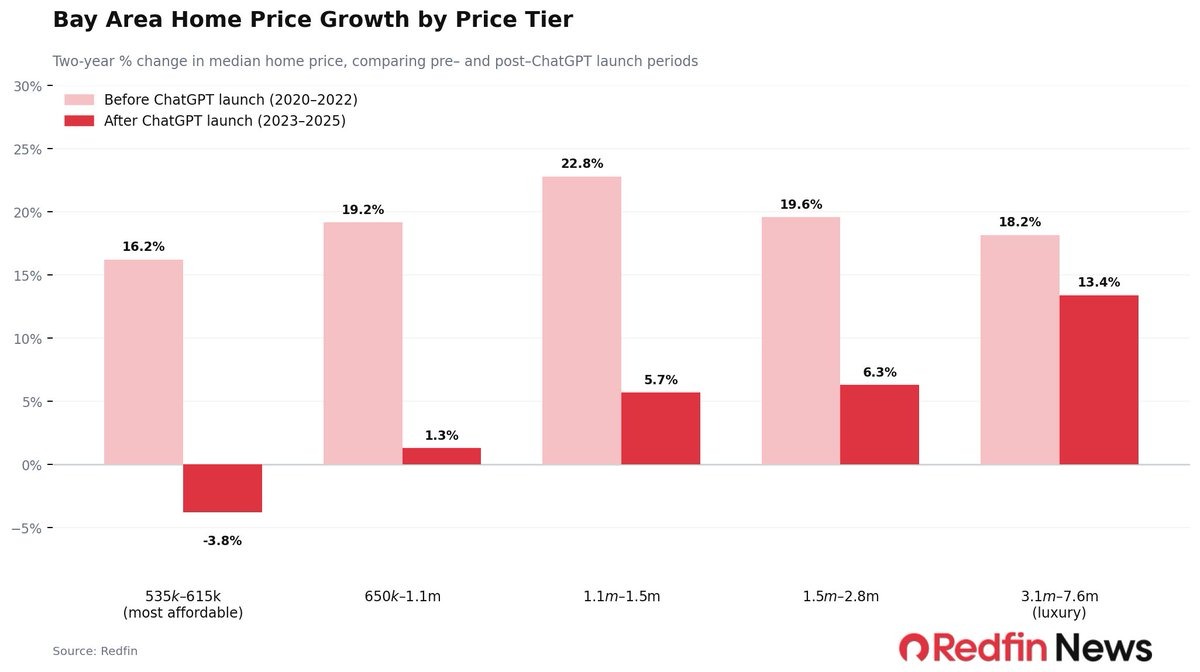
A new Redfin report found that since the launch of ChatGPT’s first model in Nov. 2022, luxury home prices in the region—classified as those selling between $3.1 and $7.6 million—have jumped 13.4%. At the same time, home values for lower-end properties in the Bay Area—those $535,000 to $615,000—have fallen by 3.8%.

“Some owners of lower-end properties have missed out on the AI boom, with home prices in the most affordable Bay Area zip codes declining over the past two years,” Yingqi Xu, Redfin senior economist, said in a statement. “It’s another sign of the K-shaped economy taking shape in the Bay Area, with AI lifting the fortunes of some households and neighborhoods much more than others.”

Many Americans today are grappling with the sobering reality of high mortgage rates, inflated home prices, and a housing stock shortage. Many are delaying homebuying by a near decade from just a few years ago, as the median age of the first-time homebuyer hit 40 in 2025, up from just 33 in 2021. 
How the AI boom is splitting the Bay Area housing market in two

Overwhelmingly it seems that AI’s biggest winners are thriving and buying up multi-million-dollar properties. 

The median home sale price in the San Francisco metro area—where companies like Meta, Alphabet, Uber, and Salesforce are based—rose 14.4% year over year in March to a record $1.7 million, according to Redfin. The firm’s chief economist Daryl Fairweather told Fortune that the market reflects an increasingly familiar pattern playing out across Silicon Valley today. 

“There are lots of people who have gotten very rich off of AI,” she said. However, the opposite also holds true. “At the same time, salaried white-collar workers are feeling the strain of the economy, worry[ing] that AI is going to replace them.”

This trend also marks a sharp break from Bay Area housing patterns before ChatGPT’s release. Between 2020 and 2022, home-price growth was roughly equal at about 20% across all price segments, from luxury to the cheapest homes. This was largely driven by low mortgage rates and pandemic-era demand.

The decline in prices at the lower end of the market may seem like an opening for buyers who have been waiting on the sidelines. But Fairweather noted that homes in that range often need significant repairs, and many are condos burdened by high HOA fees, charges that cover shared amenities like pools and gyms and can substantially offset any potential savings from a lower asking price. It’s not so much that these homes are becoming more affordable, but rather that they’re being devalued by homebuyers.

“This has more to do with the very big winners of AI, those executives and those venture capitalists that are making a lot of money off of the hype and the value of AI,” Fairweather said.

While this trend of inflated home prices may seem familiar to those in the Bay Area, it hasn’t quite reached other parts of the country yet. 

According to Redfin, New York’s luxury zip codes saw the slowest growth in the two years after the launch of ChatGPT in November 2022. In Los Angeles, too, luxury zip codes struggled, though they still outperformed other zip codes, but not meaningfully. 

The report notes that the link between AI and the luxury housing market isn’t strictly causal. But because it’s unique to the Bay Area

“The fact that this trend is absent in areas with less AI wealth suggests that the AI boom is what is fueling divergence in the Bay Area,” the report reads.