惯性聚合 高效追踪和阅读你感兴趣的博客、新闻、科技资讯
阅读原文 在惯性聚合中打开

推荐订阅源

Engineering at Meta
Engineering at Meta
Cloudbric
Cloudbric
云风的 BLOG
云风的 BLOG
A
About on SuperTechFans
The GitHub Blog
The GitHub Blog
IT之家
IT之家
F
Full Disclosure
B
Blog RSS Feed
奇客Solidot–传递最新科技情报
奇客Solidot–传递最新科技情报
Hugging Face - Blog
Hugging Face - Blog
B
Blog
H
Help Net Security
The Cloudflare Blog
Recorded Future
Recorded Future
P
Proofpoint News Feed
P
Proofpoint News Feed
C
Cisco Blogs
T
Tailwind CSS Blog
P
Palo Alto Networks Blog
D
Docker
爱范儿
爱范儿
Know Your Adversary
Know Your Adversary
博客园 - 聂微东
D
Darknet – Hacking Tools, Hacker News & Cyber Security
Y
Y Combinator Blog
雷峰网
雷峰网
AWS News Blog
AWS News Blog
D
DataBreaches.Net
博客园 - 司徒正美
Threat Intelligence Blog | Flashpoint
博客园 - Franky
C
Cybersecurity and Infrastructure Security Agency CISA
Blog — PlanetScale
Blog — PlanetScale
cs.CL updates on arXiv.org
Latest news
Latest news
Google DeepMind News
Martin Fowler
Martin Fowler
MongoDB | Blog
MongoDB | Blog
C
CERT Recently Published Vulnerability Notes
阮一峰的网络日志
阮一峰的网络日志
K
KPMG report finds enterprise disconnect between AI and its ROI | CIO
C
CXSECURITY Database RSS Feed - CXSecurity.com
酷 壳 – CoolShell
酷 壳 – CoolShell
C
Cyber Attacks, Cyber Crime and Cyber Security
腾讯CDC
小众软件
小众软件
G
Google Developers Blog
Hacker News - Newest:
Hacker News - Newest: "LLM"
Scott Helme
Scott Helme
O
OpenAI News

Shiroha白羽的博客

Golang 踩坑 —— interface 为参数的时候传 nil 指针 Codeforces Round 925 (Div. 3) Codeforces Round 924 (Div. 2) Codeforces Round 923 (Div. 3) Codeforces Round 922 (Div. 2) Codeforces Round 921 (Div. 2) Educational Codeforces Round 161 (Rated for Div. 2) Codeforces Round 920 (Div. 3) Codeforces Round 919 (Div. 2) Hello 2024 Good Bye 2023 Codeforces Round 918 (Div. 4) 个人备份的常用 macOS 清理命令 Codeforces Round 917 (Div. 2) Pinely Round 3 (Div. 1 + Div. 2) Educational Codeforces Round 160 (Rated for Div. 2) Codeforces Round 915 (Div. 2) Codeforces Round 914 (Div. 2) Codeforces Round 913 (Div. 3) Educational Codeforces Round 159 (Rated for Div. 2) Codeforces Round 912 (Div. 2) Codeforces Round 911 (Div. 2) CodeTON Round 7 (Div. 1 + Div. 2, Rated, Prizes!) Educational Codeforces Round 158 (Rated for Div. 2) Codeforces Round 910 (Div. 2) Codeforces Round 909 (Div. 3) Codeforces Round 908 (Div. 2) Educational Codeforces Round 157 (Rated for Div. 2) C++自定义的字面量 Codeforces Round 907 (Div. 2) Codeforces Round 916 (Div. 3) 关于 LRU map 的一些灵感 2023 杭州站 ICPC 现场赛 反复横跳的 Clang-Tidy(cert-dcl21-cpp) Codeforces Round 906 (Div. 2) 一段奇怪的 CPP 代码 Codeforces Round 905 (Div. 3) Codeforces Round 904 (Div. 2) Codeforces Round 903 (Div. 3) Educational Codeforces Round 156 (Rated for Div. 2) Codeforces Round 902 (Div. 2, based on COMPFEST 15 - Final Round) Codeforces Round 901 (Div. 2) Codeforces Round 900 (Div. 3) Codeforces Round 899 (Div. 2) Educational Codeforces Round#155 (Div. 2) Codeforces Round 898 (Div. 4) CodeTON Round 6 (Div. 2) Codeforces Round 897 (Div. 2) Codeforces Round 896 (Div. 2) Codeforces Round 887 (Div. 2) Codeforces Round 895 (Div. 3) blog.mauve.icu Pinely Round 2 (Div. 1 + Div. 2) Harbour.Space Scholarship Contest 2023-2024 (Div. 1 + Div. 2) Codeforces Round 894 (Div. 3) Codeforces Round 888 (Div. 3) Educational Codeforces Round#153 (Div. 2) Codeforces Round 893 (Div. 2) OTPAUTH,两步验证中的通用协议 Codeforces Round 892 (Div. 2) Codeforces Round 891 (Div. 3) Codeforces Round 890 (Div. 2) Educational Codeforces Round#152 (Div. 2) blog.mauve.icu Java Script 的 null 和 undefined 随想 记一次 SQL LEFT JOIN 没有得到预期结果的错误 Codeforces Round#789(Div. 2) GCC/G++ 预编译头性能优化 使用 Junit5 和 Mockito 实现 SpringBoot 的单元测试最优美的解决方案 centOS 防火墙 docker-compse 的问题 C++ 语言实现动态变化的线程池 Codeforces Round#744 (Div. 3) 计算机图形学 Windows 通过网络访问 WSL2 原生 JavaScript 实现图片裁剪 面试复习(计算机图形学) 面试复习(算法) Codeforces Round#706(Div. 2)-Let's Go Hiking 面试复习(Java) 面试复习(Git) 面试复习(Linux) 面试复习(数据库) 面试复习(计算机网络) 面试复习(操作系统) 面试复习(C++) Codeforces Round#699 (Div. 2) 清理 WSL2 的磁盘占用 Codeforces Round#697 (Div. 3) Windows 下的 NTFS 驱动器索引 BUG 计算机网络复习 记一次 Navicat 连接 MySQL 一直报认证错误(Access denied) 计算机网络实验复习 WSL1 使用 Docker 一直无法启动 我的ACM脚印 2020牛客暑期多校训练营(第三场)D-Points Construction Problem——构造 2020牛客暑期多校训练营(第三场)E-Two Matchings——复杂思维与简单dp 2020牛客暑期多校训练营(第二场)I-Interval——最大流转对偶图求最短路 Educational Codeforces Round 80 D. Minimax Problem——二分+二进制处理 Codeforces Round 606 E. Two Fairs——图论 Codeforces Round 612 (Div. 2) C. Garland——DP
左值-右值-将亡值
Shiroha · 2023-09-03 · via Shiroha白羽的博客

最初概念

如何确定一个值是左值还是右值?
通常有一个比较简单的判断方案:有地址的值被称为左值,没有地址的值称为右值

但是事实好像并非如此,特别是写了一些相关代码的时候,比如下面的这段

1
2
3
4
5
6
7
8
9
10
11
12
13
14
15
16
17
18
int f(int &a) {
return 1;
}

int f(int &&a) {
return 2;
}

void solve() {
int a = 1;
int &b = a;
int &&c = 1;

cout << f(1) << endl; // 2
cout << f(a) << endl; // 1
cout << f(b) << endl; // 1
cout << f(c) << endl; // 1
}

对应的输出结果也写在每一行的后面了,这似乎有一些意料之外的情况

  • 第一行,一个单独的数字 1,很明显的确实是一个右值,符合预期
  • 第二行,变量 a 明显也是一个合情合理的左值,那么也是符合预期的
  • 接下来第三行,变量 b 作为 a 的一个引用,那毫无意义也是一个左值(b 只是引用了 a 的值,实际上仍然是 a 本身),符合预期
  • 但是第四行,却让人摸不着头脑,明明 c 是一个明确的右值引用,为什么也是一个 1

这似乎表明了,c 是一个合法的左值,而非右值

尝试做一些看起来非法的操作

1
2
3
int &&c = 1;
c += 10;
cout << c << endl; // 11

看起来非常的合法合理,就像是一个活灵活现的左值,而并非它类型那样描述的右值。即然是左值,那么必然有地址,输出看看

1
2
3
cout << &a << endl; // 0x7fff1ba1f724
cout << &b << endl; // 0x7fff1ba1f724
cout << &c << endl; // 0x7fff1ba1f72c

从上面的数字可以看出来,c 确实是在栈上,即拥有一个合理合法的地址,这是发生了什么?

调查

如果把上述的代码改成汇编语言后,再看看结果

  • 汇编前
1
2
3
4
5
6
int main() {
int a = 1;
int &b = a;
int &&c = 1;
c += 10;
}
  • 汇编结果(仅摘录核心段)
1
2
3
4
5
6
7
8
9
10
11
12
13
14
15
16
17
18
19
20
21
22
23
24
25
26
27
.cfi_startproc
pushq %rbp
.cfi_def_cfa_offset 16
.cfi_offset 6, -16
movq %rsp, %rbp
.cfi_def_cfa_register 6
subq $32, %rsp ; 以上均为函数定义需要的一些基本操作,例如记录栈位置等,忽略
movq %fs:40, %rax ; 设置 canary 值,用于检测 stack overflow 现象
movq %rax, -8(%rbp) ; 将 canary 值保存到栈的前 8 个字节中
xorl %eax, %eax ; 任何值 xor 自己必定为 0,此处相当于清理 eax 寄存器
movl $1, -32(%rbp) ; 将 1 存储到 28-32 这几个字节中(int 占用 4 个字节)【变量 a】
leaq -32(%rbp), %rax ; 将【a】的地址拷贝到 rax
movq %rax, -24(%rbp) ; 将【a】的地址保存到 16-24 这几个字节中(64bit 上占用 8 个字节)【变量 b】
movl $1, %eax ; 将值 1 写入 eax
movl %eax, -28(%rbp) ; 将 eax 的值写入 24-28 这几个字节中【未知变量】
leaq -28(%rbp), %rax ; 将【未知变量】的地址拷贝到 rax
movq %rax, -16(%rbp) ; 将【未知变量】的地址写入到 8-16 这几个字节中【变量 c】
movq -16(%rbp), %rax ; 再读取【变量 c】的到 rax
movl (%rax), %eax ; 将【变量 c】认为是一个地址,取出此地址中的值并写入到 eax 中
leal 10(%rax), %edx ; edx = rax + 10
movq -16(%rbp), %rax ; 将【变量 c】的值拷贝到 rax 中
movl %edx, (%rax) ; 将 edx 的结果保存到 rax 对应的值的地址中(即写入【变量 c】作为地址所在的位置)
movl $0, %eax ; 清空 eax
movq -8(%rbp), %rax ; 取出 canary 值
xorq %fs:40, %rax
je .L3
call __stack_chk_fail@PLT

可以注意到,对于引用而言,汇编仍然使用的是指针来解决,所以可以看到变量 b 记录下的是 a 的指针,而非真正的给 a 做了一个别名。而 c 也是一个指针,指向了一个未知的变量。这似乎就是我们寻找的答案

从内存本身而言,任何值都可以认为是左值,因为一个值存在,则必定存在具体的地址,即使它是作为常量的方式写在代码中,那起码它也应该存在于代码段,“存在即有地址”

但是对于这种在代码段“有地址”的值,又违背了代码段不可修改的原则,而具体操作的时候又未免会使用到这些值,这个时候,编译器会将代码段的这个值拷贝到栈空间,然后将其再赋给具体的对象,这个拷贝过来的值,像是一个右值,同时又具有着左值的特点,更确切的说,它属于“将亡值(xvalue)”。

将亡值

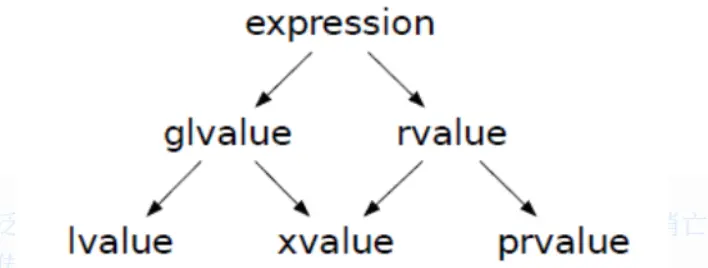
value-type

其中,lvalue 和 rvalue 就是我们一般认为上的左值和右值,而 glvalue 则是包含了将亡值的泛左值,而 prvalue 则是指那些纯右值,也就是那些在代码段里的值

将亡值则表示一种中间变量,例如使用了纯右值的时候,或者隐式类型转化,或者函数的返回值,这些都是将亡值充当的角色。实际上他们都有确切的栈上地址。

但是将亡值本身的含义是一个临时存在的变量,终是不可久留,这也就意味着编译器通常会限制对将亡值进行左值引用的方式。例如

1
double &x = (double)1;

此时编译器的报错是:Non-const lvalue reference to type 'double' cannot bind to a temporary of type 'double',即无法通过一个非常量的左值引用指向一个将亡值。而当你改成 const double &x = (double)1; 后,程序又可以通过编译了。这也说明了编译器实际上只是在做一些安全性的检查,并没有真正限制修改将亡值,甚至可以将将亡值变成长期存在的栈上的值(例如一开始的程序)