

惯性聚合 高效追踪和阅读你感兴趣的博客、新闻、科技资讯
阅读原文 在惯性聚合中打开

推荐订阅源

F
Fortinet All Blogs
WordPress大学
WordPress大学
The Cloudflare Blog
云风的 BLOG
云风的 BLOG
博客园 - Franky
D
Docker
小众软件
小众软件
阮一峰的网络日志
阮一峰的网络日志
H
Hackread – Cybersecurity News, Data Breaches, AI and More
Engineering at Meta
Engineering at Meta
MongoDB | Blog
MongoDB | Blog
U
Unit 42
M
MIT News - Artificial intelligence
B
Blog
GbyAI
GbyAI
C
Check Point Blog
P
Proofpoint News Feed
博客园 - 司徒正美
Hugging Face - Blog
Hugging Face - Blog
雷峰网
雷峰网
IT之家
IT之家
Google DeepMind News
V
V2EX
Stack Overflow Blog
Stack Overflow Blog

Ars Technica

Microsoft issues emergency update for macOS and Linux ASP.NET threat Anthropic tested removing Claude Code from the Pro plan Coyote vs. Acme is finally getting released—with a killer trailer Google unveils two new TPUs designed for the "agentic era" Tabloid reports linking 10 missing and dead scientists spur FBI probe Physicists think they've solved the muon mystery New court ruling blocks many of the government's anti-renewable policies Indian med student rakes in thousands with AI-generated MAGA hottie As EV batteries improve, ChargePoint debuts 600 kW fast charger Our favorite gear at Sea Otter Classic wasn't the bikes—it was the accessories Investors lost billions on Trump’s memecoin. Another gala won’t fix that. Pentagon wants $54B for drones, more than most nations’ military budgets Mozilla: Anthropic's Mythos found 271 security vulnerabilities in Firefox 150 Supreme Court arguments make it clear that FCC fines are "nonbinding" Silo S3 teaser hints at the wasteland's origins Framework's CEO on the RAM crisis and creating a "MacBook Pro for Linux users" Florida probes ChatGPT role in mass shooting. OpenAI says bot "not responsible." Report: Meta will train AI agents by tracking employees' mouse, keyboard use Microsoft removes Call of Duty from Game Pass, lowers subscription pricing Framework Laptop 13 Pro is a major overhaul for the modular, upgradeable laptop Framework Laptop 16 upgrades make it look less like an unfinished prototype Internal emails show how Amazon raises prices across the Internet, lawsuit says Anthropic gets $5B investment from Amazon, will use it to buy Amazon chips CATL's new LFP battery can charge from 10 to 98% in less than 7 minutes AMD Ryzen 9 9950X3D2 Dual Edition review: Tons of cache for tons of dollars What's the deal with spacesuits for the Moon? Will they be ready in time? Loneliness in older adults can often lead to memory impairment Contrary to popular superstition, AES 128 is just fine in a post-quantum world Pentagon pulls the plug on one of the military's most troubled space programs John Ternus will replace Tim Cook as Apple CEO
These clever active beam headlights are finally coming to...
Jonathan M. Gitlin · 2026-05-21 · via Ars Technica

MUNICH—Headlight technology in the US is about to get smarter. When Audi’s Q9 SUV goes on sale here later this year, it will feature the automaker’s latest adaptive beam headlights, which manage the nifty trick of providing better, brighter illumination while minimizing glare for both the driver and other road users. Such technology is old hat to our European readers, but it’s finally debuting on our roads after years of lobbying and intensive, lengthy testing to satisfy the new federal regulations. And after trying out the headlights during a recent trip to Europe, I can say, “It’s about time.”

Despite America’s reputation as an innovation powerhouse, we have lagged behind Europe and Japan in automotive lighting technology for decades, thanks to 1960s-era regulations that allowed only low- and high-beam headlights, nothing else. For years, OEMs like Audi, BMW, Mercedes-Benz, Toyota, and Volvo lobbied the National Highway Traffic Safety Administration to allow them to bring more modern technology to these shores to no avail.

At first, it was laser high beams, which could project their beams much farther down the road than conventional halogen or xenon lights. Lasers are cool, but adaptive driving beam technology is even cooler. Each headlight is actually a multipixel LED, and by turning some of those pixels off, the headlight beam can be shaped to mask the light to selectively dim oncoming vehicles instead of switching to low beams.
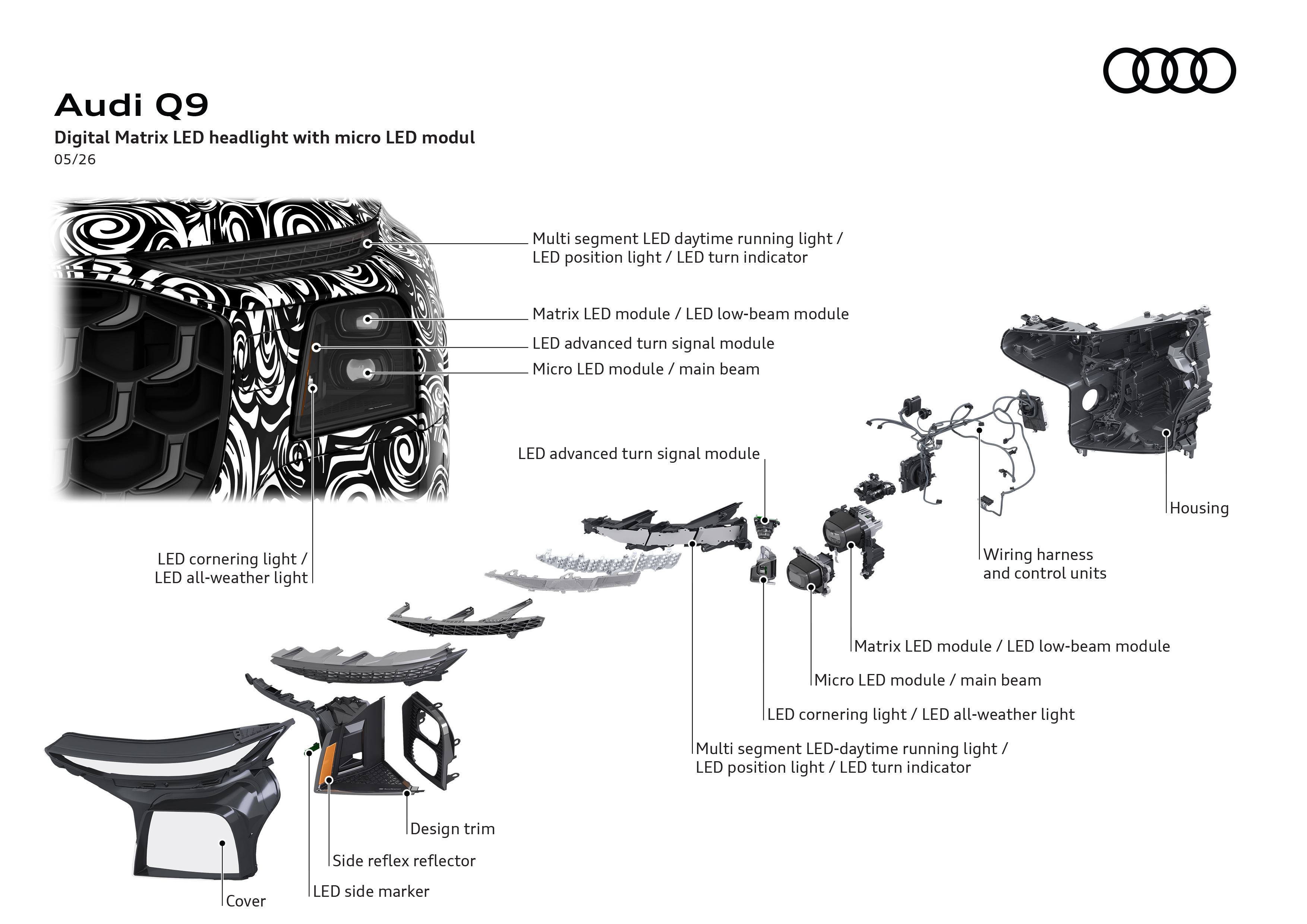
An illustration of Audi's digital matrix LED headlights.

An illustration of Audi’s digital matrix LED headlights.

Credit: Audi

An illustration of Audi’s digital matrix LED headlights. Credit: Audi

Prove it

Toyota was the first company to ask the government to let it import adaptive driving beam lights in 2013—the same year Audi introduced the technology in Europe in the A8—but it wasn’t until 2022 that NHTSA finally agreed that the tech had major safety benefits and should be allowed on US roads. In Europe and Japan, where adaptive driving beam technology has been legal for many years, approval followed road tests by vehicle regulators and independent testing authorities.

But NHTSA said that wasn’t stringent enough for the US, where automakers don’t get type approval for new products but instead certify themselves, then tell the government they comply with the safety rules. Instead, NHTSA set out a long list of tests that lights must pass to demonstrate that they don’t dazzle oncoming traffic.