
惯性聚合 高效追踪和阅读你感兴趣的博客、新闻、科技资讯
阅读原文 在惯性聚合中打开

推荐订阅源

腾讯CDC
Engineering at Meta
Engineering at Meta
Last Week in AI
Last Week in AI
V
Visual Studio Blog
Stack Overflow Blog
Stack Overflow Blog
A
About on SuperTechFans
博客园 - 司徒正美
D
DataBreaches.Net
有赞技术团队
有赞技术团队
T
The Blog of Author Tim Ferriss
MyScale Blog
MyScale Blog
I
InfoQ
Cyber Security Advisories - MS-ISAC
月光博客
月光博客
Google DeepMind News
Recent Announcements
小众软件
小众软件
G
Google Developers Blog
博客园 - 【当耐特】
U
Unit 42
美团技术团队
B
Blog
D
Docker
Blog — PlanetScale
Blog — PlanetScale

South China Morning Post

Singapore drama sparks Malaysian ire over scam hub depiction Time to act on stalled proposal toughening child abuse penalties, lawmakers say ‘Eager to explore’: Chinese migrants return to Venezuela after Maduro’s capture ‘We have no trust in the other side’: Iran blames US as talks end with no deal Opinion | Why securing Hong Kong’s economic future is a cultural question Hong Kong’s ministerial team spent HK$46.6 million on visits in past 3 years China family creates AI clone to comfort elderly mum after only son dies in crash Canada Olympic star Williams plans on ‘having a ‘blast’ at Hong Kong Sevens Singapore’s robotaxi drive revs up with help from Chinese AV leaders Editorial | Making Hong Kong desirable to overseas students must be a priority All 7 are dentists and hot. The Asian-American family blowing up social media Editorial | Ageing Hong Kong should welcome more open conversations around death My Take | Discovery Bay will never be the same if the restriction on taxi access is lifted Medical intern suspended after complaint over patient data in social media post Fish and vegetarianism major flashpoints in India’s West Bengal election Chinese crystal ‘paves way’ for GPS-free thorium clock navigation SCMP Best Bets: Endued can show his quality at Sha Tin Russia and Ukraine begin 32-hour ceasefire for Orthodox Easter Israeli spy firm Black Cube involved in Cyprus corruption probe ‘A big deal’: military drills show Tokyo’s growing focus on deterring China China targets middlemen in renewed crackdown on ‘hidden’ corruption Hong Kong-born gymnast leading quest to turn Singapore into elite hub Thais celebrate new year despite fuel price shocks delaying travel Harry Bentley tees up two good chances in Smart Golf and Elite Golf at Sha Tin Is this Kenyan rail project a model for Chinese and Western firms in Africa? Unearthing peace: ancient China gravesite reveals significance of broken weapons Meet Queen Elizabeth’s youngest grandchild, James, who was at Easter service Turtle found dead after apparent fall in Hong Kong’s Wong Tai Sin Landlords of 5,557 subdivided homes seek 3-year grace period to fix flats Trump critique pauses UK handover of Chagos Islands to Mauritius
Reflections | How the Chinese did laundry before washing ...
Wee Kek Koon · 2026-05-16 · via South China Morning Post

My washing machine has finally given up the ghost – a poltergeist, really, judging by the deafening din it makes – and I am in the market for a replacement.

Am I being odd for feeling a small thrill at the prospect? I must confess to a mild obsession with laundry. Much as I resist the comparison, I have almost certainly inherited this tendency from my mother, who runs two loads a day, come rain or shine, festive season or not.

I am a more restrained enthusiast: I limit myself to one daily wash of worn clothes and used towels. Even so, this habit raises eyebrows. Many people I know prefer to let their dirty laundry marinate for several days before tackling it in one go. Some even do it once a week!

Unless one owns an industrial-sized machine, how does a week’s worth of laundry emerge truly clean? When the drum is stuffed to the gills, fabrics have no room to slosh about in the suds. It seems less like washing and more like a rush-hour MTR carriage for shirts and socks pressed together in silent, immobile resignation.

In pre-industrial China, before the advent of washing machines and chemical detergents, laundry was a labour-intensive affair shaped by local environments and available materials. Clothes were typically washed in rivers or streams. Groups, most often women, would gather at the water’s edge, soaking garments before beating them against stones or with wooden pestles to dislodge dirt.
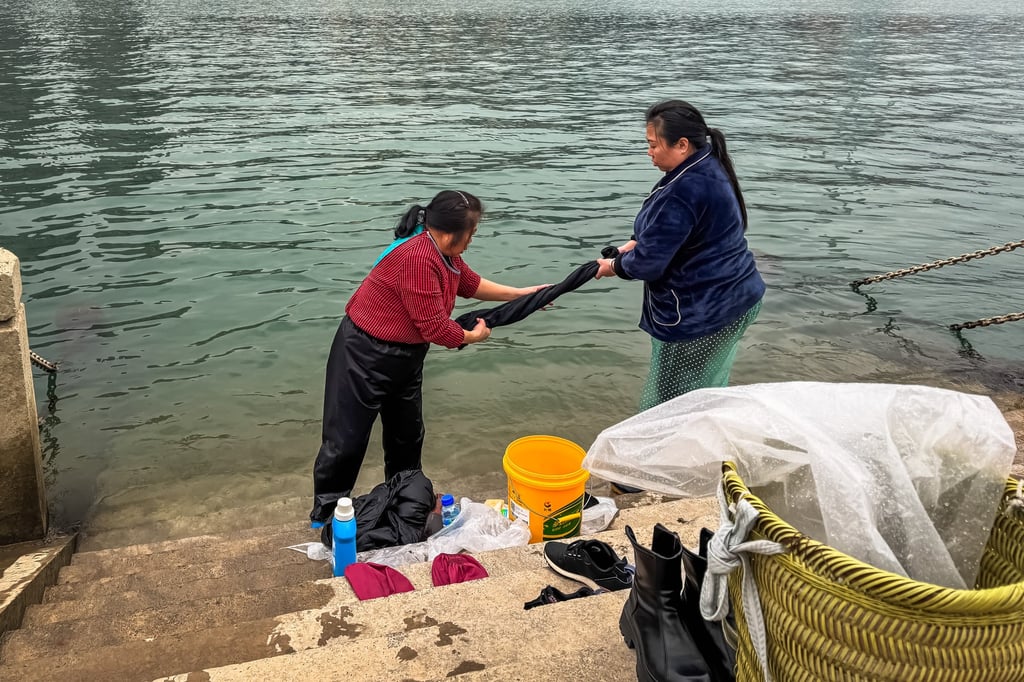
Two Chinese women wash clothes in the Wu River in Chongqing’s Fuling district using traditional hand-washing techniques. Photo: Getty Images

Two Chinese women wash clothes in the Wu River in Chongqing’s Fuling district using traditional hand-washing techniques. Photo: Getty Images

Repeated blows on wet fabric loosened grime embedded in the fibres, which running water then carried away. It was a straightforward but effective technique, and the pestle became a standard household item in many regions. One suspects it also doubled as a useful outlet for anger and frustration.