








Lydia Ourahmane has been living in Venice this year, in an apartment on the Giudecca with gorgeous views over the lapping, flickering water to the main Venetian island. The British-Algerian artist has been making an exhibition that will open to coincide with the Venice Biennale, the art world’s biggest global gathering. For months, artists and curators from every corner of the planet have been shipping and installing thousands of artworks on the little archipelago. Then, in November, when it’s all over, they will disperse again. There is something both amazing and dreadful about this vast circulation of stuff.
This is not, however, what Ourahmane, 33, has been doing. Instead, it is from Venice itself that her show has sprung. Itinerant by habit – she lives in Barcelona and Algiers, and spent her childhood “ping-ponging” between the UK and north Africa – she is a conceptual artist, in the proper sense, an artist of ideas. She tells me that she needs her art to follow the grain of the world, to be part of it. “Before I even make something, I have to be able to see a way for it to be reabsorbed into the world,” she says. That’s why previous artworks have involved, for example, a gold dental implant set among her own teeth, and a pair of Ghislaine Maxwell’s old curtains. This year it has involved, among other things, building a pier.
That pier is the end point of a set of intuitive and imaginative connections that she has been following like a paper trail since she arrived in Venice. She became entranced by the story of Poveglia, an island in the lagoon, little-known to outsiders. During times of disease it was used as a quarantine island; later it housed an asylum. To locals, though, it’s a refuge of another kind – a place they take their boats to swim and sunbathe. A decade ago it came on to the market. Fearing it would become another luxury resort, the locals formed a cooperative and, against all the odds, succeeded in acquiring it.
With her Venice-based producer Giorgio Mastinu, and British curator Polly Staple, Ourahmane visited the island. The tempting thing to do, she points out, might have been to gather some materials from the strange and fascinating place, and then use them to create a work. But, she says, that would be “extractivist” – and the community has “done so much work to resist extraction. So I decided to work with them by making a pier.”
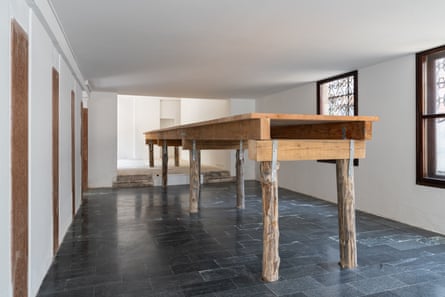
The day after we meet in Venice in March, the cooperative votes to accept her offer. A pier – making it easier to moor boats and reach the island – has duly been designed and built by local craftspeople. It is now part of her show at the city’s Nicoletta Fiorucci Foundation before it goes on to its permanent life. “It’s like a village, Venice. It’s like you’re meeting the butcher, and then the architect, and then the priest. The whole show is made like this,” she says.
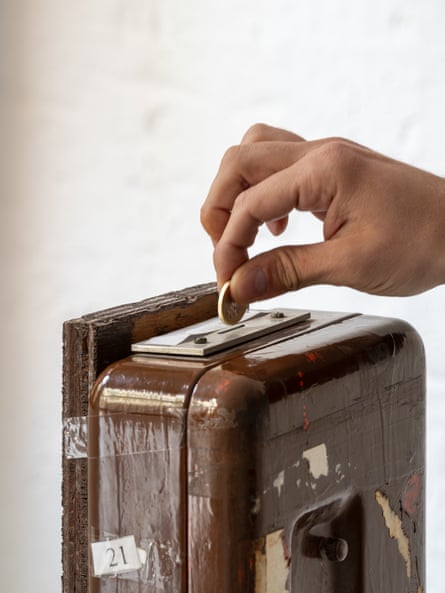
What is the priest’s role? I wonder (the butcher, in this case, being a figurative entity). She tells me she is talking about the priest of the church of San Giovanni Crisostomo, where a remarkable Bellini altarpiece of St Jerome is illuminated if you slip a euro coin into an old-fashioned machine. Charmed by the contraption, she has acquired it for her exhibition – swapping it with the priest for a newer machine for the church. To get the lights put on in her show, you’ll have to stick a euro coin in the slot. “You see the machines in every church,” she says. “It’s an encouragement to make an offering. But it’s also true they keep the painting or the work in the dark so that you can’t see it unless you can afford to see it – which is the basis for most museums.”
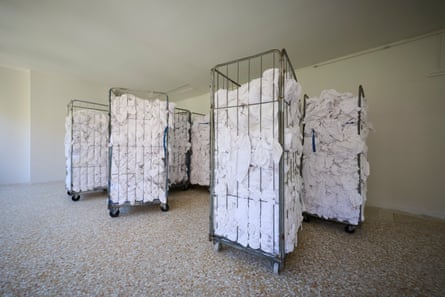
Ourahmane is overflowing with ideas, some of them practicable, some of them marvellously unfeasible. She has succeeded, she tells me a few weeks after we meet in Venice, in her plan to borrow 1.3 tonnes of decommissioned Venetian hotel bedlinen for what has become an oddly mesmerising sculpture; but an idea to build an instrument to play the light of the sun has been parked, for now. “My practice is so elastic at this point that I just make it work,” she says. “I don’t really have a fixed set of expectations: reality determines what the work is. I came here with a blank slate.”
This extreme flexibility is, she speculates, partly a function of her upbringing. She is the daughter of an Algerian father and a Malaysian mother, both of them devout Christians. She grew up in the port city of Oran in Algeria, during its “black decade” of civil war. Her loving home became a sort of “hippy commune” for Christians, she says, “an alternative reality to what was happening outside”.
She always felt safe, she says, but in reality that was far from the case. One night, “terrorists broke into our home. We happened not to be there because my mum had an instinct to leave.” There were death threats. On one occasion she says that her father went to the police station and there was a photo of someone who had once helped with building work at their house. It turned “out he was the head terrorist in the area. He used to come into work ... and tell my dad what happened last night – because he was doing it.”
When things got too dangerous the family moved to England – but her parents, feeling a sense of duty to their community, returned to Algeria. “My dad is always saying, ‘Your British passport is my biggest gift to you,’” she tells me. It took years, persistence and a lot of queueing to get it. Perhaps Ourahmane has inherited his gift for negotiation; she often calls on it in her work. Her degree show at Goldsmiths in 2014, for example, included 20 Naftal-branded oil barrels, which took months of bureaucratic wrangling to import from Algeria to London – becoming the first legally exported artwork since Algerian independence in 1962. “As an immigrant, there’s so much negotiation that happens internally,” she says. “So it almost becomes a muscle – a question of how you reconfigure yourself around this space, or this set of rules.”
History, colonialism, immigration: all are examined in her work. As a child, she was told a story about her grandfather – a tale she took for granted until it dawned on her how remarkable it really was. He was a crack sniper in the French colonial army. But during the second world war, when he learned he was to be ordered to the eastern front, he balked. The sure way to be excused service was to be disabled. He thus extracted, without anaesthetic of course, his entire head of teeth.
That resonant tale came together with another story, experienced by Ourahmane directly. One day in Oran she met a young man who tried to sell her a gold chain, which he said belonged to his mother, for €300, then the going price for a passage to Europe. As part of an exhibition she staged at London’s Chisenhale Gallery in 2018, she bought the chain, then had it melted down and transformed it into an implant among her own teeth. “It was about making a story from these two very disparate realities,” she says. “It was a way of making them register each other.” She’s had trouble ever since with that implant, she says. The bone became infected. As a metaphor for the traumas of migration, it is somewhat on the nose.
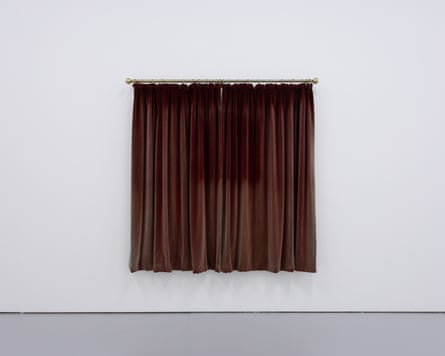
As for Ghislaine Maxwell’s curtains, they showed up in an exhibition she made about Britishness for Bristol’s Spike Island in 2024, in collaboration with her friend Sophia Al-Maria. “We start thinking a lot about how objects can witness events, historical events,” she says. Maxwell’s curtains were retrieved from a bin by a friend of Ourahmane’s when her London mews house was being cleared during the pandemic. “There’s an energetic field to anything that is handled, you know,” she says. “And when you live with something, with anything, it absorbs a certain amount of charge.” And yet – “it’s just a set of curtains”.
For Ourahmane, art is “a natural way of ordering a disordered reality. And that partly comes from speaking multiple languages and pinging between two or three positions – it’s then that the work becomes the constant.” In the end, she says, she thinks of her art as another language: one that’s “active in the world, and going through just the same reality that we experience every day”.