









It’s the clinging, transparent PVC that does it, a horribly surgical-looking, synthetic skin covering each of Anish Kapoor’s three paintings – can we call them that? – entitled Plastic Sacrifice I, II, III. They resemble a serial killer’s trophy art. Through the wrapping you gawp at three-dimensional purple and crimson entrails that slop off the wall, forming valleys and protuberances that, it seems, would collapse all over the floor if the carnage wasn’t contained by these butcher bags.
Sensationalist and macabre? Rembrandt’s painting Slaughtered Ox is just as visceral as it contemplates the flayed, hollowed body of a huge ox hanging upside down, its yellow fat and blood-dark meat a mirror of our own doomed flesh, not to mention the crucifixion. In the age of smartphones and minuscule attention spans, Kapoor gives artistic depth a go, addressing God and mortality, those themes of the old masters, in a metaphysical rollercoaster ride of a show, a divine bloodbath.
As for short attention spans, he fills the Hayward with so many tricks and surprises you’re likely to drop your phone mid-text into a black hole. Whether it falls in is less certain. One gallery is filled with optical teases that leave you unsure which bottomless abyss or portal is an actual void and which is a flat painting that merely seems to fall away into unknown regions. I’m fairly confident the first work is just a painting of a black square – as flat as the one Kazimir Malevich painted in 1915. Approach from one side and you see the shiny paint surface in the gallery lights: flatness visible. But from another angle the surface melts, receding into a tunnel towards a molten, misty whiteness.
These games are influenced by Kapoor’s experiments with the light-swallowing nanomaterial Vantablack. Look at two Vantablack works here from the side and solid objects, balls and blades, protrude from the canvases, but because they’re painted in the magic colour like their background, if you stand in front they are literally invisible.
You will want to stick a finger in Kapoor’s voids, like the wide-eyed man putting his finger into the wound in Christ’s side in Caravaggio’s The Incredulity of Saint Thomas. And like the story of doubting Thomas, this art is about the nature of the divine. That’s not new for Kapoor – he has form evoking cosmic mystery. A 1992 piece suggests the door to an ancient Egyptian tomb: an upright block of sandstone with a door-like aperture painted dark blue, its real depth bewildering, leading you into another world.
But his interest in religion is more explicit than ever – and much more provocative. The room of eye-fooling voids is an aperitif for what turns into a jaw-dropping sacrificial banquet. In the next space you are staggered by a mind-warping spectacle, a mountain hanging upside down from the ceiling. Huge enough to feel real. He calls it Mount Moriah at the Gate of the Ghetto, referring to the place where God told Abraham to sacrifice his son Isaac.
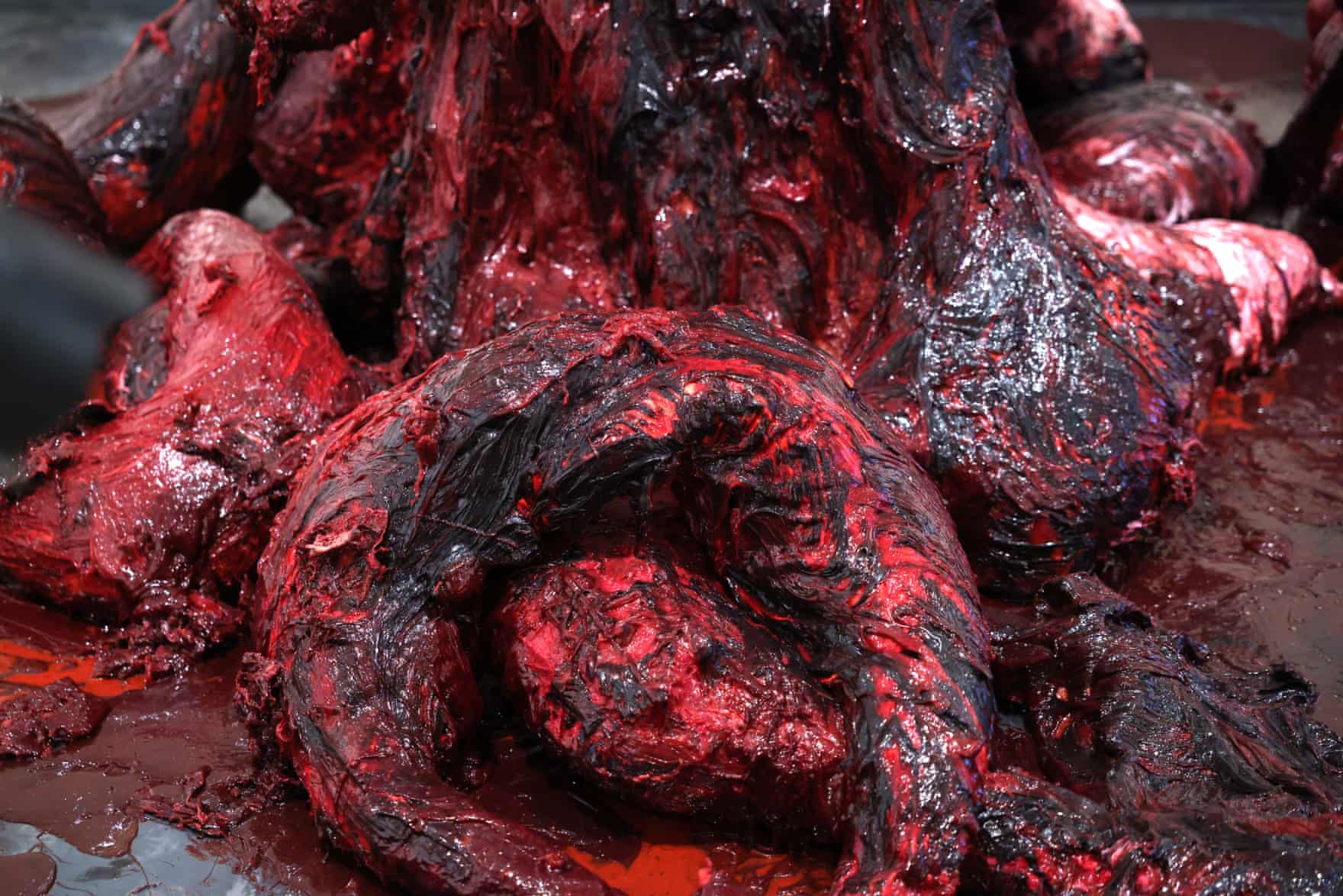
It’s like being inside a cave, under the earth. The dangling mass is painted in thick slathers of red and black paint suggesting both geology and the human body as the mountain drips fire or lava that metamorphoses into wet, fresh blood pouring down, or up. Kapoor’s overhanging cave-mountain is the scene of God’s cruellest moment. Kill your son for me, he demands, and Abraham is ready to do it. There’s no angel here to stay his hand. You wonder if you too are about to be sacrificed. Will this mountain plonk down on your head, making you a martyr to modern art? It’s hard to create a sense of danger in a gallery when we are so inured to outrage and extremity, but this had me trembling with horror – and delight.
This gobsmacking exhibition twists the knife, starting with a literally massive joke: a red curvy PVC inflatable that cuts off what is normally open-plan access to a mezzanine space. But when you get past it by another route, to find Kapoor’s mountain hanging over you, you discover the red inflatable bulging beside the hanging rock in three round organic forms that suddenly don’t seem funny: they are monstrous bags of blood.
On the other side of the mountain are his Plastic Sacrifice paintings. How many sacrifices does Kapoor’s god need? By this point I’d felt pleasure, amazement, awe, fear, disgust and some actual nausea. How much more of this are you supposed to take?
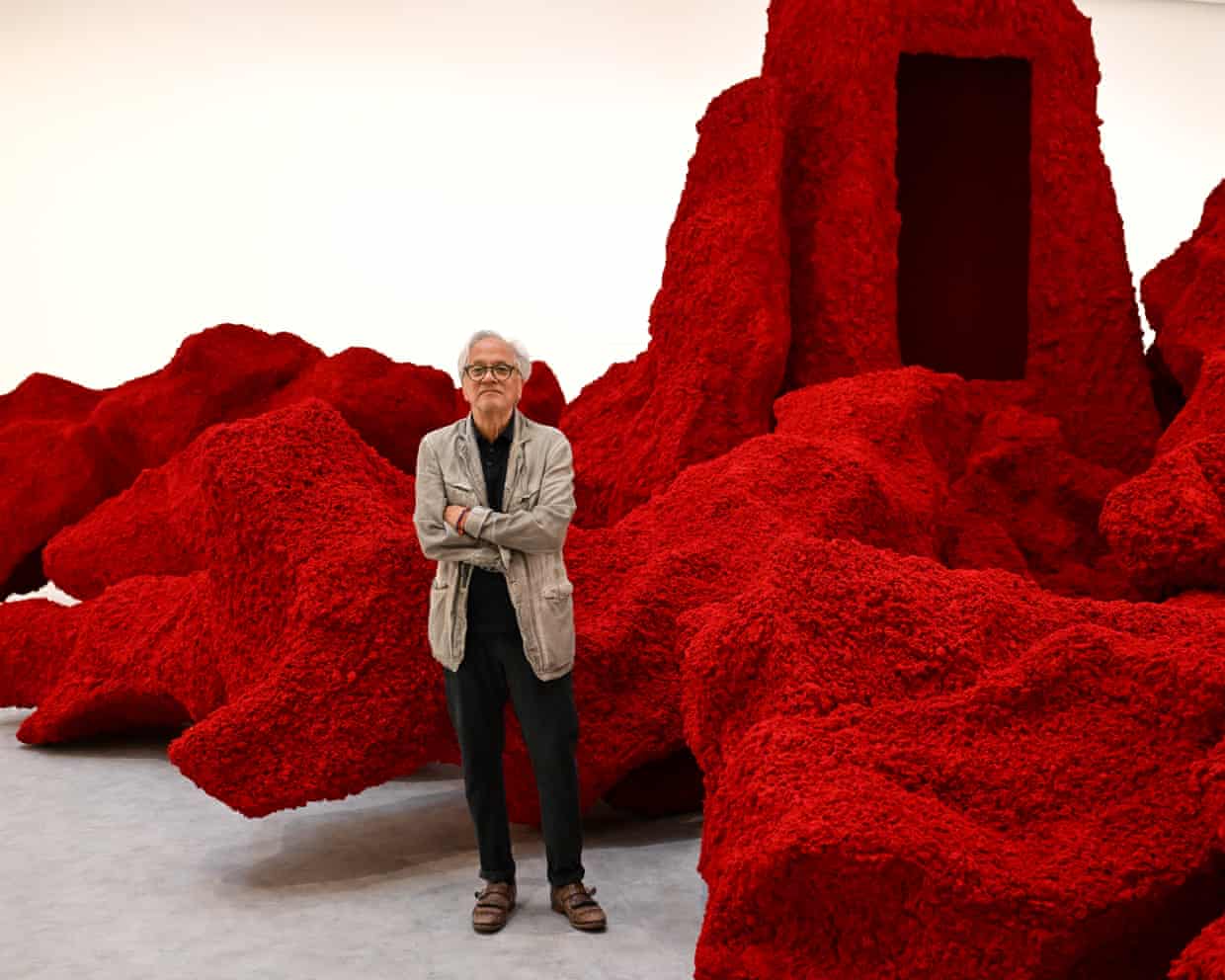
Quite a bit. You move on to Ha Makom (“The Place”), another colossal mountainous landscape. At least this one is the right way up. Tentacular outcrops of fake stone, covered in pulsing globs of red pigment, emanate from a towering central pinnacle containing a dark portal – a door to the hidden, like Kapoor’s black voids, but here it represents something definite. God, I guess.
And beyond that you reach the rite he has been working up to: god-like forms presiding over a mass slaughter. They tower over giant metal trays in which blood-soaked bodies and body parts are heaped up, and purple gore spills out through gutters. We seem to be in the human-sacrificing world of the Aztecs. Yet there’s beauty in the paintings surrounding these rebarbative murder-trays. Showers and rectangles of gold emerge from planes of colour, like the golden rain in Titian’s Danaë. The paintings are collectively entitled Ritual Expiation – through all this violence you can apparently find peace.
Art doesn’t have to be rational or explicable. Kapoor’s thesis that religion begins in sacrifice, that blood and spirit are one, may seem bizarre, even absurd, but it has produced work that moves, frightens and stuns. In an era when art often seems content with small, dry efforts, Kapoor soaks the Hayward in the blood and guts of his unfettered imagination.