








At 4.45pm in Châtelet, central Paris, a man leans out of his third-floor balcony, blasting EDM from his speakers. A makeshift cardboard sign is strapped to his decks, detailing his Instagram account in capital letters. On both sides of him, his friends hype him up from opened windows, and on the ground a crowd has started to gather. Completely spontaneous, slightly ridiculous and entirely alive, this is typical of Fête de la Musique.
Born in 1982 as a free, France-wide, government-sanctioned initiative to encourage citizens to pick up instruments and play for their neighbours, the Fête has long since outgrown its origins. Word of mouth, TikTok and the growing allure of French language music have propelled it to heights no arts ministry could have planned for, and Black Francophone culture has become the heartbeat of the weekend. Bouyon, shatta, zouk, French Afrobeats, trap, hip-hop and R&B are the sounds that have travelled farthest, enticing fresh crowds of Brits, predominantly Black, to Paris every June.
At a bar selling cups of ice to attendees, an American who made the trip after seeing videos on TikTok puts it simply: “I saw a bunch of videos of Black people in the street having a good time and I was like, where is this? It was giving me carnival vibes, Juneteenth vibes. I love to be in places where Black people are having fun.” The Fête has become, for a global diaspora, a cultural pilgrimage.
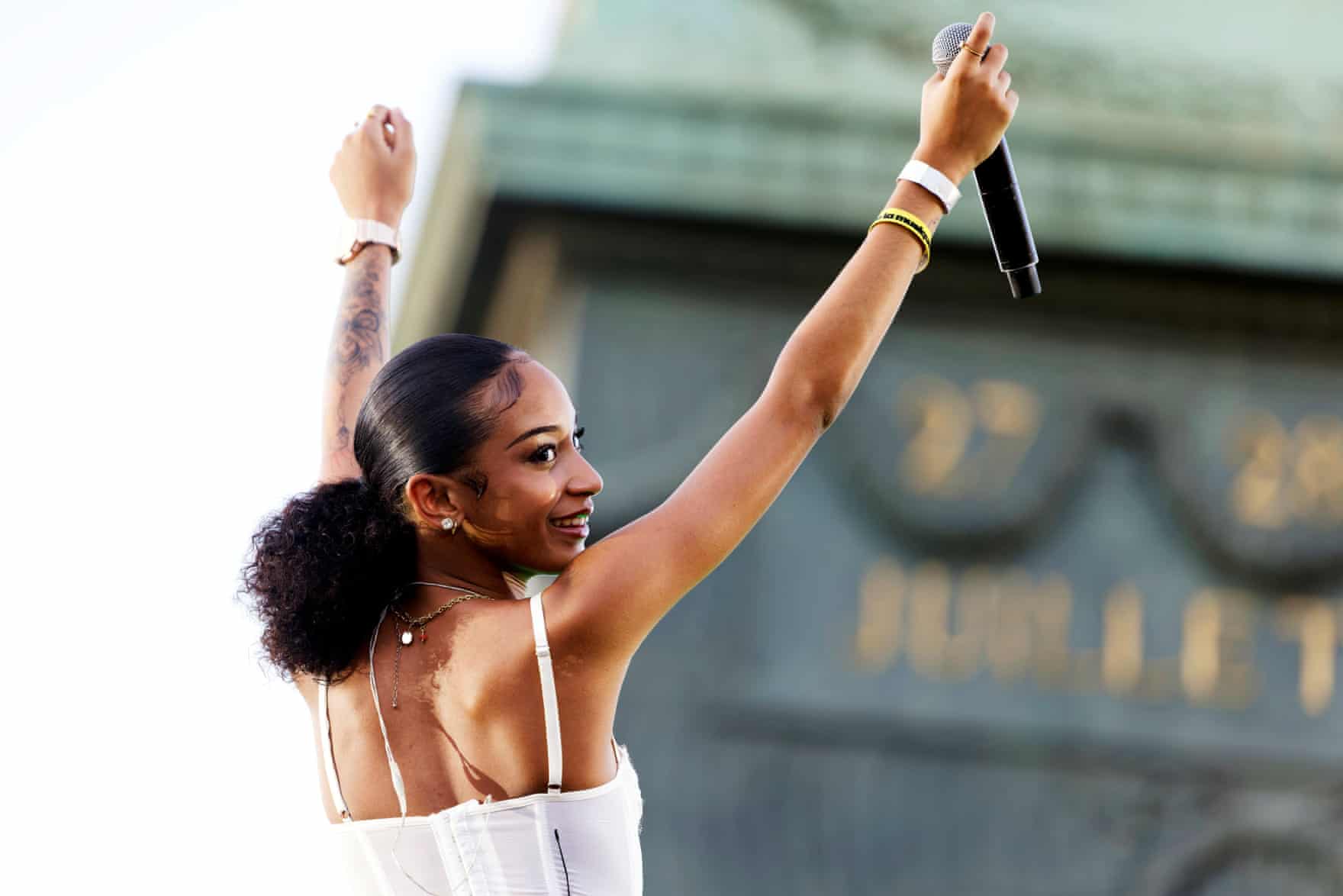
In live sets across Paris, Black Francophone music’s biggest names have been put centre stage: Miimii KDS, Tiakola, Kalash, Jeune Morty, Rnboi. Brands have also moved in – Spotify made its first major appearance this year at the Place de la Bastille – barriers have gone up, and the infrastructure is visibly straining under the weight of its own popularity. Tightly packed streets, poorly cordoned roads and at points, cars stranded in the middle of crowds, the city is struggling to keep pace with what the Fête has become.
By early evening, the heatwave pushes temperatures to 38C, and crowds gather in bikini tops and baggy jorts, with portable fans. Flags from across the diaspora are draped over shoulders; a happy coincidence with the World Cup on. Water guns are sprayed from windows into the throng below, a welcome intervention from residents who have found themselves as hosts of a city-wide party.
Step away from the branded stages and the vibe in Paris is like no other. Thirty minutes of walking and you will hear 10 different genres and 10 different crowds. Older Parisians with thin cigarettes and beers, nodding to French jazz. Industrial techno booming outside streetwear shops. French trap remixed on every other corner. A Haitian block party in a courtyard, everyone singing dancehall lyrics they clearly know by heart. A Filipino street party with home-cooked food. “It feels like home,” says one attendee. “There’s really something for everyone here.” Everyone finds their own corner and their own volume for the night.
From start to finish, Miimii KDS’s Sé Miimii reigns as the unofficial national anthem, or arguably Mauvais Djo’s Pilé. Bouyon, a frenetic style of French Caribbean dance music, rules along with French Afrobeats, but amapiano, afroswing and British hip-hop are never far behind. And diasporan staples such as Pop Smoke’s Dior, Vybz Kartel’s Clarks, Giggs’s Talkin’ the Hardest and Khalil Harrison & Tyler ICU’s Jealousy unite strangers across streets. French MCs lead crowds through rounds of “olé, olé, olé” while Brits pick up slang words – “oh ouais”, meaning “oh yeah”; “wesh”, meaning “hey” – fast enough to feel like locals by the time that they start making their way home in the early hours of the morning.
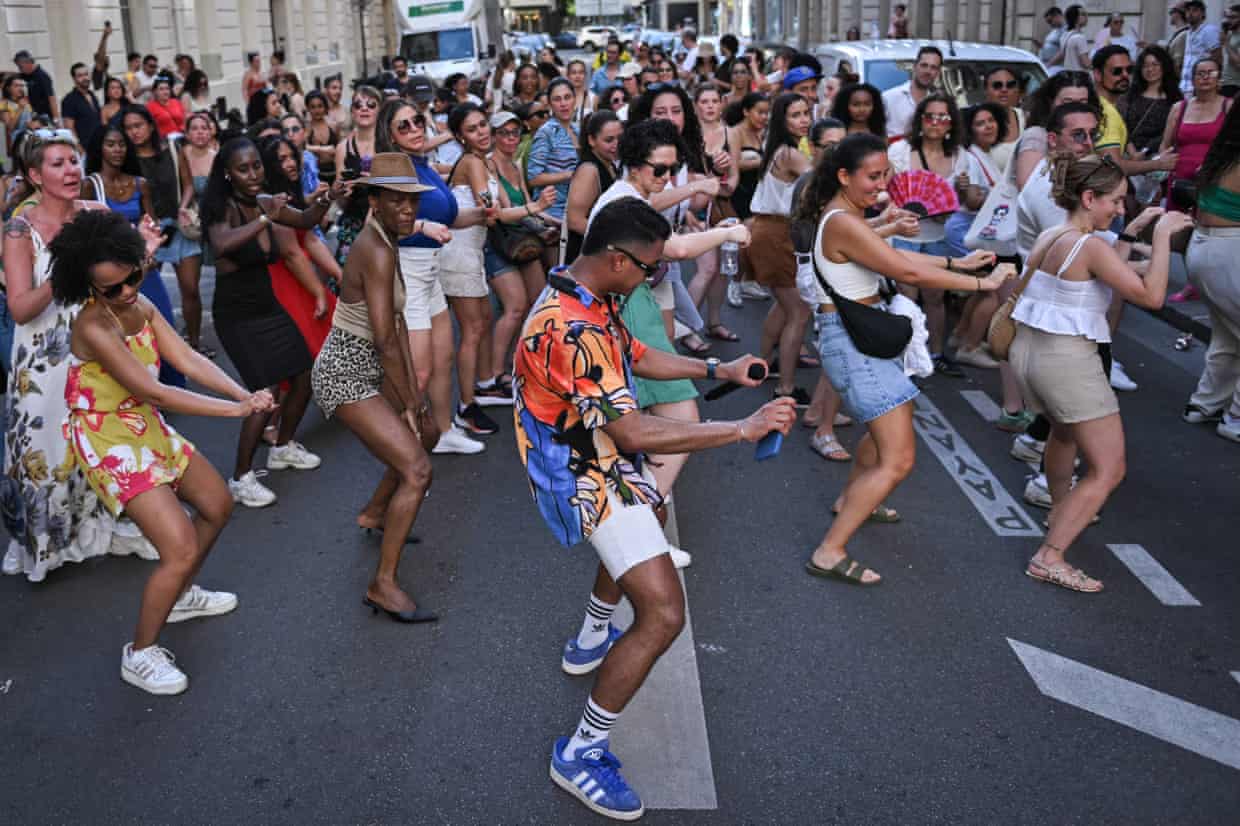
The closest British equivalent is Notting Hill carnival, though the two aren’t exactly analogous. Carnival was born in the late 1950s to heal racial tensions and celebrate Caribbean culture in the aftermath of the Notting Hill race riots and the murder of Kelso Cochrane. It is concentrated, choreographed, rooted in a specific community and a specific wound. Fête carries no such origin. It sprawls across an entire city with no floats to catch at a set time, no single neighbourhood to converge on. “Here, there is no point where one party stops and another one starts,” says one British attendee, a lifelong carnival visitor. “The cultural synergy at Fête feels like something new. It’s not genre or location-specific.”
The critique, that the British influx has diluted something, that non-French speakers have taken over a thing that was never theirs, is not without basis. French people who grew up with the Fête as free and unrestricted will naturally feel the shift. Organisers will need to resist too many brands simply turning up, spending money on billboards and turning this expressive, utopian-minded event into just another corporate festival; extracting value from a Black grassroots cultural phenomenon. The smaller, free stages that have helped make the event what it is cannot afford to be drowned out.
But in person, for all that Paris is creaking a little under the weight of Fête, these tensions do not play out as starkly as they do online. In an age where live music is increasingly ticketed and priced out of reach, an event drawing more than two million people across an entire city, almost entirely for free, feels less like a problem and more like a godsend. You just have to be willing to walk and dance until your feet hurt.