





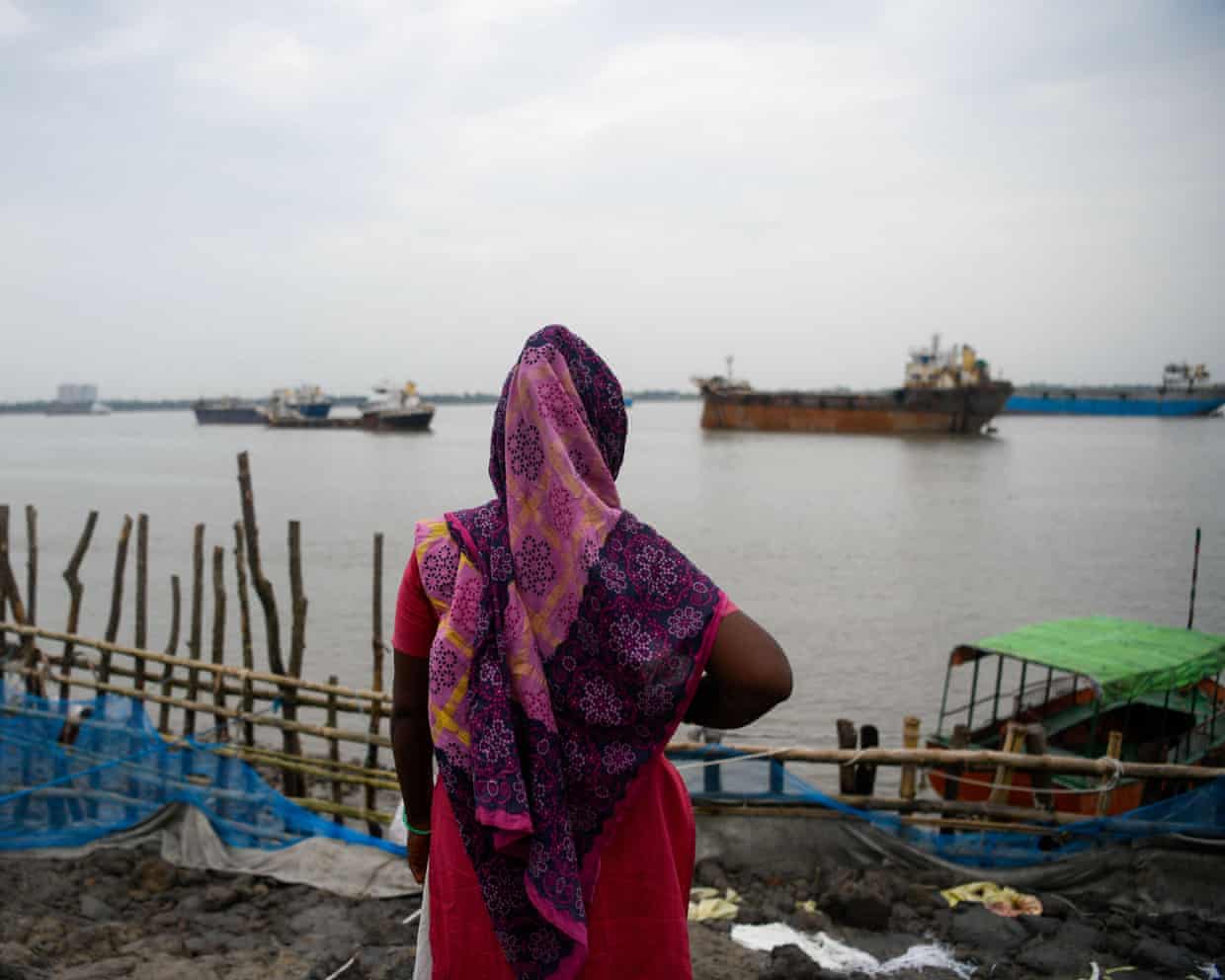
In the spring of 2024, I am finally able to visit Banishanta, the island in southern Bangladesh that has been haunting my dreams. When I arrive I find it is little more than a long patch of grey mud, with a string of flimsy huts lining a craggy shore. Thirteen years earlier, I was on a boat on my way to the Sundarban mangrove forest when a guide casually pointed out the island and told me it was a state-licensed brothel that had been there since the time of the British.
When I went home, I didn’t want to think about Banishanta, because if I did, I would have to imagine the terrible things the women there were enduring while I lived a life of casual entitlements many thousands of miles away. Yet the women squatted in my imagination, refusing to leave. I resolved to never write about them, because it would say things about the world I didn’t want to know. It was only when I decided I could write a novel, set on a fictional island, about a rebellion of women, that I allowed them in.
Fictional representations of women’s protests have often been set in speculative worlds. Think of Gilead in The Handmaid’s Tale, or more recently, Naomi Alderman’s The Power, in which women are suddenly given the power to inflict pain, thus subverting gendered roles and dynamics. They often begin with women under extreme, often theocratic forms of patriarchal structures – as well as Atwood’s Gilead, there is Miriam Toews’s Mennonite community in Women Talking. The protagonists then challenge these conditions through collective action. They give us, in fiction, what we yearn for in life – a dramatic reversal of fortunes. If I could do that, I thought, I could write about the island. It would be about the possibility of such a place. It would be a manual for survival, a way to imagine liberation – not just for those women – but for all women.
Perhaps the most famous women’s strike in literature took place in 411BC in the pages of Aristophanes’ Lysistrata. The witty eponymous heroine is determined to bring an end to the 20-year Peloponnesian wars by instructing the women of Sparta and Athens to “refrain from depths of love”. Meaning, they must refuse to have sex with men. In the end, the men relent, ending the war and reuniting with their wives. Although it is by no means a feminist tract – the women are portrayed as horny, drunken and hardheaded – it is remarkable that Aristophanes wrote so boldly about gendered power, creating the blueprint for a kind of strike that would shock, even today.
We live in a time of malignant patriarchy, one that spreads aggressively through every corridor of our lives. It is not a new thing: Lysistrata’s comrades wonder casually if, deprived of sex, their husbands might rape them.
What has changed is that, having grown up with the expectation that women’s rights will continue to expand, we are now witnessing a moment when our basic freedoms and safety are under threat, where power is battled, adjudicated and wielded on the bodies of women.
Nowhere is this felt more keenly than on Banishanta, where women’s bodies are traded for insignificant sums on a daily basis. But as I wonder in rage whether I will spend the rest of my days under the darkening shadow of male dominion, I ask whether this could be, as Walter Benjamin might say, a time of emergency that is also a moment of emergence. And if we were to create such a moment, then it would be through protest and collective action. And so I set myself the task of creating a fictional protest, if only to grant me some hope in my darkest moments.
It’s difficult to get around Banishanta, even with the help of the women. The ground is soft beneath my feet, the sun is punishing above, and there is barely any space between the embankment and the shabby structures that cling to it. The women are old and very young. They are weathered and yet appear almost childlike in their curiosity. We hold hands and they put their arms around me, immediately warm, asking about my life, my husband, my children. Farzana dresses in loud colours and makes her presence felt, unlike her best friend, Asha, a soft-spoken newcomer. As we are talking, an older woman arrives with two small plastic bags of food. “Auntie does the cooking,” Asha whispers. In the cramped room with the barred window and the mud floor, the single bed, the clothes strung up on the walls, there is nowhere to cook.
South Korea’s 4B movement is the closest modern ideation of Lysistrata’s strike. 4B is about rejecting the patriarchy by refusing the four things that serve it: dating, marriage, sex and childbearing. Although Han Kang’s The Vegetarian is not ostensibly about 4B, the main character, Yeong-hye, makes the dramatic decision to become a vegetarian, and follows this by committing a series of confusing, impenetrable acts of protest. Described by her husband as “completely unremarkable in every way”, she gradually turns herself into a person who exists entirely outside societal expectations. Her husband and her family continually violate her, but she makes herself “utterly unknowable”, and it is through this unknowability that her power holds firm. In the end, although her body is destroyed, she unleashes a hypnotic alternative to the way things have always been.
In the 1980s, jailed Irish republican women at Armagh prison joined their male counterparts in the “dirty protest”. Four hundred men at Long Kesh prison had been smearing the walls of their cells with faeces since 1978, but when the women joined them, their protest was considered repulsive, even to their comrades. A journalist visiting both prisons said: “I found the smell in the girls’ cells far worse than at Long Kesh, and several times found myself having to control feelings of nausea.” His article prompts the anthropologist Begoña Aretxaga to ask: “What can make 30 dirty women more revolting than 400 dirty men?”
Inside one of the huts on Banishanta, Komola chops vegetables and tells me how much better the girls have it now. She arrived in great debt to the man who trafficked her, whereas Asha and Farzana are free to come and go as they please. I wonder what that really means, given that Asha has left her daughter behind in her village, and no one in her family knows where she is. A heavily made-up woman passes through and winks at us. That’s my husband, Komola declares. She doesn’t explain what husband implies in this context, and I don’t ask. What does it mean, I wonder, to live in a world without men?
Sultana’s Dream, written in 1908 by Rokeya Sakhawat Hossain, is widely considered to be the earliest depiction of a female utopia. In Ladyland, women are the rulers, and men live in purdah, a reversal of the strict gender segregation Sakhawat herself grew up in. Ruled by a mild-mannered queen, they have eliminated war through the judicious deployment of technology; they have an endless food supply because their country is run by scientists, and the men “should not do anything, excuse me; they are fit for nothing”. In this world, multiple aspects of human progress are only possible if the men are imprisoned and the women are free.
Sakhawat’s vision of a world without men, Han’s depiction of a woman without desire and Aristophanes’s portrait of a society in which women have taken over are all radical experiments. They show us that we can refuse to become female subjects who marry, bear children and exist within the frameworks we have inherited. We must be able to imagine these alternatives if we are to reverse our fortunes.
As for the women of my fictional island – I could not help but give them a triumphant revolt, and so I made them stage a protest in which they refuse sex, refuse even to wash and yes, they smear their menstrual blood on their foreheads. And I told myself, if those women can say no to the way the world is, so can the rest of us. I think of them as a salve for the blows of male power inflicted on us every day. I think of them spitting in the eye of the malignancy and declaring, with Lysistrata, “no threat shall creak our hinges wide”.