



惯性聚合 高效追踪和阅读你感兴趣的博客、新闻、科技资讯
阅读原文 在惯性聚合中打开

推荐订阅源

博客园 - 三生石上(FineUI控件)
G
Google Developers Blog
Vercel News
Vercel News
Cyber Security Advisories - MS-ISAC
N
Netflix TechBlog - Medium
奇客Solidot–传递最新科技情报
奇客Solidot–传递最新科技情报
钛媒体:引领未来商业与生活新知
钛媒体:引领未来商业与生活新知
Engineering at Meta
Engineering at Meta
B
Blog
博客园_首页
量子位
博客园 - 叶小钗
L
LangChain Blog
T
The Blog of Author Tim Ferriss
云风的 BLOG
云风的 BLOG
Blog — PlanetScale
Blog — PlanetScale
F
Fortinet All Blogs
S
SegmentFault 最新的问题
宝玉的分享
宝玉的分享
D
DataBreaches.Net
雷峰网
雷峰网
The Cloudflare Blog
freeCodeCamp Programming Tutorials: Python, JavaScript, Git & More
Threat Intelligence Blog | Flashpoint
Last Week in AI
Last Week in AI
P
Proofpoint News Feed
TaoSecurity Blog
TaoSecurity Blog
罗磊的独立博客
MongoDB | Blog
MongoDB | Blog
The GitHub Blog
The GitHub Blog
I
Intezer
H
Help Net Security
The Hacker News
The Hacker News
The Register - Security
cs.CL updates on arXiv.org
AWS News Blog
AWS News Blog
V
V2EX
Microsoft Security Blog
T
Tenable Blog
Spread Privacy
Spread Privacy
A
Arctic Wolf
P
Proofpoint News Feed
T
Threat Research - Cisco Blogs
Schneier on Security
C
CERT Recently Published Vulnerability Notes
让小产品的独立变现更简单 - ezindie.com
The Last Watchdog
The Last Watchdog
Latest news
Latest news
T
Troy Hunt's Blog
L
LINUX DO - 热门话题

The Guardian

New Zealand’s North Island braces for Cyclone Vaianu with thousands ordered to evacuate Artemis II splashdown – in pictures Swalwell denies allegations of sexual assault as calls grow for him to withdraw from California governor race Trump news at a glance: Epstein survivors have words for Melania Trump after surprise statement Multiple people face charges, including murder, in California fireworks blast Rory McIlroy surges into six-shot Masters lead with stunning second-round flourish Roberto De Zerbi targets ‘Ange-ball’ revival to save Spurs from relegation Bath hit back to reach semi-final after stunning Northampton in 11-try epic Australia crash out of BJK Cup after Britain secure upset with doubles win Zebras, wealth and power: Hungary’s election tests Orbán’s grip on power ‘TikTok effect’ brings sellout crowds and younger fans to Grand National meeting King signs up David Beckham to his Chelsea flower show team The war over Omagh’s gold: the £21bn mine plan tearing a community apart Britain’s shadow workforce is paid as little as 65p an hour. Who cares for the carers? Tim Dowling: my wife is on a quest to restore my thinning hair SUVs are making Britain’s potholes worse, say scientists Blind date: ‘She claimed she was usually shy. I wouldn’t have guessed’ I’m a sauna person now: the Becky Barnicoat cartoon ‘I got everything I dreamed of – when I had no ability to handle it’: Lena Dunham on toxic fame, broken friendships and her ‘lost decade’ Six great reads: the man who let snakes bite him, masked heavy metal and the brutal reality for foreign students in the UK Meera Sodha’s recipe for noodles with rose beancurd, spring greens and egg Cuba’s doctors were a lifeline for the world. Now the Caribbean is shamefully complicit in the US drive to expel them An environmental disaster in Moldova has Russia’s fingerprints all over it ‘This is as important as your teeth’: are you skipping this key part of mouth hygiene? Man arrested after four die trying to cross Channel in small boat Ukraine war briefing: doubts linger in Kyiv over Moscow’s promise to uphold Orthodox Easter ceasefire Ichiro Suzuki statue unveiling goes awry as bronze bat snaps during ceremony Arrest of national war hero Ben Roberts-Smith cuts deeply to core of Australian psyche European football: Real Madrid held at home by Girona to extend winless run ‘You come back different’: how rugby players change after motherhood Human rights groups decry US plan for Guantánamo camp for Cuban migrants Potential US host cities for 2031 Women’s World Cup games mull withdrawal over Fifa concerns Arne Slot insists he is ‘aligned’ with Liverpool board and fans as squad is rebuilt Kamala Harris ‘thinking about’ running for president again in 2028 JD Vance warns Iran against trying to ‘play’ the US in peace talks West Ham double up twice to thrash Wolves and put Spurs in relegation zone Trump administration releases new renderings of so-called ‘Arc de Trump’ Bafta apologises for events surrounding John Davidson’s Tourette’s outburst Cocktail of the week: Bar Shrimp’s la rosita – recipe New drug may extend survival in aggressive ovarian cancer, trial shows One dead and 27 injured after bus with British passengers crashes in Canary Islands OpenAI CEO Sam Altman’s home targeted with molotov cocktail Alarm as acting CDC director delays report showing Covid vaccine benefits Argentina just ripped up its pioneering glacier law. What does this mean for millions of people’s drinking water? ‘Illegal’ forest service overhaul risks causing ‘chaos’ across US public lands, union claims Prince Harry sued for defamation by charity he co-founded Anthropic’s new AI tool has implications for us all – whether we can use it or not Concerns raised about motorbike tourist trail after death of British teenager in Vietnam The Guardian view on Trump’s civilisational threats: the words that fuel war must be condemned The Guardian view on dystopias for our times: the American nightmare Weather tracker: Cyclone Maila batters Solomon Islands with 115mph winds Doctors’ leader claims new reduced pay offer killed chances of ending strikes in England Netanyahu-ism has achieved nothing for Israelis – and come at a monstrously high price Deborah Levy: ‘CS Lewis’s White Witch terrified me – but I wanted to meet her’ How I Shop with Michelle Ogundehin: ‘We grownups have enough stuff already’ ‘Butter Birkin’: popcorn plastic It bag in demand by Devil Wears Prada fans Trump’s war and Melania’s Epstein statement, with US editor Betsy Reed – The Latest Orbán and Magyar trade accusations in last days of Hungary election campaign Reckonwrong: How Long Has It Been? review | Safi Bugel's experimental album of the month Martin Rowson on Middle East peace talks – cartoon Fears of UK and EU flight cancellations as airports warn of jet fuel shortages Peers vote to ban pornography depicting sex acts between stepfamily members Week in wildlife: an ostrich on the lam, a tortoise crossing a road and surfing seals ‘There’s no shortage of terrifying technology’: how AI became TV drama’s new go-to villain Texas court overturns sentence for man on death row for nearly 50 years Power up! Could force be the secret to supercharging your fitness? ‘Irresponsible failure’: Google, Meta, Snap and Microsoft slam EU over child sexual abuse law lapse Blank canvas: what to wear with white trousers Critics assemble! Here’s my list of the greatest superhero movies of all time Amazon to finally launch Leo satellite internet in ‘mid-2026’, says CEO Pete Hegseth’s holy war: the militant Christian theology animating the US attack on Iran Toxic putdowns, brutal zingers ... and an unexpected love story – inside the joyful climax to brilliant sitcom Hacks Add to playlist: the beautifully dazed, countrified indie-rock of Tracey Nelson and the week’s best new tracks ‘I’m worried there’s too much of me,’ says a birch: inside the interspecies council giving nature a voice Dolce & Gabbana says co-founder Stefano Gabbana has quit as chair Why is anyone surprised by the US and Israel’s latest war? It’s only what the world allowed them to do in Gaza Super Mario what?! The seven best obscure Mario games Holly Humberstone: Cruel World review – Taylor Swift fave trades gothic melancholy for pop glow-up Thrash review – cursed shark thriller sinks like a stone on Netflix ‘The biggest, baddest, saltiest chick you would ever see’: why no one sang the blues like Big Mama Thornton Go Gentle by Maria Semple review – a joyfully clever New York romcom ‘Tranquil, natural and barely a tourist in sight’: readers’ favourite hidden gems in Spain Benjamina Ebuehi’s sweet and salty chocolate chip cookies recipe ‘I’m not a commercial director – I’m not even a professional film-maker’: Jim Jarmusch on the seven-year journey to make his new film Malcolm in the Middle: Life’s Still Unfair review – the TV magic they’ve created here is absolutely miraculous The Miniature Wife review – Matthew Macfadyen is wasted in this pointless comedy From soups and greens to roots, how to survive the ‘hungry gap’ From fat transplants to LED mittens: how the fear of ‘old lady hands’ mobilised the beauty industry Anna Wintour’s Vogue cover is more than a cameo – it’s a power play ‘They’re gonna make me cry’: I competed at a speed puzzling championship You be the judge: should my girlfriend stop mixing gold and silver jewellery? Maritime and port workers: how is the Middle East conflict affecting you? How games capture the awe and terror of cosmic isolation Why does alcohol make us both happy and miserable – and what else does it do to our minds and bodies? I never text back – and it’s ruining my relationships The pet I’ll never forget: Beau, the labrador who saved my life Life Is Strange: Reunion review – a decade-long story comes to an impassioned close Why is gaming becoming so expensive? The answer is found in AI Sign up for the First Edition newsletter: our free daily news email Sign up for the Feast newsletter: our free Guardian food email
High risk yet home to thousands: the makeshift towns at the mercy of landslides and floods in Peru
Douwe den He · 2026-05-18 · via The Guardian

In December 2009, a late‑afternoon storm unleashed torrential rain over Ayacucho, in Peru, hitting poor hillside neighbourhoods hard. The deluge overwhelmed drainage systems, turning streams into lethal flows of mud, stones and debris that flooded houses and streets and trapped drivers at a busy junction.

Ten people died, 18 were injured, and 530 houses were destroyed or damaged, according to a government inquest. “It was a disaster,” recalls Edgar Castro, a leader in Ayacucho’s largest informal neighbourhood, Mollepata.

Nearly 17 years on from the tragedy, thousands more have built their houses in areas at high risk of extreme weather on the outskirts of Ayacucho. Castro, who lives with the threat of history repeating itself, represents 34 community groups who are working with local government to bring these areas – starting with Mollepata – into the fold of urban planning.

Throughout Latin America, one in five people live in unplanned settlements, built haphazardly and often in high-risk zones for flooding, landslides or drought. These are inherently more vulnerable to natural disasters brought on by the climate crisis.
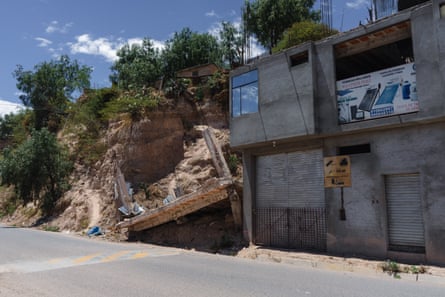
A house destroyed by a landslide next to a boarded up building.
A house destroyed by a landslide, which are becoming more frequent due to the climate crisis. Photograph: Anastasia Austin

“As extreme weather events become more frequent, the urban poor are simultaneously exposed to temperature extremes and least equipped to manage them,” says Cynthia Goytia, professor of urban economics at Torcuato Di Tella University in Buenos Aires.

Mollepata is a telling example in Latin America. Self-built adobe or brick houses with corrugated metal roofs balance precariously on steep slopes bordering the road from Ayacucho’s centre. What starts as a paved road soon turns into a dusty, pothole-ridden path.
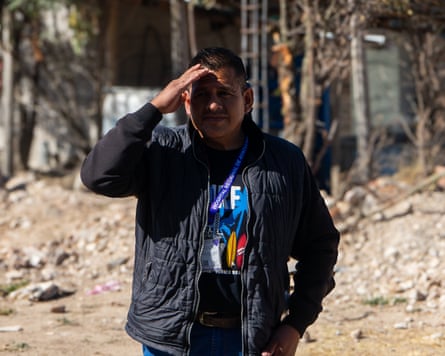
A man shields his face with his hand from the sun.
Edgar Castro, a leader of Mollepata informal neighbourhood. Photograph: Anastasia Austin

Until the early 2000s, few people lived here. But as property prices soared, new arrivals occupied former grazing land on the city’s rural outskirts. This grew into Mollepata, where people crowd into informal dwellings, at about seven times the density of Ayacucho itself.

Between 2007 and 2017, Mollepata’s population increased 20-fold, from 316 to 6,624, according to Ayacucho authorities, who estimate that by 2027 it will reach 17,000. Yet, according to people who live there, official data bears little relation to reality. “Mollepata has more than 30,000 inhabitants if you count kids, adults and old people,” says Castro, adding that they live “in a no-man’s land”.

Two-thirds of its population and all of its schools are in areas deemed high-risk for natural disasters, according to authorities. And it is just one of several informal neighbourhoods whose rapid growth aggravates the already alarming risk of extreme weather disasters for those neighbourhoods and for Ayacucho as a whole.


Ayacucho lies in the heart of the Peruvian Andes, where annual rainfall has halved since 1984. The local glacial peak has also lost 95% of its snowcap. For city dwellers that means shorter, less predictable rainy seasons. Rainfall, when it comes, drops in short, increasingly intense storms that overtake the Ayacucho valley, causing floods and landslides.

The rest of the time, people face severe water shortages and soaring temperatures, made worse by concrete structures that trap heat. Poorly constructed dwellings in informal settlements are worse still, with inadequate ventilation and inefficient cooling systems.
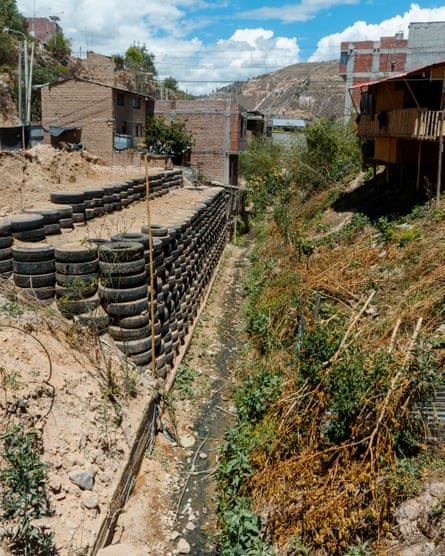
Houses built on the sides of a steep slope. Tyres have been piled up to level the land.
Recent years have seen a sharp increase in construction on steep slopes, ravines, and riverbanks due to a lack of alternative land. Photograph: Douwe den Held

This way of building turns whole neighbourhoods into “little ovens”, says Juan Carlos Prado, an environmental specialist working for the municipality.

The informal neighbourhoods at highest risk from these disasters also tend to be the most underserved. They lack reliable water systems and accessible emergency or medical services – so when a catastrophe hits, they are the least prepared to respond.

Many rely on just one unpaved access road – a single bridge connects Mollepata to the rest of Ayacucho. “If that collapses, they’re isolated in an instant,” Prado says.

With this in mind, and under the shadow of the 2009 tragedy, the municipality runs education campaigns. But Castro says that many people “still don’t take these consequences into account”.

According to experts, the only solution for those in risky terrain is to move. “We can’t negotiate with nature. We can’t get in the way of the rivers,” Prado says, though he doesn’t know a single case in which people voluntarily abandoned their plots.

“Families make calculated trade-offs between affordability, proximity to livelihoods, and existing social networks, often accepting elevated environmental risk as the price of urban access,” says Goytia.

The city has no money for relocation programmes, according to Prado. “They say to us, ‘Where can I go?’ ‘Where do you want me to live?’ ‘Solve it for me’,” he says. “But what solutions can we give? The only thing we can say is, ‘Try to find another place because you are too exposed’.”
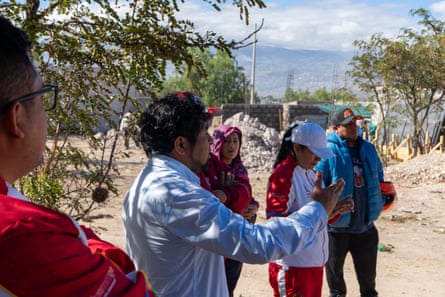
A group of people stand on a dusty dirt road in the sun.
Mollepata residents and Ayacucho municipal officials discuss how to bring the neighbourhood within safe planning regulations. Photograph: Anastasia Austin

In 2025, Ayacucho municipal government published a plan to improve public services, structure private and public land, and establish measures to manage disaster risks. Since then, it has begun meeting association leaders to bridge the gap between plans drawn up in municipal offices and the reality on the ground.

The climate crisis is making the environment more arid and the dirt road more dusty, damaging people’s health and quality of life. By grading and compacting the main road, officials hope to minimise dust and make it easier to get to Ayacucho, where most emergency services are concentrated. Drainage ditches will be built to mitigate the risk of flash floods from the rainy season.

Yet, bringing in government retroactively comes with challenges. Because of existing irregular water infrastructure under the road, the drainage ditches must be shallow. And while the government will provide machinery, local people must remove any debris and guide the machines, as only they know where underground tubes run.

Mollepata’s community leaders seem more than ready to meet these demands, promising to rent a dump truck and coordinate volunteer groups. They also discuss the need to increase green areas, vital to mitigating the urban heat-island effect.
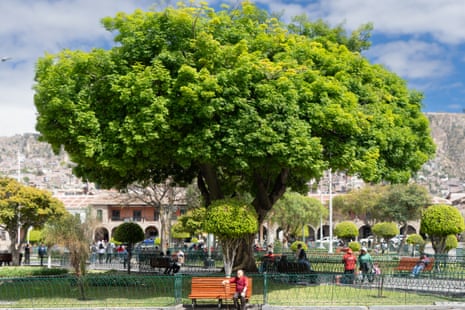
An elderly man sits on a bench beneath a large tree in a town square on a sunny day.
Ayacucho’s green central square provides relief on a hot day. Tree-planting initiatives are planned for Mollepata. Photograph: Douwe den Held

The town official in charge of reforestation promises to provide people with tree seedlings in the rainy season, when water is less scarce. There is even land set aside for a park.

“Over the past four decades, Latin American governments have largely moved away from demolition and forced eviction toward formalisation, regularisation and comprehensive neighbourhood upgrading programmes,” Goytia says.

But the efforts in Mollepata demonstrate how challenging this policy shift can be, given local governments’ resource constraints. Integrating Mollepata into the city will cost more than 530m soles (about £116m), almost five times Ayacucho’s municipal annual budget, according to official estimates. A shorter list of high-priority projects would still cost 460m soles.

For local people, issues such as insecurity, lack of transport, and rubbish disposal are often more urgent than water shortages, floods and avalanches. While authorities and those established in Mollepata work to integrate it into the city, new settlements are emerging as rural Peruvians seek footholds there.
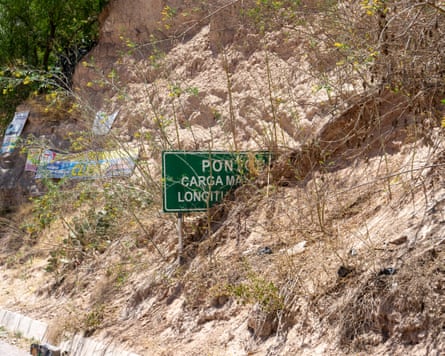
A partly visible green road sign emerges from a steep bank on mud next to a road.
A road sign buried by a landslide. Despite the risks many people don’t want to leave their communities. Photograph: Douwe den Held

With most of the relatively safe areas already built up, recent years have seen a sharp increase in building on steep slopes, in ravines and along riverbanks. “The situation is becoming critical,” Prado says.

Still, at least in Mollepata, local people and municipal workers strike a hopeful tone. Castro sees the approval of his settlement plan as a great achievement and lauds officials for travelling to the settlement to meet the people.

“By getting their boots dirty,” Castro says, “they see how we live here and the situation we are in.”