








Troops of monkeys living on the Rock of Gibraltar have learned to eat soil in what scientists believe is an effort to settle their stomachs after all the junk food they receive – and sometimes steal – from crowds of tourists.
Researchers spotted the intentional mud eating, known as geophagy, while observing groups of Barbary macaques in the territory. Monkeys that had the most contact with tourists ate the most soil and consumption peaked in the holiday season, they found.
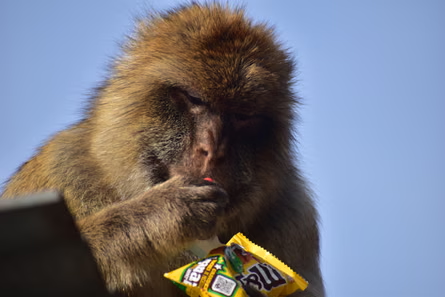
About 230 macaques live on Gibraltar in eight distinct groups, and while local authorities provide them with daily helpings of fruit, vegetables and seeds, tourists routinely feed them snacks ranging from bags of chips and chocolate bars to M&M’s and ice-creams.
The observations don’t prove why the monkeys eat soil, but scientists suspect it has a protective effect on the digestive system. The only macaques on the rock that were not seen eating soil belonged to a group that is isolated from visitors and tourists.
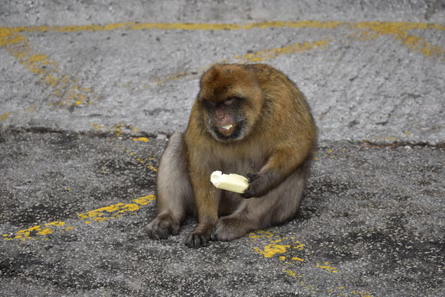
Dr Sylvain Lemoine, a primate behavioural ecologist at the University of Cambridge, said the monkeys may be eating the soil to rebalance their gut microbiomes, the populations of microbes that live in the digestive tract, which become disturbed by the fatty, salty and sugary snacks the monkeys binge on.
“We think that eating this junk food disrupts the composition of the microbiome and we know that bacteria and minerals in soil can help recompose the microbiome and alleviate the negative effects,” Lemoine said. “We think there’s a protective effect of the soil.”
Observations between summer 2022 and spring 2024 found that nearly a fifth of all food consumed by the macaques was junk food from tourists. Macaques that lived around the top of the rock, which is particularly popular with tourists, were more than twice as likely to eat junk food than others. They also consumed the most soil.
Lemoine said the monkeys were fed junk food by locals as well as visiting tourists, who have offered salted peanuts, chocolate bars, crisps, dried pasta, bread, Coca-Cola, orange juice, M&M’s, ice-cream and more. “There’s a lot of ice-cream. They love Magnums and Cornettos. What they don’t like very much is sorbet.”
In total, the researchers recorded 44 monkeys eating dirt on 46 occasions. In three instances, the macaques ate soil shortly after being fed ice-cream, biscuits or bread. When visitor numbers fell in the winter, the monkeys were 40% less likely to eat tourist food and more than 30% less likely to eat soil.
Writing in Scientific Reports, the researchers describe how the monkeys appear to learn the habit from others, with macaques favouring different types of soil depending on their troop. Most monkeys search out the terra rossa, or red clay, found across Gibraltar, but the Ape’s Den troop, which occupies the lower western slopes, favours tar-clogged soil from potholes in asphalt roads.
Humans around the world eat soil, particularly pregnant women in parts of Africa, Asia and South America, where it is consumed to help with nausea or to provide critical minerals. But the researchers saw no rise in soil-eating among pregnant or lactating monkeys, suggesting the behaviour is not driven by a need to supplement their diets.
Instead, Lemoine said the macaques seemed to eat the soil to “buffer their digestive system” against high-energy, low-fibre snacks and junk foods that are known to cause stomach upsets in some primates.
Tourists are told not to touch or feed the monkeys on Gibraltar, but the rule is not well enforced. While the junk food may be harmful to the macaques, so might the soil, as much of it is found close to busy roads on the rock. “There are a lot of vehicles passing every day, and most are not electric yet,” Lemoine said. “We want to analyse the soil. We’re very interested in seeing the levels of pollutants.”
Dr Paula Pebsworth, a primatologist at the University of Texas at San Antonio, said geophagy served multiple purposes linked to detoxification and mineral supplementation. In her own work on chacma baboons in South Africa, monkeys consumed substantial amounts of soil, likely in response to plant toxins.
“The idea that soil consumption may help monkeys cope with tourist provisioning is also plausible and has been documented at [Japan’s] Arashiyama Monkey Park. However, while geophagy may serve as a coping mechanism, a more effective management approach is to reduce or eliminate the provisioning of human foods,” she said.