











🏖️ We're taking a break next week, and will be back on August 28. Due to this, and the imminent Go 1.27 release, we're shaking the format up a bit this week…!
__
Your editor, Peter Cooper
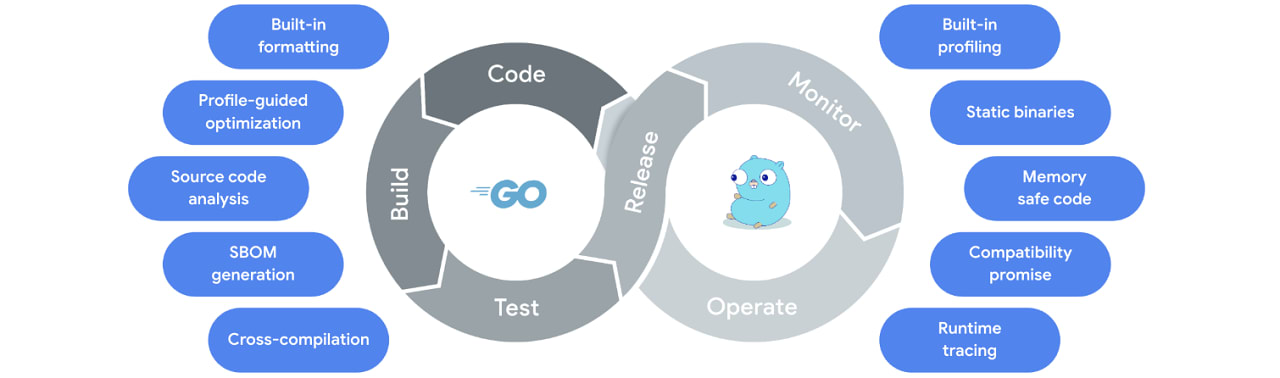
Why Go is an Ideal Language for AI-Assisted Software Engineering — Two Googlers, including Go lead Cameron Balahan, make the case that Go's features, like standardized formatting, a solid standard library, and the compatibility promise, make it a particularly good language for agents.
Cameron Balahan and Richard Seroter (Google)
🗣️ This piece provoked some discussion, most notably on Hacker News where the tone was quite adversarial, while r/golang did a better job than the post itself of explaining what's specifically Go about the argument.
IN BRIEF:
-
Go 1.27 Release Candidate 3 is out, with the final just around the corner. More on that later in this issue.
-
🔐 Go 1.26.6 and Go 1.25.13 are out too with ten security fixes (explained within), including two that let a malicious
GOPROXYorGOSUMDBslip module content past the checksum database. -
Fiber 3.5, the latest version of the popular Express-inspired web framework, has been released with speedups, middleware security hardening, and fixes.
📊 Profile-Guided Optimization in Go — Turning PGO on for encoding/json parsing yielded up to 4.7% more throughput in Daniel's experiment. He also trained profiles on three different JSON documents and measured each build against all three, so you can see how well a profile transfers to previously unseen workloads.
Daniel Lemire
📄 Understanding Go AI Inference: Yzma – yzma provides a way to integrate llama.cpp into Go apps, but how it does it without CGo is the interesting bit! Jesús Espino
📄 Sets in Go: Past, Present and Future – Slides from this week's GopherCon UK talk on the set types proposed for Go 1.28. Luciano Ramalho
📄 Rewriting the Appwrite CLI in Go – A TypeScript to Go migration story covering why Go vs Rust, and how their now Go-powered CLI is still distributed on npm, as per-platform binary packages. Chirag Aggarwal (Appwrite)
👀 Go 1.27 is almost here!
Final Go releases often arrive a week or so after the third release candidate (as mentioned above), so Go 1.27 may be released next week while we're away… 😱
If it lands in our absence (it'll be announced on the official Go blog), here are a few resources to help you navigate the release:
-
The DRAFT Go 1.27 Release Notes – The release notes, while still in draft form, are essentially a laundry list of everything that will land. And, bonus, this page will magically become the final release notes upon release.
-
🎉 The online Go 1.27 Release Party – JetBrains is holding an event along with members of the Go team on August 25 at 4:00 pm UTC.
-
Generic Methods Land in Go – The feature Go Weekly readers have been most excited about this year by a long shot, if clicks are anything to go by.
-
Finding Leaked Goroutines in Go 1.27 – A look at what the new goroutine leak detector in
runtime/pprofcan and can't do. -
Jesús Espino's Go 1.27 Interactive Tour covers a wide range of features.
🏆 Highlights of the Year So Far
Before we take a week away, we're reflecting on some of the highlights of 2026 so far. We know it's not always possible to read every issue, so here are a few items you may have missed that we enjoyed! :-)
-
The Most Popular Go Dependency Is… – Testify! Thibaut Rousseau shares the fascinating process he went through to figure that out, and shares the rest of the top 10.
-
The Go 1.26 Interactive Tour – As we learnt last week, this was Anton Zhiyanov's final Go tour and it still provides a good look at modern Go features you might not yet be using.
-
Go Naming Conventions: A Practical Guide – A thorough single-page reference covering identifiers, filenames, packages, and the concept of "avoiding chatter."
-
templUIshadcn-templ: Customizable UI Components for Go and Templ – Templ is Go's answer to JSX… kinda. And shadcn-templ (the new name for templUI) offers a suite of components and themes, leaning on Tailwind CSS, to use with it. -
A 'Pure Go' Linux Environment, Inspired by Fabrice Bellard – I forgot this existed, but it still impresses! With a single
go runyou can get a Linux environment up and running. Now I just need to find a use for it…
And that's a wrap! We'll see you again on Friday, August 28! 👋
P.S. A huge thanks to everyone who's sent in submissions lately. There have been so many that I've fallen behind a lot, but every email gets read and I'll be playing catch up on my return :-)