

惯性聚合 高效追踪和阅读你感兴趣的博客、新闻、科技资讯
阅读原文 在惯性聚合中打开

推荐订阅源

月光博客
月光博客
云风的 BLOG
云风的 BLOG
小众软件
小众软件
雷峰网
雷峰网
博客园 - 【当耐特】
V
V2EX
WordPress大学
WordPress大学
IT之家
IT之家
Last Week in AI
Last Week in AI
罗磊的独立博客
奇客Solidot–传递最新科技情报
奇客Solidot–传递最新科技情报
Apple Machine Learning Research
钛媒体:引领未来商业与生活新知
钛媒体:引领未来商业与生活新知
V
Visual Studio Blog
freeCodeCamp Programming Tutorials: Python, JavaScript, Git & More
有赞技术团队
有赞技术团队
The Cloudflare Blog
Jina AI
Jina AI
博客园 - 司徒正美
阮一峰的网络日志
阮一峰的网络日志
博客园 - 聂微东
大猫的无限游戏
大猫的无限游戏
博客园 - 三生石上(FineUI控件)
让小产品的独立变现更简单 - ezindie.com

Show HN

GitHub - astefanutti/shaderbang: Shebang for Shaders Show HN: Generate Claude Code Workflows using Spec Driven Development approach Show HN: AI agents for UK GDAD PCF roles and their skills The Two Pillars: Mixer Mode and Meta-Software in the Reorganization of Software Work After AI GitHub - JaiCode08/teleport-env What 1,000+ Harness Experiments Taught Me About Self-Improving Agents Show HN: Liiists, a Markdown-first, iOS and CLI list app SwiperTab – Get this Extension for 🦊 Firefox (en-US) GitHub - kouhxp/fftext: Summarize, explain, fact-check, or translate any text, URL, or file. No GPU. No cloud. One command GitHub - sweetpad-dev/sweetpad: Develop Swift/iOS projects using VSCode GitHub - dogmaticdev/IRON: IRON a.k.a. Intermediate Representation Object Notation is a Interpreter/Database that is used to create Programming Languages. GitHub - sjhalani7/vaen: Package your AI coding harness into a portable .agent file, and share it across repos, teams, & the community without ever having to copy-paste instructions, skills, MCP config, or secrets. Show HN: Gandalf the Grader Show HN: Citadeld – replay any CI failure locally from a single file GitHub - tdortman/cuSBF: High-Performance GPU Super Bloom Filter coral-ai/claude-code-token-xray at main · Coral-Bricks-AI/coral-ai GitHub - ulyssestenn/funes: Funes is a Git-based framework for LLM-managed knowledge work: an AI Librarian ingests raw sources, builds an interlinked Markdown knowledge base, and uses it to produce cited reports, analyses, and other outputs. GitHub - ThatXliner/gah: Git Add Hunk, built for agents to use GitHub - harmont-dev/harmont-cli: Command-line client for the Harmont CI platform GitHub - brooksmcmillin/mcp-authflow: OAuth 2.0 Authorization Server framework for MCP servers GitHub - javaid-codes/audit-supply-chain-agents GitHub - amorey/gochan: A small library of common channel architectures for Go, inspired by Rust GitHub - arifozgun/OpenGem: Free, Open-Source AI API Gateway with Gemini, OpenAI & Anthropic Compatibility in 1 file GitHub - Pranesh950/BioPetals: 🌸 Run BIOxAI models at home, BitTorrent-style. Fine-tuning and inference up to 10x faster than offloading GitHub - cnguyen14/bounty-doctor: Diagnose a GitHub bounty issue before you waste hours: detects honeypot scam repos, AI-bot attempt swarms, and stale contests. Show HN: CoreMCP – MCP Server for On-Prem DBs Show HN: KittyHTML – Render HTML/CSS as an inline image in your terminal GitHub - bingud/filemat: Web-based file manager Show HN: TruthLens – Free multi-signal deepfake image detector GitHub - apexlocal-jz/claude-usage-tray: Windows system-tray app showing your Claude Code rate-limit usage at a glance. Zero deps, ~300 lines of PowerShell. Cross-IDE (works regardless of VS Code, Cursor, plain terminal).
Podlite 2.0 released Podlite
zagap · 2026-06-03 · via Show HN

Podlite — one markup, many possibilities

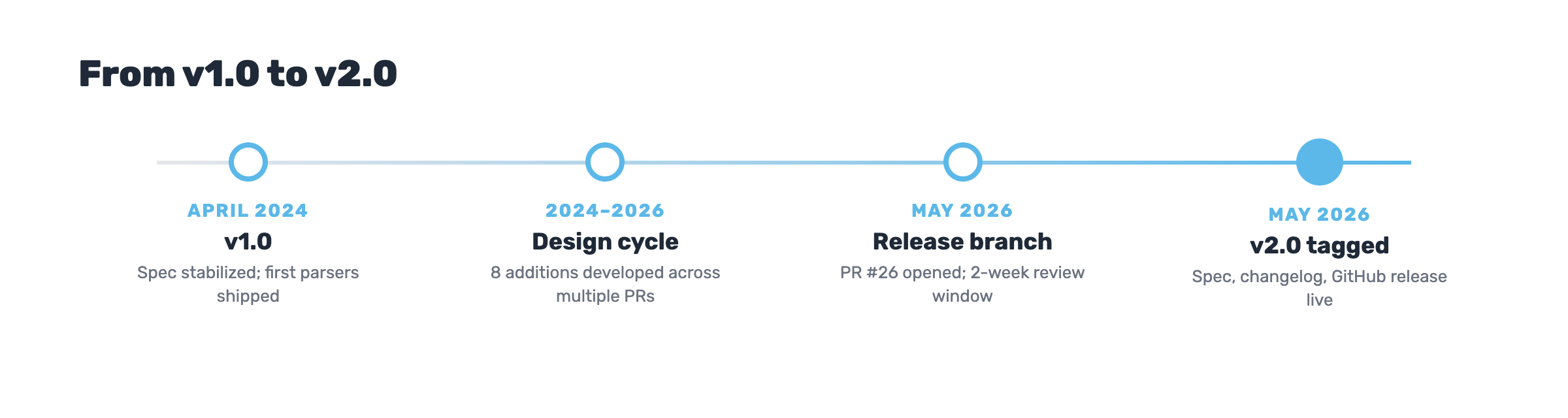
Podlite 2.0 is tagged. The specification is at podlite.org/specification. The full changelog sits inside the spec under =head2 v2.0.

The Coming in Podlite 2.0 article from the review window covered what is new in depth. This post focuses on what to do now: how to migrate existing documents and where to find the rest. For most documents the answer is short — a well-formed v1.0 document renders unchanged under v2.0.
From v1.0 to v2.0

Breaking changes

Two changes parse differently than before. Neither touches a well-formed document — if anything needs updating, it is a parser, not your text.

Legacy attribute syntax removed

A few outdated string attribute formats are gone. The bracket form (:key<value>) and the parenthesized form (:key('value')) remain.

If a document uses the current syntax, nothing changes.

=include is now a directive

=include always behaved like a directive, but the spec previously listed it under block types. Tokenization rules differ between directives and blocks. Parsers built against the v1.0 spec must move =include into the directive dispatch path alongside =config and =alias.

For document authors: no change. =include still takes the same syntax and produces the same output. The reclassification matters only for tools that build ASTs.

New features at a glance

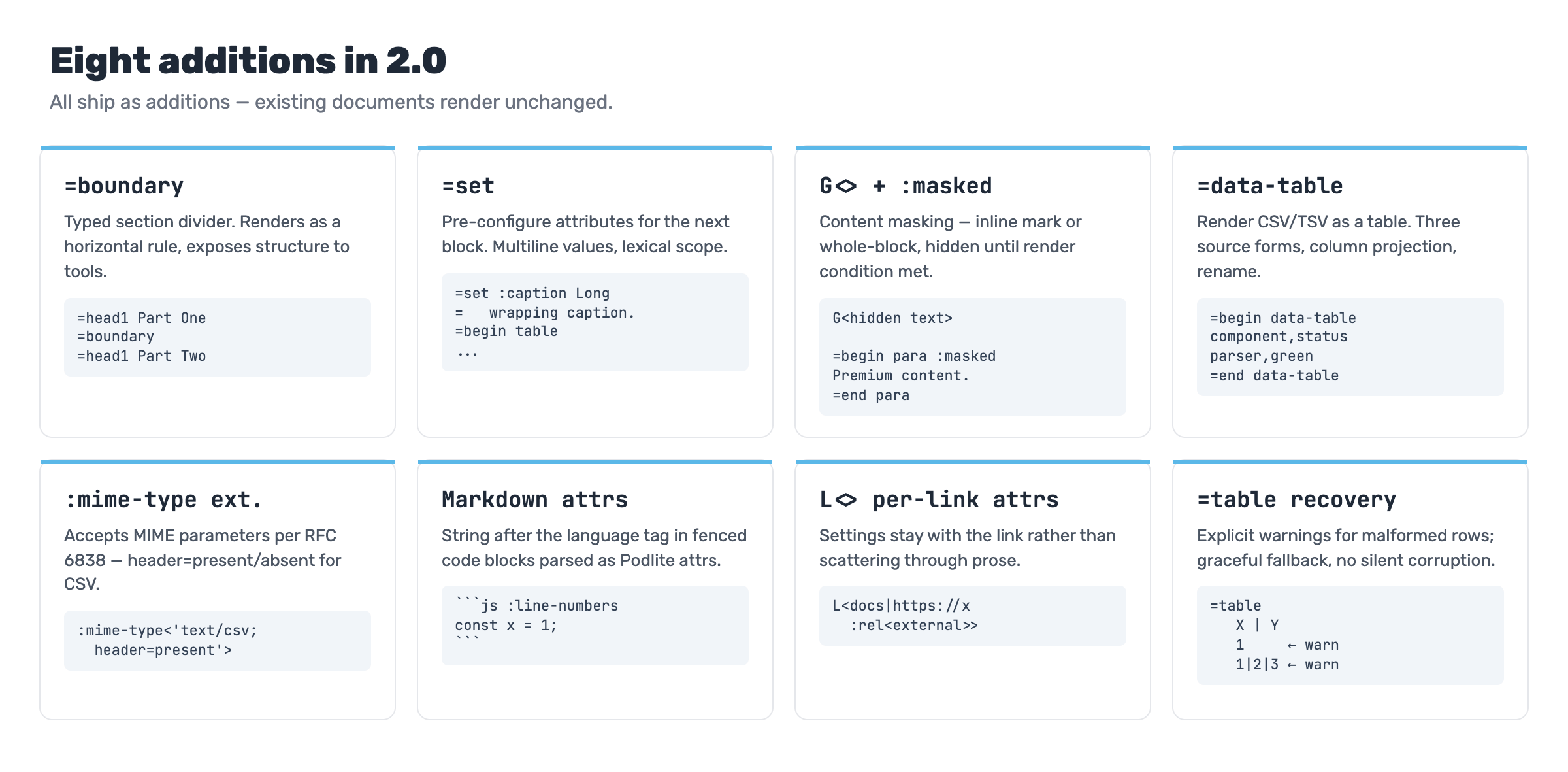
Eight additions ship in v2.0. Existing documents render unchanged.
All eight at a glance

  • =boundary: a typed section divider. Renders as a horizontal rule, exposes structure to tools.

  • =set: pre-configure attributes for the next block. Multiline values, inline markup, lexical scope.
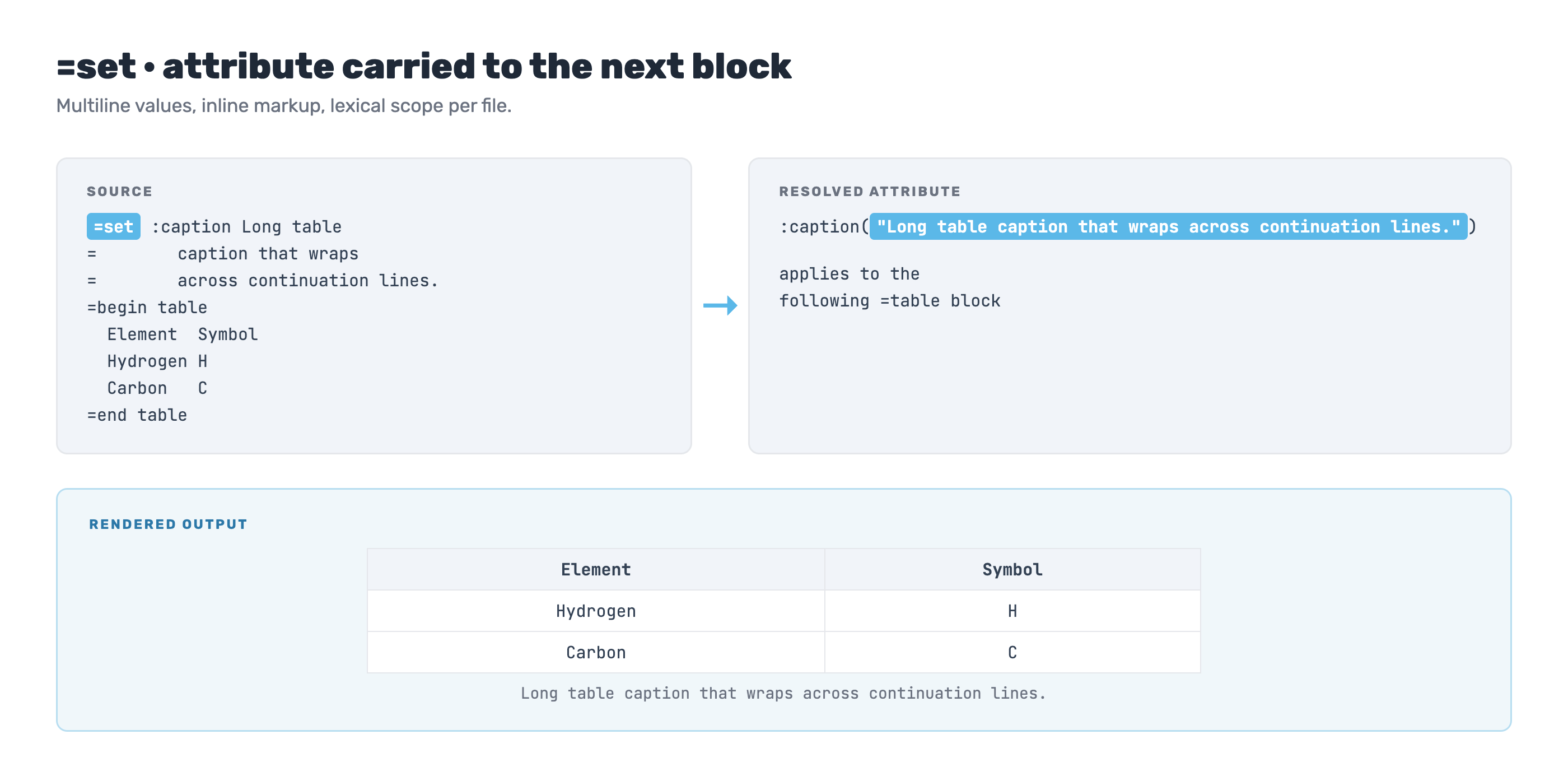
=set — multiline caption flows to the next block

  • G«» + :masked: content masking. Inline mark or whole-block attribute; hidden by default, revealed by render condition.
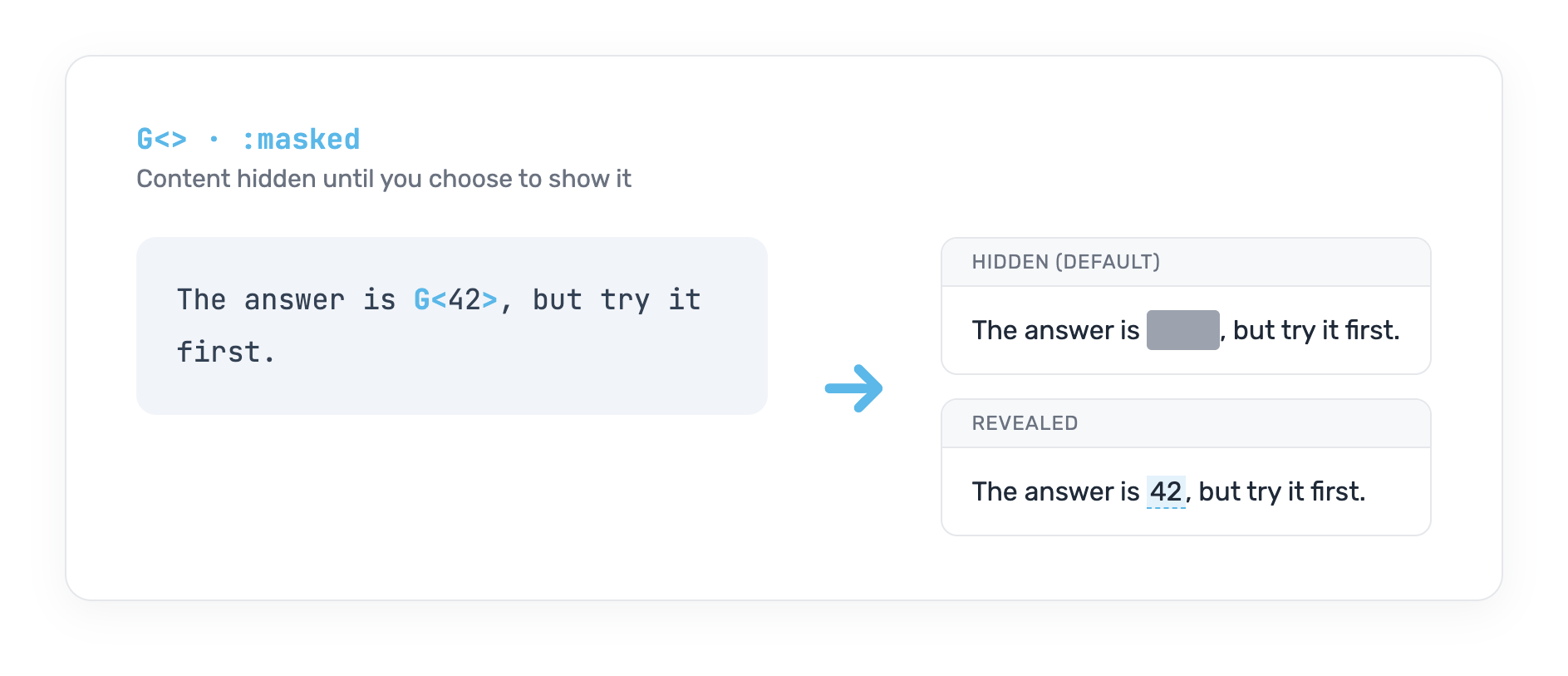
G<> + :masked — hidden by default, revealed by render condition

  • =data-table block: renders CSV or TSV as a table. Three source forms (inline body, external :src<file:X>, =data reference). :columns selects projection, :rename{} overrides display names.

=begin data-table :caption('Quarterly sales') :mime-type<'text/csv; header=present'>
quarter,product,revenue
Q1,Widget,12000
Q1,Gadget,18000
Q2,Widget,15400
Q2,Gadget,21200
=end data-table
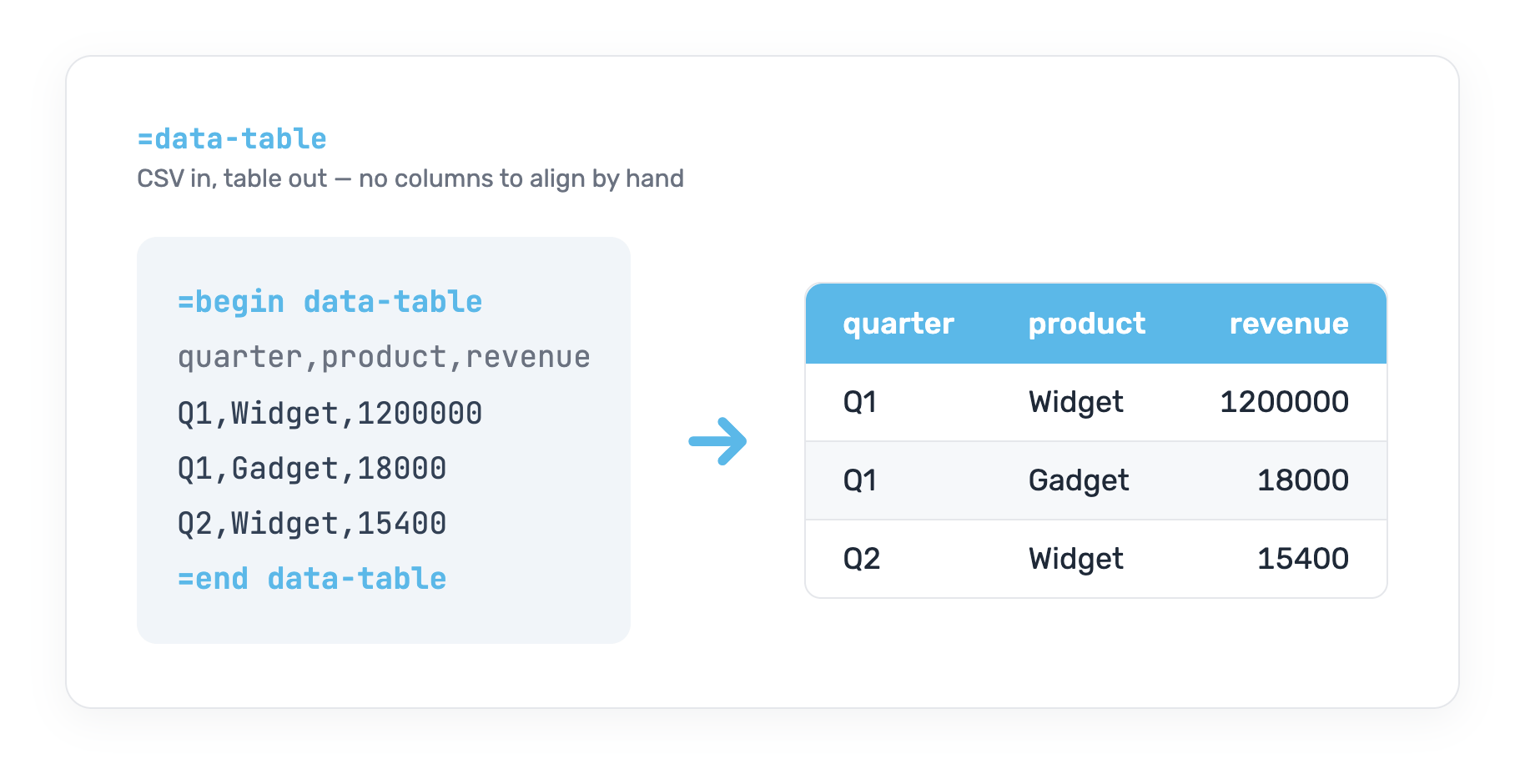
=data-table — CSV in, table out

  • Extended :mime-type syntax: accepts MIME parameters per RFC 6838, with header=present|absent for CSV/TSV header indication per RFC 4180 §3.

  • Markdown fenced code block attributes: the string after the language tag is now parsed as Podlite attributes.

  • Per-link configuration attributes for L<>: settings stay with the link rather than scattering through prose.

  • =table error recovery: explicit warnings for malformed rows (cell count mismatch, mixed separators), graceful fallback instead of silent corruption.

For full examples and rationale, the Coming in Podlite 2.0 article is still accurate.

Where to go from here