

惯性聚合 高效追踪和阅读你感兴趣的博客、新闻、科技资讯
阅读原文 在惯性聚合中打开

推荐订阅源

S
Security @ Cisco Blogs
Scott Helme
Scott Helme
Threat Intelligence Blog | Flashpoint
T
Threat Research - Cisco Blogs
AWS News Blog
AWS News Blog
Spread Privacy
Spread Privacy
D
Darknet – Hacking Tools, Hacker News & Cyber Security
Security Latest
Security Latest
Simon Willison's Weblog
C
Cybersecurity and Infrastructure Security Agency CISA
G
GRAHAM CLULEY
cs.CL updates on arXiv.org
I
Intezer
S
Securelist
Google DeepMind News
S
Schneier on Security
T
Troy Hunt's Blog
Help Net Security
Help Net Security
Microsoft Azure Blog
V
V2EX
Security Archives - TechRepublic
O
OpenAI News
博客园 - Franky
G
Google Developers Blog
Stack Overflow Blog
Stack Overflow Blog
TaoSecurity Blog
TaoSecurity Blog
MyScale Blog
MyScale Blog
P
Privacy International News Feed
K
KPMG report finds enterprise disconnect between AI and its ROI | CIO
Google Online Security Blog
Latest news
Latest news
Vercel News
Vercel News
T
The Blog of Author Tim Ferriss
博客园_首页
S
Security Affairs
PCI Perspectives
PCI Perspectives
WordPress大学
WordPress大学
C
Cisco Blogs
Recent Announcements
L
LangChain Blog
GbyAI
GbyAI
F
Fortinet All Blogs
N
News and Events Feed by Topic
T
Tor Project blog
IT之家
IT之家
P
Palo Alto Networks Blog
D
DataBreaches.Net
小众软件
小众软件
宝玉的分享
宝玉的分享
F
Full Disclosure

Librehat的部落格

Soft AP on Linux with WPS – Librehat的部落格 Install Citrix Receiver for Linux in Toolbox – Librehat的部落格 My Attempts to Integrate Home Assistant with ADT UK – Librehat的部落格 Home Assistant Core Setup on Banana Pi M5 – Librehat的部落格 Flatpak Wine 微信安装手记 – Librehat的部落格 Banana Pi M5 Pro Quick Review – Librehat的部落格 部落格迁移到甲骨文云 – Librehat的部落格 Citrix Receiver UK Keyboard Layout Issue on Linux and Chrome OS – Librehat的部落格 FydeOS上手体验 – Librehat的部落格
Chrome OS Flex on Samsung Galaxy Book Pro 360 Dual Boot – Librehat的部落格
librehat · 2025-12-29 · via Librehat的部落格

Happy Chinese New Year (Year of Dragon/Loong) to you all!

A New Year’s surprise from Google. The latest version of Chrome OS Flex finally supports Samsung Galaxy Book Pro 360 to an extent that can be used as a daily driver.

Hardware Compatibility

To clarify, I’m using an original (first-gen) Samsung Galaxy Book Pro 360 (16G RAM, i7 11th Gen CPU). The Chome OS Flex version I’m currently using is:

Google Chrome: Version 121.0.6167.188 (Official Build) (64-bit)
Platform: 15699.66.0 (Official Build) stable-channel reven
Channel: stable-channel
Firmware Version:
ARC enabled: false
ARC:
Enterprise enrolled: false
Developer mode: true

Linux Kernel version is now 5.15, which explains the better hardware compatibility.
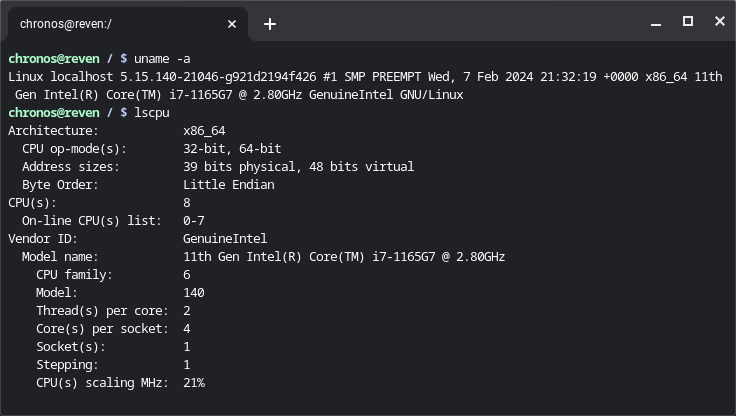
Linux Kernel version is 5.15.140 in Chrome OS Flex 121

What’s Working

  • WiFi
  • Audio
  • Bluetooth
  • Display Brightness Control
  • Touchscreen
  • Tablet Mode Switch
  • Touchpad
  • Camera

Essentially, almost everything :)

What’s Not Working

  • Fingerprint Sensor. This is not something that works in a regular Linux distribution anyway, so not a big surprise here.
  • Suspend/Resume (Sleep). I’m currently unsure whether this is caused by Chrome OS Flex itself or linuxloops (see Dual Boot below), but my laptop will hang when it tries to wake up from sleeping (after closing lid). A simple workaround is to configure Chrome OS Flex to just turn off the display rather than sleep.

Dual Boot

If you have two hard disks installed (the original/first-gen Galaxy Book Pro 360 has an additional slot), you could use the official installer to install it to the second disk, then restore your GRUB2 and add an entry to it.

If you don’t have two disks but still want to dual boot (or multi-boot) Chrome OS Flex and other OSes (e.g. Windows, or some Linux distributions), then you can use linuxloops from @sebanc (the same author of brunch). Essentially, it creates a disk image, to which GRUB2 can boot. Just follow the instructions from the GitHub project and use Chrome OS Flex as the distribution. Once the command finishes, you’ll have a GRUB2 menuentry to add.