

惯性聚合 高效追踪和阅读你感兴趣的博客、新闻、科技资讯
阅读原文 在惯性聚合中打开

推荐订阅源

钛媒体:引领未来商业与生活新知
钛媒体:引领未来商业与生活新知
Jina AI
Jina AI
月光博客
月光博客
F
Fortinet All Blogs
Stack Overflow Blog
Stack Overflow Blog
OSCHINA 社区最新新闻
OSCHINA 社区最新新闻
V
Visual Studio Blog
小众软件
小众软件
博客园 - 三生石上(FineUI控件)
博客园 - 司徒正美
P
Proofpoint News Feed
酷 壳 – CoolShell
酷 壳 – CoolShell
M
MIT News - Artificial intelligence
奇客Solidot–传递最新科技情报
奇客Solidot–传递最新科技情报
B
Blog RSS Feed
Apple Machine Learning Research
S
SegmentFault 最新的问题
博客园_首页
让小产品的独立变现更简单 - ezindie.com
J
Java Code Geeks
L
LangChain Blog
博客园 - 聂微东
G
Google Developers Blog
博客园 - Franky

Comments for Hackaday

AI The Truly Environmentally Friendly Way News Sites Are Blocking Internet Archive Over AI Scraping Fears How The 2020s Chip Crisis Led To A Buggy Saleae Analyzer In 2026 Evidence For Water Vapor Plumes On Europa Vanishes In Re-Analysis Mechanical Stability For Your Coils 3D Printed Hose Sprayer Sets Phasers To Suds The Merits Of Comment-Driven Development As Counterweight To TDD Building A Desktop Catalytic Cracker Process 4 Billion Pixels Per Second From 16 DIY Cameras For The Best V-Tubing Rig Ever An Unlikely Host For An 8080 Emulator Using Brand New NiMH Cells After Sitting 12 Years Unused Investigating The S3 Virge’s Reputation As A 3D Decelerator Card As It Turns Out, There’s More Than One Cassette Mechanism Being Made After All Using Windows 11 On An LGA 775 PC With AGP Videocard An Ethernet WiFi Router on a Pi Pico 2W This Week In Security: Messing With AI, 7Zip And Notepad++ Vulnerabilities, HTTP2 Bomb, And More Using Electrolysis For More Than Just Generating Hydrogen Vintage Turntable Gets Brain Transplant And Home Assistant Integration Connecting Your Car To Home Assistant Microsoft Claims 20 Second Qubits If You Want To Hack Me, Come In Through The Speaker Ways To Embed Magnets In 3D Prints And Not Ruin Printers An RGB Keyboard For Your Hackaday Communicator Badge Ask Hackaday: How Do You Feel About Electronic Shelf Labels? Make Your Ceiling Disappear With ADS-B And Short-Throw Projector Fixing A Nintendo Game Boy Clone That Runs Too Fast Web-Based Control For A CB Radio Distilling Stale Gasoline To Make It Usable Again DIY Ceramic Circuit Boards Surely Count As Solarpunk Texas Instruments Changes The NE5532 And Others Into Incompatible Versions
Bike-Powered Shredder Makes Short Work Of 3D Printer Waste
DurDurDur · 2026-06-16 · via Comments for Hackaday

Skip to content

[Brogan M Pratt] and his students do a lot of 3D printing, and as such found themselves producing a lot of plastic waste. Seeing an opportunity, they built a bike-powered plastic shredder that turns a little human exercise into the power needed to transform waste plastic into small bits. Shredding plastic is a necessary first step for any sort of processing, so getting this part working reliably is as important as it is educational.
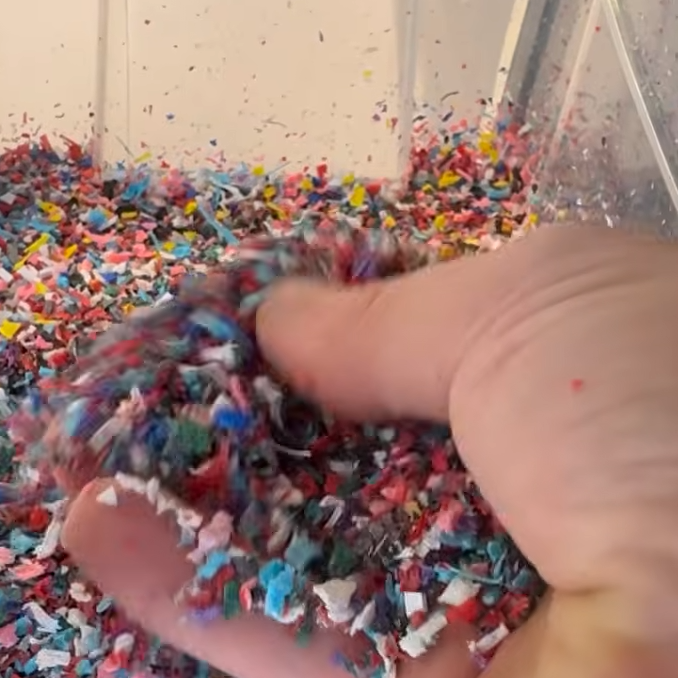
Shredding is a necessary first step to processing plastic waste.

Being in the Netherlands, using a bike makes perfect sense. But it turns out there’s a lot more to making a human-powered plastic shredder than simply bolting a sprocket to a shredder, looping the bike chain over it, then climbing on and working up a sweat.

In between the bike and the shredder is a large gear reduction, a fifteen kilogram flywheel, and a heavy-duty frame to anchor everything in the face of so much mass and torque. Add some covers and safety guards and the result is a stationary bike with a hopper for waste, a bin for output, and enough rotational torque and inertia to chew through stubborn bits without stalling.

Now that the shredder works, what’s the plan for all the little plastic shreds? The goal is to turn it back into usable filament which is obviously very useful, but we’ve also seen that compression molding plastic waste can work pretty well, too.

Being an educator, [Brogan] makes it clear that a bike-powered shredder, while pretty cool, is not the only missing link in sustainability. There is currently no easy way to recycle plastic at scale. But the shredder is a critical part of demonstrating the whole process in a hands-on way, and learning why recycling plastic at scale is a genuinely difficult job.