


惯性聚合 高效追踪和阅读你感兴趣的博客、新闻、科技资讯
阅读原文 在惯性聚合中打开

推荐订阅源

奇客Solidot–传递最新科技情报
奇客Solidot–传递最新科技情报
人人都是产品经理
人人都是产品经理
爱范儿
爱范儿
aimingoo的专栏
aimingoo的专栏
博客园 - 叶小钗
H
Help Net Security
Microsoft Security Blog
The Cloudflare Blog
S
SegmentFault 最新的问题
小众软件
小众软件
钛媒体:引领未来商业与生活新知
钛媒体:引领未来商业与生活新知
博客园 - 司徒正美
The GitHub Blog
The GitHub Blog
量子位
H
Hackread – Cybersecurity News, Data Breaches, AI and More
V
V2EX
Martin Fowler
Martin Fowler
博客园 - 【当耐特】
J
Java Code Geeks
D
DataBreaches.Net
云风的 BLOG
云风的 BLOG
F
Fortinet All Blogs
Blog — PlanetScale
Blog — PlanetScale
Last Week in AI
Last Week in AI

Comments for Hackaday

AI The Truly Environmentally Friendly Way News Sites Are Blocking Internet Archive Over AI Scraping Fears How The 2020s Chip Crisis Led To A Buggy Saleae Analyzer In 2026 Evidence For Water Vapor Plumes On Europa Vanishes In Re-Analysis Mechanical Stability For Your Coils 3D Printed Hose Sprayer Sets Phasers To Suds The Merits Of Comment-Driven Development As Counterweight To TDD Building A Desktop Catalytic Cracker Process 4 Billion Pixels Per Second From 16 DIY Cameras For The Best V-Tubing Rig Ever An Unlikely Host For An 8080 Emulator Using Brand New NiMH Cells After Sitting 12 Years Unused Investigating The S3 Virge’s Reputation As A 3D Decelerator Card As It Turns Out, There’s More Than One Cassette Mechanism Being Made After All Using Windows 11 On An LGA 775 PC With AGP Videocard An Ethernet WiFi Router on a Pi Pico 2W This Week In Security: Messing With AI, 7Zip And Notepad++ Vulnerabilities, HTTP2 Bomb, And More Using Electrolysis For More Than Just Generating Hydrogen Vintage Turntable Gets Brain Transplant And Home Assistant Integration Connecting Your Car To Home Assistant Microsoft Claims 20 Second Qubits If You Want To Hack Me, Come In Through The Speaker Ways To Embed Magnets In 3D Prints And Not Ruin Printers An RGB Keyboard For Your Hackaday Communicator Badge Ask Hackaday: How Do You Feel About Electronic Shelf Labels? Make Your Ceiling Disappear With ADS-B And Short-Throw Projector Fixing A Nintendo Game Boy Clone That Runs Too Fast Web-Based Control For A CB Radio Distilling Stale Gasoline To Make It Usable Again DIY Ceramic Circuit Boards Surely Count As Solarpunk Texas Instruments Changes The NE5532 And Others Into Incompatible Versions
Watch YouTube On A Game Boy Color With A Special Cartridge
Maya Posch · 2026-06-27 · via Comments for Hackaday

Skip to content

There’s no questioning [Throaty Mumbo]’s uncanny skill at answering questions that nobody ever asked, such as whether it’s possible to watch YouTube videos on a Nintendo Game Boy Color handheld gaming system.

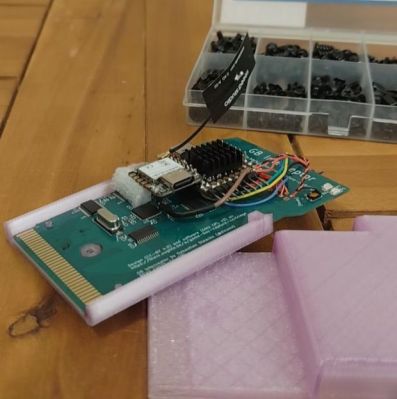
Of course the answer here is a resounding ‘sorta’, loosely defined by what you mean with ‘watch’ and ‘video’ exactly. For the impatient there’s the GitHub project page with the project summary, along with a detailed video containing hijinks and a playback demo on real Game Boy Color hardware with the cobbled-together GBCTube cartridge.

The nice thing about these cartridge-based gaming systems is that you get direct access to the system’s hardware via the cartridge bus, with for systems like the GBC a basic cartridge PCB readily available if you’re feeling that prototyping itch.

Such a cartridge breakout board for the GBC was thus used as the core of this project, with an ESP32-C6 acting solely as Wi-Fi bridge for the RP2350B MCU which handles basic player firmware and bridging duty between the GBC and the streamed video data from the host PC. It’s the latter does the heavy lifting of wrangling the YouTube experience into something that sort of works on the GBC’s amazing, very vibrant, backlight-free 160×144 resolution color LCD.

With the cartridge inserted you can search for a video title on the GBC, select a video which is then downloaded with yt-dlp on the host PC and prepared for streaming. Audio is handled by the RP2350B to free up CPU cycles on the GBC, for which a separate speaker is slapped into the cartridge for high-fidelity mostly-synced audio.

Perhaps the most fascinating question that one is left with is whether a more powerful Espressif MCU like e.g. the ESP32-S31 could combine all these tasks into a single package. Not because there’s a particular reason to do so, but more out of sheer morbid curiosity, perhaps.