



A long time before Beowulf clusters wired up with commodity Ethernet hardware became a hobbyist thing and a running joke, the transputer took a swing at a very similar architecture. This used stand-alone computers that were networked together with other transputer systems, to achieve task-level parallelism. For some people like [Lance Harvie] this is the kind of hardware that he used during his university years for a project, with him not only still having that hardware, but also recently adding to this collection with a recent eBay purchase.
The transputer story is a fascinating one, forming a major part of the UK’s semiconductor industry during the 1980s, creating a strong legacy as the computer industry awkwardly tried to figure out what types of parallelism to target. Whereas the industry largely moved to instruction-level (superscalar) parallelism alongside tightly coupled task-level parallelism along with multiple CPU cores on a single die, one could consider today’s supercomputer clusters to be one example of the transputer legacy.
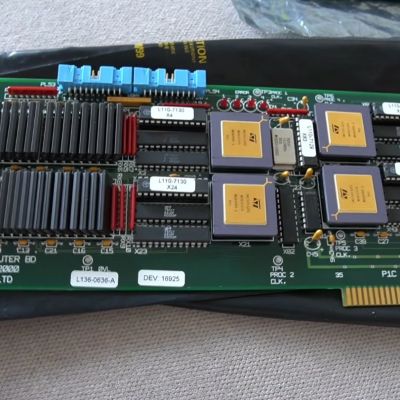
[Lance]’s university-era board features the T400, which he shows off while recalling programming it in the Occam language. He’s currently looking for an ISA-to-USB adapter to be able to use it again with a modern PC. While searching around, he came across an EBay listing for a four-processor board, containing four T425s. These are significantly more powerful and also can use external memory, unlike the T400.
This four-CPU board omits the external serial links, as it’s meant to be used in e.g. a scientific instrument as a stand-alone 4-unit transputer system, with all of the available four serial links per processor connected on the PCB. Even more interesting is that the processors on this board were manufactured in 1999 by ST, which was many years after transputers stopped being developed.
As [Lance] explains, this was due to the UK government pulling the plug on the transputer project, with the IP subsequently ending up at ST who kept producing the chips until 1999 at its Philippines plant.
In time, [Lance] hopes to power up all these boards and use them again in combination with a modern-day Linux-based computer. We’re definitely looking forward to seeing that happen.
Although you can definitely use any random MCU these days as your very own transputer module or link chip, with e.g. SPI making for an attractive alternative for the high-speed serial links, there’s always something to be said for using real, original hardware.


