


惯性聚合 高效追踪和阅读你感兴趣的博客、新闻、科技资讯
阅读原文 在惯性聚合中打开

推荐订阅源

WordPress大学
WordPress大学
aimingoo的专栏
aimingoo的专栏
月光博客
月光博客
博客园 - Franky
Martin Fowler
Martin Fowler
U
Unit 42
阮一峰的网络日志
阮一峰的网络日志
Recent Announcements
The Cloudflare Blog
博客园 - 聂微东
酷 壳 – CoolShell
酷 壳 – CoolShell
宝玉的分享
宝玉的分享
J
Java Code Geeks
B
Blog RSS Feed
博客园 - 三生石上(FineUI控件)
MongoDB | Blog
MongoDB | Blog
腾讯CDC
博客园_首页
博客园 - 司徒正美
D
DataBreaches.Net
I
InfoQ
GbyAI
GbyAI
IT之家
IT之家
罗磊的独立博客

Blog – Hackaday

Why Not Yserver? It’s Xserver, But Rust-y. OpenCAL: Computed Axial Lithographic 3D Printing For Everyone Is A CS Degree DOA Thanks To LLMs? IEEE Says TBD. Double The VRAM Of An RTX 3070 The Pacemaker Patch Robot Chess But Each Piece Is A Small Robot Bambuddy Says Bye To Bambu Lab Cloud Services Converting A Scanning Electron Microscope Into A TEM Is Surprisingly Easy Custom Watch Is On The Case Patterns Everywhere Behold A 60 Hz Refresh Rate E-ink Monitor GentleOS, A Simple OS For Your Old PC Deeply Optimized MSX Emulation On ESP32-S3 With VGA Output Homebrew Macropad Looks Good The Air Position Indicator For The B-29 Building A 1:150 Scale Toyota ProBox Micro Remote Control Car Adding Weight To A 3D Print With Plaster Of Paris, Cleanly Hackaday Podcast Ep 373: GPS, Danger In Space, And Robby The Robot A Peek Inside The Secret Lagercrantz Suitcase Radio This Week In Security: Microsoft On Microsoft, Register Your Domains, Linux On ARM, And FreeBSD Joins The File Cache Club Glue-in Hinge Design Tries Something Different The Hackaday Communicator Badge, Re-Imagined With New Firmware Amiga 1232 Storm CD Packs Every Upgrade Into One Wedge So Many Analog To Digital Converters Repairing A Pair Of Voodoo 2 GPUs For Some SLI Action AI The Truly Environmentally Friendly Way Evidence For Water Vapor Plumes On Europa Vanishes In Re-Analysis Mechanical Stability For Your Coils 3D Printed Hose Sprayer Sets Phasers To Suds The Merits Of Comment-Driven Development As Counterweight To TDD
Alan Turing’s Remarkable, Nearly-Forgotten Voice Encrypti...
Donald Papp · 2026-06-26 · via Blog – Hackaday

Skip to content

[Popular Mechanics] has an interesting article about Alan Turing’s nearly-forgotten speech encryption device. Codenamed Delilah, it was in many ways an early form of digital encryption. It was secretly developed alongside his most famous wartime achievement of breaking the encryption used by the Nazis’ Enigma machine; itself a remarkable device we’ve covered in detail in the past.

Delilah was developed at a separate location, and Turing worked with a young electrical engineer by the name of Donald Bayley who not only helped Turing implement design concepts and theory as practical circuitry, but took copious notes of their work and discussions. His documents, which went up for auction a few years after his death in 2023, reveal a first-hand account of their work.
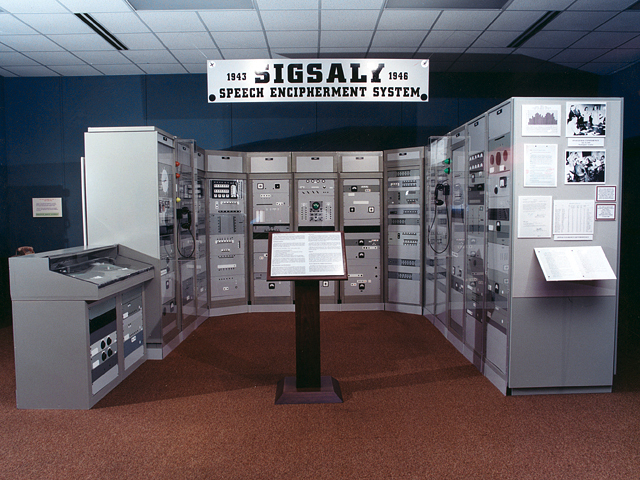
SIGSALY (the name is not an acronym, by the way) was a working voice encryption system whose main drawbacks were its massive size, weight, and power requirements. [image: Wikipedia]

Back then, a vocal encryption system did exist. Bell Labs had developed SIGSALY, a seriously top-secret system that provided encrypted voice communications at the highest levels. But one of SIGSALY’s biggest drawbacks was that it was absolutely monstrous.

Delilah did the same job, but was portable and battery-powered. Delilah was three small boxes weighing around 39 kg, and it’s hard to overstate just how remarkable of a feat of miniaturization this was. However, by the time Delilah was wrapped up, the war was over and the project wound down without ever being produced or deployed in any meaningful way.

Encrypted communications is standard stuff today, but back then there was simply no need for a vocal encryption system in peacetime. The reason we know what we do today is thanks mainly to the effort Bayley put into documenting things.

It again demonstrates that if the people involved don’t write things down while they know it, that knowledge can simply disappear. Sometimes people make the effort and the rest of us benefit, like with the Delilah project and also with the history of liquid rocket propellants — a dry-sounding topic that we assure you is anything but.