



惯性聚合 高效追踪和阅读你感兴趣的博客、新闻、科技资讯
阅读原文 在惯性聚合中打开

推荐订阅源

博客园 - Franky
WordPress大学
WordPress大学
Hugging Face - Blog
Hugging Face - Blog
freeCodeCamp Programming Tutorials: Python, JavaScript, Git & More
小众软件
小众软件
人人都是产品经理
人人都是产品经理
罗磊的独立博客
博客园 - 聂微东
雷峰网
雷峰网
量子位
美团技术团队
V
V2EX
The GitHub Blog
The GitHub Blog
大猫的无限游戏
大猫的无限游戏
奇客Solidot–传递最新科技情报
奇客Solidot–传递最新科技情报
IT之家
IT之家
The Cloudflare Blog
爱范儿
爱范儿
T
Tailwind CSS Blog
博客园 - 三生石上(FineUI控件)
让小产品的独立变现更简单 - ezindie.com
宝玉的分享
宝玉的分享
Last Week in AI
Last Week in AI
Jina AI
Jina AI

Hackaday

Bavarian Court Tells Gemini It Can’t Be A Real Boy Until It Tells The Truth Why Not Yserver? It’s Xserver, But Rust-y. OpenCAL: Computed Axial Lithographic 3D Printing For Everyone Is A CS Degree DOA Thanks To LLMs? IEEE Says TBD. Double The VRAM Of An RTX 3070 The Pacemaker Patch Bambuddy Says Bye To Bambu Lab Cloud Services Converting A Scanning Electron Microscope Into A TEM Is Surprisingly Easy Custom Watch Is On The Case Patterns Everywhere Behold A 60 Hz Refresh Rate E-ink Monitor GentleOS, A Simple OS For Your Old PC Deeply Optimized MSX Emulation On ESP32-S3 With VGA Output Homebrew Macropad Looks Good The Air Position Indicator For The B-29 Building A 1:150 Scale Toyota ProBox Micro Remote Control Car Adding Weight To A 3D Print With Plaster Of Paris, Cleanly Hackaday Podcast Ep 373: GPS, Danger In Space, And Robby The Robot A Peek Inside The Secret Lagercrantz Suitcase Radio This Week In Security: Microsoft On Microsoft, Register Your Domains, Linux On ARM, And FreeBSD Joins The File Cache Club Glue-in Hinge Design Tries Something Different The Hackaday Communicator Badge, Re-Imagined With New Firmware Amiga 1232 Storm CD Packs Every Upgrade Into One Wedge So Many Analog To Digital Converters Repairing A Pair Of Voodoo 2 GPUs For Some SLI Action AI The Truly Environmentally Friendly Way Evidence For Water Vapor Plumes On Europa Vanishes In Re-Analysis Mechanical Stability For Your Coils 3D Printed Hose Sprayer Sets Phasers To Suds The Merits Of Comment-Driven Development As Counterweight To TDD
Robot Chess But Each Piece Is A Small Robot
Maya Posch · 2026-06-14 · via Hackaday

Skip to content

A topless chess piece. (Credit: 3DprintedLife, YouTube)

We have seen a number of self-playing chess boards over the years, but the general theme has been standard chess pieces moved by either an internal electromagnet or an external robotic arm. This is, of course, a reasonable choice, as it reduces complexity, and sometimes you can even use standard chess pieces on a regular board. But what if each piece could move by itself? That seems cooler, so that’s what [3DprintedLife] did with 3D-printed chess pieces that are also tiny robots.

Although technically not the first, as you can buy the commercial Chessnut Move offering, this being an open hardware and source project makes it a lot more interesting, also because the general design is generic enough to be usable for applications other than just playing chess.

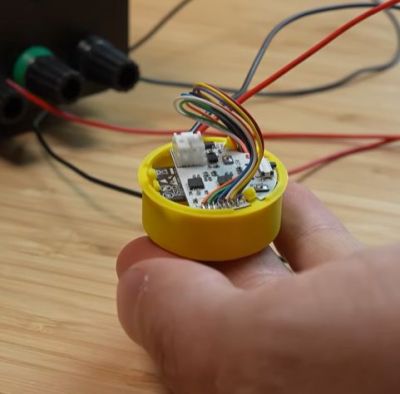
The MiniBots, as the individual pieces are called, are built around a custom PCB with an ESP32-C3 module, two PMO8-2 miniature stepper motors with requisite drivers, a magnetometer, and are powered by a 170 mAh LiPo battery. Communication with the central hub is done using ESP-NOW, with each MiniBot using its own dedicated channel.

This hub’s mainboard also runs on an ESP32-C3 for the wireless interface, while the processing is handled via a serial link with a Raspberry Pi SBC that runs the main Python-based software. Localizing the individual pieces on the board is done by scanning electromagnets embedded in the board and using the readings from the individual magnetometers to triangulate the positions.

Although at the end of the video a basic prototype sort of works, the ESP32-C3, being a single-core MCU, tripped up the firmware, necessitating some changes that should be in the next update, along with power saving and easier recharging being issues to address.

If you want to see a more conventional chess robot, we’ve seen plenty.