





by Alem Tuzlak on May 14, 2026.
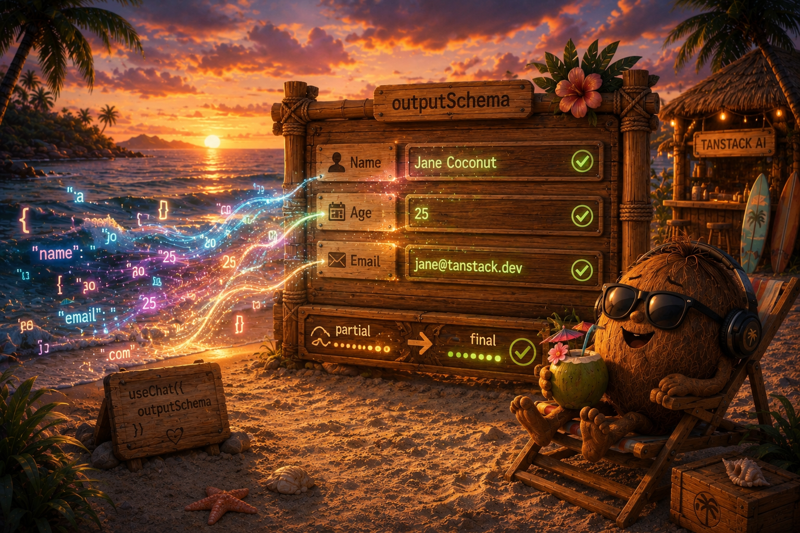
You ask an LLM for a Person object. You hit send. The spinner spins. Five seconds. Ten. Twenty. Somewhere on a server in Oregon, the model is happily generating tokens, and your user is staring at a loading state until the very last } of the JSON arrives.
That UX is bad and you already know it. The fix, in theory, is "just stream it." The fix, in practice, has been writing 15 lines of glue: an onChunk handler, a useState, a parsePartialJSON call, a manual cast to your Person type. Repeat in every project. Hope you got the types right.
This release kills the glue. useChat({ outputSchema }) now gives you a typed partial and final straight from the hook. One schema. End to end.
Until now, mixing streaming with outputSchema in @tanstack/ai looked something like this on the client:
This works, but every byte of it is something you didn't want to write:
The schema lives on the server. The same schema would happily describe partial and final on the client. There was no reason for the client to be guessing.
Pass the schema. Get the types back.
That's the whole thing.
The same hook returns the message stream you already use, so partial UI previews and chat transcripts live side-by-side without conflict.
The headline is the hook, but the work that made it possible touches the whole stack.
A real type for the structured-output stream. chat({ outputSchema, stream: true }) now returns a StructuredOutputStream<T> that's a proper discriminated union: every regular StreamChunk plus a single tagged StructuredOutputCompleteEvent<T> carrying a strongly-typed value.object. You no longer fight any when you destructure or switch on the event.
Tagged variants for the other custom events too. While we were in there, ApprovalRequestedEvent and ToolInputAvailableEvent became their own tagged shapes. Tool-calling flows narrow cleanly without a helper.
Per-chunk debug logging in the structured path. The streaming structured output path now calls logger.provider on every chunk, matching the behavior of plain chatStream. Provider-level debugging is no longer a black box just because you opted into a schema.
Provider coverage. OpenAI, OpenRouter, Grok, Groq, and Ollama (anything riding the openai-base) all go through the same streaming structured output pipeline. The summarize adapter got the same treatment, so structured summaries stream end-to-end too.
Framework parity. useChat({ outputSchema }) works in @tanstack/ai-react, @tanstack/ai-vue, @tanstack/ai-solid, and @tanstack/ai-svelte. Same return shape, same types, same behavior.
There's a temptation, when designing this kind of API, to invent a separate hook: useStructuredChat, useTypedChat, something parallel. That would have been a mistake. A schema isn't a different mode of chatting, it's just extra information the hook can use.
By folding outputSchema into the existing useChat, the upgrade path from "I'm using a chat hook" to "I'm using a chat hook with typed streaming output" is literally one prop. Your tool wiring, your approval prompts, your transcript state, everything that was already on useChat still works exactly the same way. The new behavior only exists for the keys that depend on the schema.
The cost of "one more hook for a slightly different case" is paid in docs, in user confusion, and in the long tail of useFooButSometimesBar hooks people inevitably accumulate. We'd rather not.
Install the latest:
Define the schema once. Use it on both sides.
On the server, hand the schema to chat and stream the response as Server-Sent Events:
On the client, point useChat at that endpoint and pass the same schema:
Read the full guide: tanstack.com/ai/docs/chat/structured-outputs.
Drop the glue. Pass the schema. Ship the feature.
此内容由惯性聚合(RSS阅读器)自动聚合整理,仅供阅读参考。 原文来自 — 版权归原作者所有。