


惯性聚合 高效追踪和阅读你感兴趣的博客、新闻、科技资讯
阅读原文 在惯性聚合中打开

推荐订阅源

月光博客
月光博客
罗磊的独立博客
The GitHub Blog
The GitHub Blog
V
V2EX
Last Week in AI
Last Week in AI
博客园 - 聂微东
MyScale Blog
MyScale Blog
美团技术团队
L
LangChain Blog
博客园 - Franky
腾讯CDC
OSCHINA 社区最新新闻
OSCHINA 社区最新新闻
博客园_首页
S
SegmentFault 最新的问题
爱范儿
爱范儿
让小产品的独立变现更简单 - ezindie.com
Stack Overflow Blog
Stack Overflow Blog
量子位
小众软件
小众软件
宝玉的分享
宝玉的分享
J
Java Code Geeks
Google DeepMind News
D
Docker
奇客Solidot–传递最新科技情报
奇客Solidot–传递最新科技情报

KittenLabs

Casiomania Marantz UD5007 power supply replacement AnotterKiosk GPD Pocket 4 Speaker DSP IP-over-Toslink FX3 LVDS Frame grabber Extreme Pi Boot Optimization WiFi auth with OsmoHLR/SIM cards Windows 11 tweaks & usability improvements Using custom domains as a Fediverse redirect 25GBit/s on macOS & iOS Router overclocking Real gaming router Manage RDP certificates on Windows using SSH 20 port USB-C charger Reviving a dead Gigabyte MJ11-EC1 mainboard NVMe BIOS Option ROM 2.5GbE PCIe NIC mod board Blinkekatze ThinkPad T41/T43 USB-C HomeSwitch 4 DC UPS (Lithium) OLED nametag Thermal camera macro Blåmba LPT printer emulator PC104 ISA adapter Palm IIIc USB-C OtterCast Gigaset DECT debug adapter
GPS locked Raspberry Pi
By Manawyrm (@manawyrm@chaos.social) | Sunday, June 23, 2019 · 2019-06-23 · via KittenLabs

Feeding a high-accuracy external frequency reference into a Raspberry Pi 1

Raspberry Pi 1 PCB backside, crystal removed, coax connnected instead Oscilloscope, showing sine waveform

For highly-accurate timekeeping or signal generation with a Raspberry Pi, it’s possible to replace the on-board crystal with an external reference input. On the Raspberry Pi 1 the main system oscillator is a 19.2 MHz quarz crystal.

In order to be able to feed a square wave input signal (like the output from the GPS-reference or a u-blox NEO module), a (quick-and-dirty) low-pass filter was built. It uses 47pF capacitor and 1µH inductor.

Metal circuit board, prototype low-pass-filter in Manhattan construction Low-pass filter, connected to Raspberry Pi 1

Software like WsprryPi and rpitx can be locked with this method as well.

Without the LPF, the Raspberry Pi seemed to run off some harmonic frequency from the square wave clock signal. The ACT led would still blink, network didn’t come up and serial console output was unreadable. Measurements with a scope showed a UART frequency of ~210000 baud, but I wasn’t able to decode any of that.

I’ve been running the Pi with ntpd against the servers of the PTB (National Metrology Institute of Germany), which is locked to their atomic clocks. So far the results look nice, I think I’m probably only measuring the jitter and latency of my internet connection.
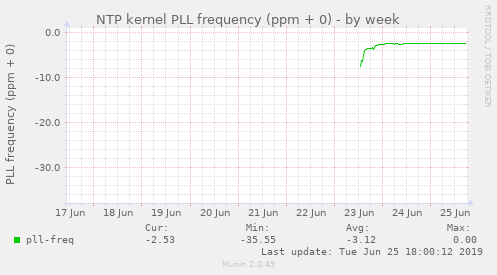
munin graph

A more common approach is GPS synchronization via a 1 PPS signal over the GPIO pins. This can then be handled via a kernel module, but can only be used for timekeeping.