












· 3 min read
The setup is as follows: you have a camera attached to a UAV which is taking pictures regularly every five seconds, and you need at least 80% overlap between the photos in order to properly stitch them together into a Digital Elevation Model (DEM). What do you do? How far apart should each photo be? How fast do you need to fly your UAV in order to achieve this?
This post demonstrates how to go about calculating the required maximum distance between successive photos in order to ensure a certain percentage overlap between those photos, as a function of the required overlap, the angle of view of the camera and your height above the ground.
I then go on to show how to simply work out how fast you need to fly your UAV to achieve this overlap, given the time between successive photographs.
The geometry of the situation is shown below:
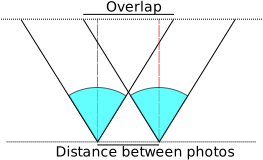
Let’s call the inter-photo distance dintd_{int}, the angle of view αy\alpha_y, the height hh and the required overlap fraction ω\omega (i.e. if we want 80% overlap, then ω=0.8\omega = 0.8).
dint=2htan(αy2)−overlapd_{int} = 2h\tan\left(\frac{\alpha_y}{2}\right) - \text{overlap} =2htan(αy2)−2hωtan(αy2)~~~~~~~~~~~~~~~~~~ = 2h\tan\left(\frac{\alpha_y}{2}\right) - 2h\omega\tan\left(\frac{\alpha_y}{2}\right) =2htan(αy2)[1−ω]~ = 2h\tan\left(\frac{\alpha_y}{2}\right)\left[ 1 - \omega \right]
The speed that a UAV must fly at, vUAVv_{UAV} , given the time interval between successive photos, tintt_{int}, is then simply given by:
vUAV=dinttint=2htan(αy2)[1−ω]tintv_{UAV} = \frac{d_{int}}{t_{int}} = \frac{2h\tan\left(\frac{\alpha_y}{2}\right)\left[ 1 - \omega \right]}{t_{int}}
Taking a reasonable value for the angle of view, αy=48.9∘\alpha_y = 48.9^{\circ}, the time interval betweem successive photos, tint=5t_{int} = 5 seconds and taking ω=0.8\omega = 0.8 thus gives the very reasonable value for the velocity of the UAV as:
vUAV=0.182h meters/secondv_{UAV} = 0.182h ~ \text{meters/second}
So if you’re taking photos at a reasonable h=50h = 50 meters, then:
vUAV=9.09 meters/secondv_{UAV} = 9.09 ~ \text{meters/second}
Luckily, this is a very reasonable value! (Remembering that this is the maximum speed you can go before your overlap becomes too small for proper photogrammetry.)
此内容由惯性聚合(RSS阅读器)自动聚合整理,仅供阅读参考。 原文来自 — 版权归原作者所有。