





I was just attending a virtual academic conference, where, frustratingly and annoyingly, 9 out of 10 sessions were about AI. But then, in one of the sessions that discussed human writing vs AI writing, I saw this slide:
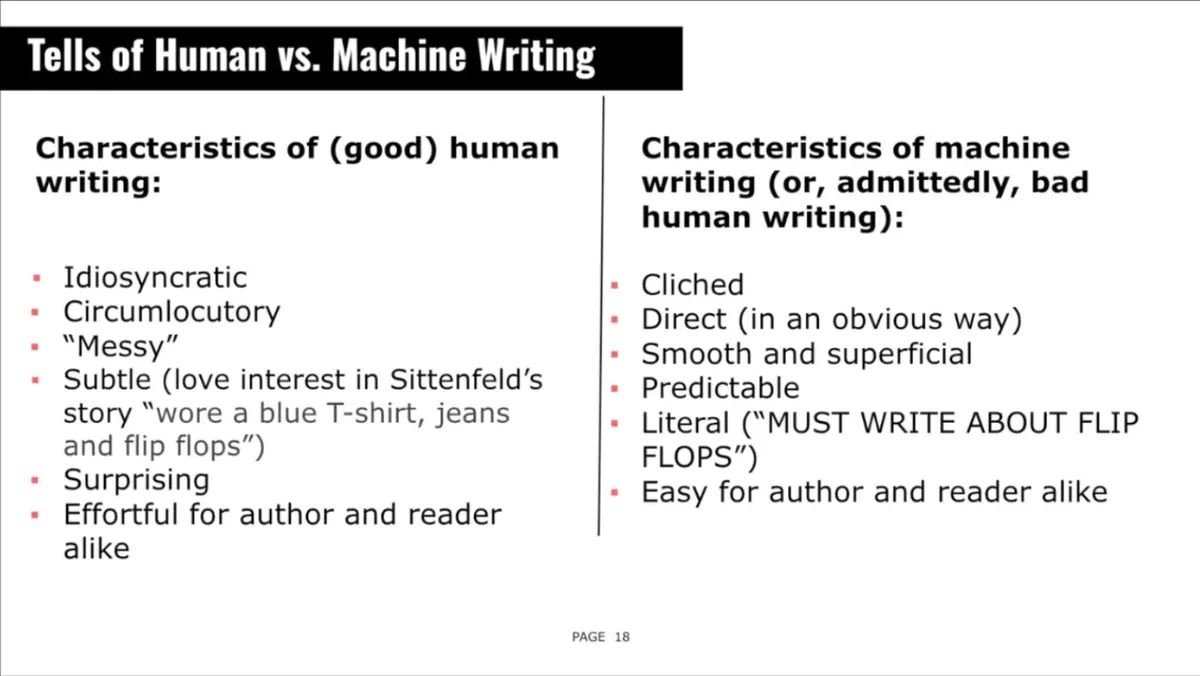
| Human Writing (good) | Machine Writing (or bad human writing) |
|---|---|
| Idiosyncratic | Cliched |
| Circumlocutory | Direct (in an obvious way) |
| “Messy” | Smooth and superficial |
| Subtle (e.g. flip-flops mentioned once, in passing) | Predictable |
| Surprising | Literal (“MUST WRITE ABOUT FLIP FLOPS”) |
| Effortful for author and reader alike | Easy for author and reader alike |
Fucking excuse me? This is so misleading and inaccurate on so many levels.
For context, this session referenced a literary experiment held on The New York Times by an author to compare a section of fiction written by human (the author herself) vs generated by AI. At the conference, the session presenter—a university prof—asked their students to reflect on the experiment, and together they came up with the above “tells” of human writing vs machine writing.
These metrics are so off, so wrong, and so bad that I don’t even know where to begin to unpack my frustration about shit like this being taught in postsecondary education nowadays. These metrics are fundamentally flawed from the start because they were derived from a single literary experiment, which contained just 2,000 words of example text in a specific fiction genre (beach read).
Not all (good) human writing needs to be idiosyncratic, messy, and/or surprising—technical writing and news reporting are 2 easy examples. If you’re writing a technical document and it has those qualities, that’s actually bad writing. Many kinds of writing simply should not have any of those characteristics of “good human writing.”
One of the points that the session presenter made was that, in the NYT experiment, the one written by human requires the reader to put in some effort to follow, while the one written by ChatGPT is easier to follow, and therefore the human written one is “better.”
Funnily enough, if the presenter had looked up the definition of “beach read,” they’d learn that a beach read is:
a usually light work of escapist fiction (such as a thriller or romance)
broadly : any enjoyable or accessible book considered suitable for reading while on vacation (as on a beach)
A beach read is supposed to be “light” and “accessible”—it’s supposed to be very easy to read!
But also, why the fuck is “harder to read” a good thing? How does being harder to read mean human writing or good writing? It sounds to me like that human writer needs to improve their writing skills so their writing is easier to follow. PhD dissertations are typically hard to read due to excessive and unnecessary use of advanced vocabulary1 and complex sentence structures—in my opinion, this is a “bug,” not a “feature.” If you’re writing something that’s meant to be read, to communicate, then just write it in a way that’s easy to understand; don’t intentionally obfuscate it. You’re not more educated, literate or smarter just because you use vocabulary that no one normally uses.
People falsely thinking they can easily tell human writing from AI writing has led to the undesirable and unexpected effects that punish people who actually can write well or at least attempt to write well.
More and more frequently, my writing has been flagged as AI-generated by people and AI detectors alike:
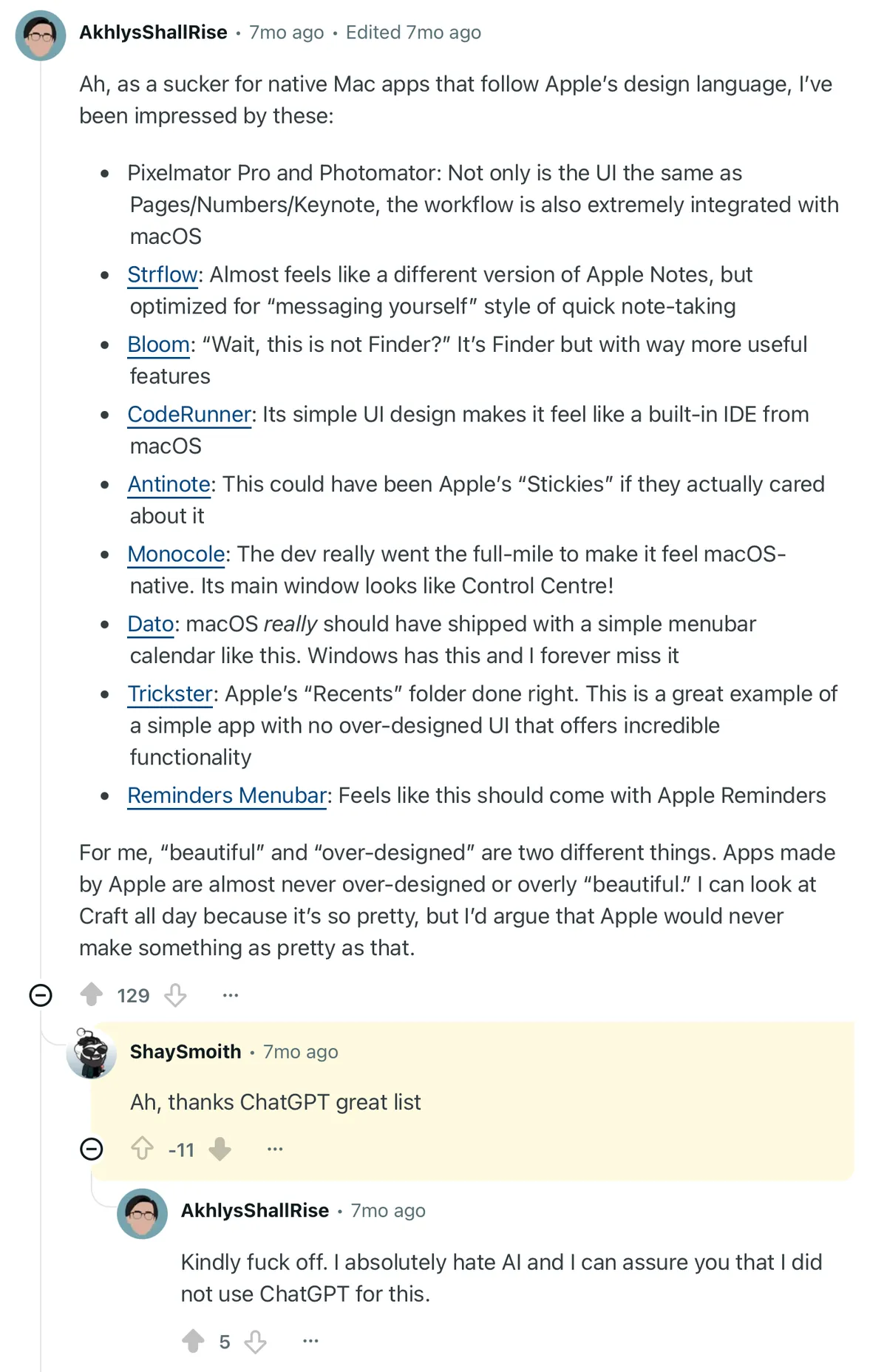
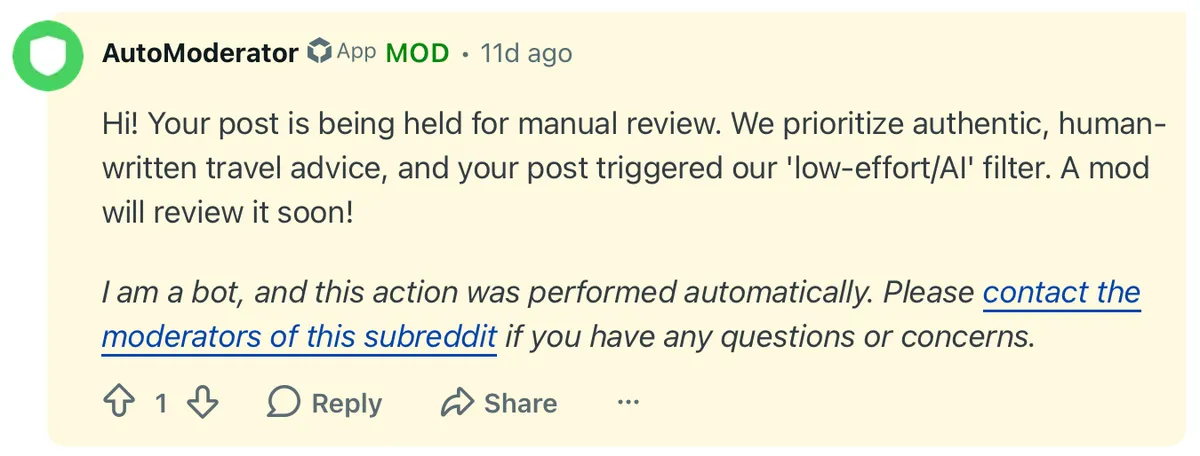
It increasingly feels that more and more people are dismissing writing that’s “good” in the traditional sense as AI-generated. And I find that incredibly infuriating, frustrating and saddening.
While this post might not be my best example (as it’s more of a rant), I naturally always try to write well because I was trained to do so as an English and professional writing major in my undergrad. We were trained to write clearly and succinctly with correct grammar and proper diction. My wonderful writing prof drilled into our minds that to communicate effectively, we should write in a way that’s clear and easy for the readers to understand with as little ambiguity as possible.
We were also taught the importance of writing with your audience and the genre and context in mind—don’t write a beach write that reads like literary fiction or a software application manual that’s unpredictable and idiosyncratic.
Let’s also not ignore the fact that one can easily revise a piece of AI-generated writing via follow-up prompts. In the NYT experiment, the prompt asked the AI to mention flip-flops, and so in the AI-generated text, flip-flops were mentioned a dozen times. Basing on that, one of the author’s criticisms for the AI-generated writing was that it followed one of the instructions too much.
But all it would take to fix that was ask the AI to reduce the mention of flip-flops to the author’s desirable number. Similarly, if you want the text to be harder to read, just ask the AI to do so; AI is 100% capable of making these changes.
Believing that one can distinguish between human writing and AI writing via some kind of “tells” is naive, simply because both human and AI writing can be good and bad.
My wife worked in the publishing industry for a while, and she told me that many bad but human-written romcoms are being accused of AI use because the writing is bad.
So basically, to quote my wife:
so if it’s clean, efficient writing, it’s ai
if it’s bad, predictable writing, it’s ai
ok let me go kill myself
Previous |
Reply via email. Subscribe to my blog via email or RSS feed.
Obviously, actual terminology is excused.↩
此内容由惯性聚合(RSS阅读器)自动聚合整理,仅供阅读参考。 原文来自 — 版权归原作者所有。