





Published · 3 min read
I don’t have the best memory. Hell, I barely remember what I did yesterday. Over the years, I’ve tried countless apps to track my tasks, but most of them are too complex. Sign-ins, corporate policies, integrations, fancy UIs. I don’t have time for that crap. I believe in KISS (Keep It Simple, Stupid). It was one of the first principles I learned, probably in my Computer Architecture or Computer Organization class.
Another core principle I swear by is divide and conquer. I first heard about it in my second term class, C102, when we used recursion in our final project, Bomberman. The idea applies everywhere, especially when managing your time and tasks.
My solution to task management is a combination of these two principles.
The Problem
Days come and go, blending into one another. You wake up, get through the motions, and before you know it, another day is over. You had things you wanted to do. I know the feeling when you had things you needed to do but somehow, they slipped through the cracks. The problem isn’t that you lack motivation or discipline; it’s that life is noisy. Distractions, shifting priorities, and unexpected interruptions make it easy to lose track of what truly matters.
And when you don’t keep track of what you’ve accomplished, it can feel like you’ve done nothing at all. This is especially true for leaders. A day can be filled with meetings, decisions, and conversations that don’t produce immediate, tangible results. Without a system, it’s easy to feel like you’re spinning your wheels, even when you’re making real progress.
That’s where my simple system comes in.
The System
I keep a simple document with the date as the heading and a list of tasks underneath. If something is complex, I break it down into steps or even substeps. I complete as much as I can and move to the next day. Some tasks span multiple days, and meetings often generate action items that I need to track.
The beauty of this system is its flexibility:
- I assign work ahead of time, so when the day arrives, I don’t have to waste time figuring out what to do.
- I add tasks throughout the day, even small ones like texting someone because if I don’t write it down, I’ll forget.
- I break big tasks into smaller parts, making it easier to tackle. I approach very big tasks by spreading them across multiple days.
As a leader, it often feels like you didn’t do anything significant. But looking at what I’ve done daily, I can at least see some sort of accomplishment.
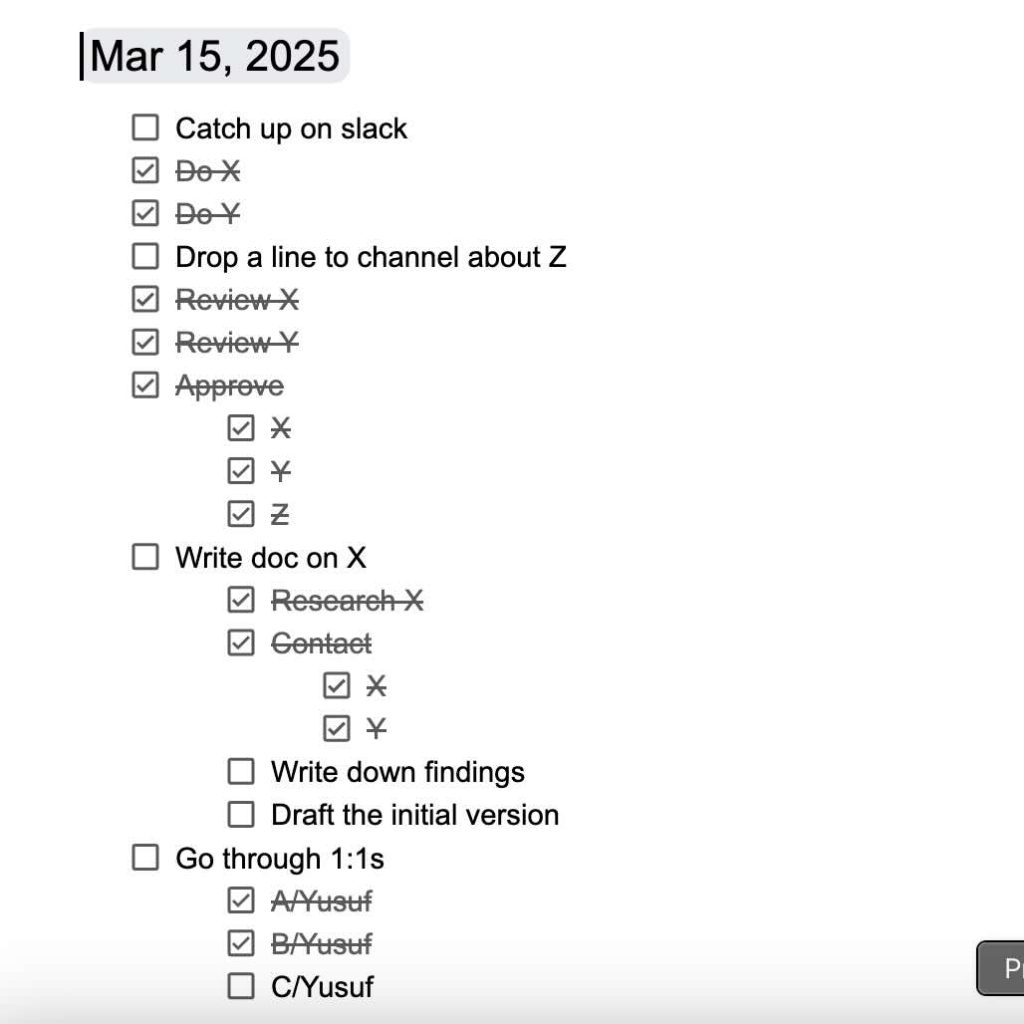 simple task management
Why This Works
- Simplicity – No drama, no unnecessary features, just a document.
- Accountability – Every task is written down and visible.
- Flexibility – Tasks evolve throughout the day.
- Future Planning – I can queue up tasks for the coming days.
- Validation – It gives a sense of accomplishment when you look back and see progress.
It’s a straightforward yet powerful way to stay organized. If you’ve struggled with overcomplicated task management tools, try this. Just a doc, a date, and a list. That’s all you need.