





Where is the center of the internet? There is no single correct answer. You could measure submarine cables, network interconnection, cloud capacity, traffic, or the number of people online, and each would produce a different map.
But one result from my 2026 Internet Map caught me completely off guard. When I ranked American metro areas by the amount of publicly routed IPv4 address space geolocated to them, the top result was not New York, Chicago, or Silicon Valley. It was Ashburn, Virginia, a suburb about 30 miles northwest of Washington, D.C. In this article, “Ashburn” refers to the broader Northern Virginia data-center and interconnection cluster centered there.
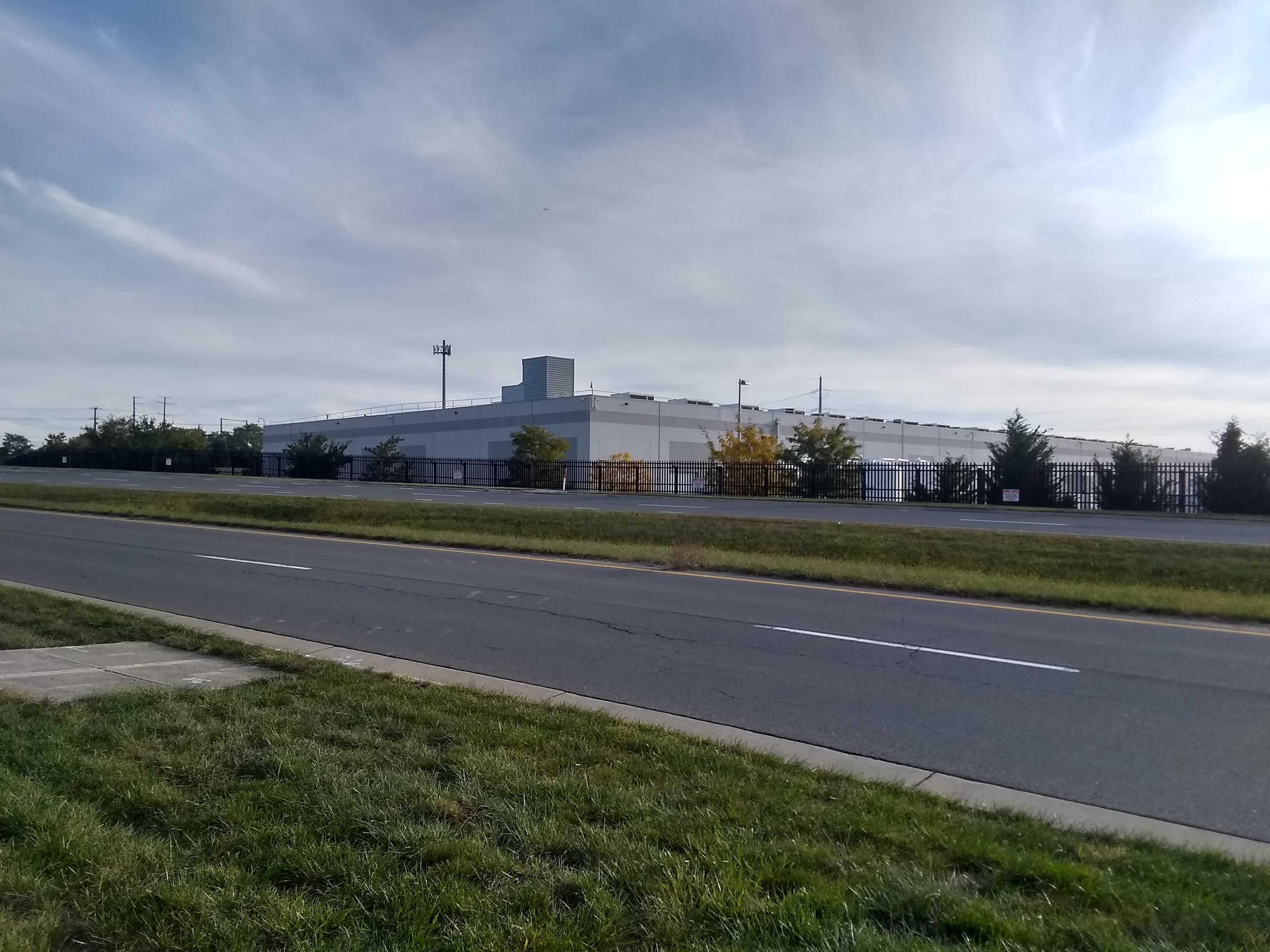
A data center in Ashburn, Virginia; By Vahurzpu - Own work, CC BY-SA 4.0
| Rank | Metro area | IP dominance |
|---|---|---|
| 1 | Ashburn | 100,934,452 |
| 2 | New York | 69,322,932 |
| 3 | Seattle | 30,696,072 |
| 4 | Chicago | 28,980,879 |
| 5 | Columbus | 22,291,535 |
Ashburn reached roughly 101 million IPv4 addresses, substantially more than New York and more than Seattle and Chicago combined. The ranking was not measuring population or economic activity. It was picking up the enormous concentration of internet infrastructure in Northern Virginia.

What the Number Means
IP dominance is the number of publicly routed IPv4 addresses geolocated to a metro area. It is not a count of users, servers, or traffic. An IP address may represent a virtual machine, load balancer, edge node, corporate gateway, or thousands of users behind carrier-grade NAT. Geolocation is also imperfect: prefixes may be registered at an office, announced from several regions, or associated with the nearest recognizable city rather than the exact location of the hardware.
IPv6 is excluded because its enormous allocation sizes make address counts mostly reflect allocation policy rather than physical infrastructure. So the exact totals should not be taken literally. But large, persistent concentrations of IPv4 space can still reveal where cloud providers, hosting companies, content networks, and other publicly reachable systems have accumulated.
Ashburn also has about 32.68 Tbps of public peering capacity in my dataset, measured as the combined port capacity available through public Internet Exchange Points. That places it behind New York and Chicago, but still among the largest interconnection markets in the United States. What makes Ashburn unusual is the combination: a large interconnection market and an enormous concentration of geolocated address space.
Why Ashburn?
Northern Virginia got an early start. MAE-East was one of the first major commercial internet exchange points in the United States. It connected networks around Washington, D.C., before expanding into facilities in Vienna, Reston, and Ashburn. Providers established points of presence nearby, carriers installed fiber, and data-center operators built around that growing network ecosystem.
MAE-East eventually declined, but the infrastructure and network presence remained. By then, the region had developed a feedback loop: a network benefits from locating near its carriers, customers, cloud providers, and peers, and every new participant makes the location more useful to the next one. Over time, Ashburn accumulated data centers, exchange fabrics, private connections, cloud regions, and long-haul fiber routes. AWS’s us-east-1 is the best-known example, but it is only one part of the cluster.
Virginia reinforced that growth with available land, access to power, and tax exemptions for qualifying data-center equipment. Ashburn became important because so much of the internet already had a reason to be there.
The Power Problem
That advantage now has a serious limit: electricity. Data centers need enormous amounts of electricity delivered to a specific site through transmission lines and substations. Adding generation elsewhere on the regional grid does not immediately solve a local shortage; the power has to reach the facility on a predictable schedule. In Northern Virginia, data-center construction has often moved faster than the grid could expand, leaving some projects facing multiyear waits for full electrical service.
PJM’s 2026 forecast shows peak load in the Dominion zone rising by more than 20 gigawatts by the late 2030s. PJM explicitly attributes much of that increase to data-center growth. Transmission corridors, substations, and generation all take years to permit and construct. Land is already expensive, and new infrastructure faces increasing political resistance.
For the first time, Ashburn’s network gravity may be weaker than the pull of power that can actually be delivered elsewhere.
AI Changes the Equation
Artificial intelligence makes the power problem more severe. Many existing data centers were designed around rack densities in the low tens of kilowatts, while NVIDIA documents roughly 120 kW of power consumption for a single GB200 NVL72 rack. That much power becomes heat. Conventional air cooling becomes difficult and inefficient, pushing new AI systems toward direct-to-chip liquid cooling and other designs that require different electrical, plumbing, and heat-rejection infrastructure.
Some newer Ashburn campuses can support these systems. Older facilities may require major upgrades, and not every building can be economically converted. AI workloads also change the importance of location. Customer-facing services benefit from being close to users, networks, databases, and other cloud systems, but large model-training clusters are different. They still need substantial connectivity, but metro-level latency matters less than power availability and the high-bandwidth network inside the campus.
That gives operators more freedom to build training clusters in places with available electricity, land, and cooling capacity. The likely result is not a complete migration away from Ashburn, but a division of labor: new training clusters can be built elsewhere, latency-sensitive inference remains distributed near users and major network hubs, and Ashburn continues to host cloud services, storage, interconnection, and the systems connecting everything together.
Ashburn May Be Unbundled
Another city does not need to recreate Ashburn to weaken its dominance. Ashburn became powerful because connectivity was difficult to reproduce. For the next generation of data centers, power may be the harder resource to secure. Long-haul fiber can be extended to a new campus; delivering hundreds of megawatts of firm power on a predictable schedule is much harder.
Ashburn’s thousands of existing interconnections cannot simply be packed into trucks and moved elsewhere. It will remain one of the world’s most important places for exchanging traffic.
But the center of interconnection and the center of computation may begin to separate.
Ashburn may not be replaced by one competing hub.
It may be unbundled.