


惯性聚合 高效追踪和阅读你感兴趣的博客、新闻、科技资讯
阅读原文 在惯性聚合中打开

推荐订阅源

F
Fortinet All Blogs
V2EX - 技术
V2EX - 技术
The Last Watchdog
The Last Watchdog
宝玉的分享
宝玉的分享
T
Tenable Blog
WordPress大学
WordPress大学
K
Kaspersky official blog
Microsoft Security Blog
大猫的无限游戏
大猫的无限游戏
H
Hackread – Cybersecurity News, Data Breaches, AI and More
Hacker News - Newest:
Hacker News - Newest: "LLM"
P
Palo Alto Networks Blog
Help Net Security
Help Net Security
V
Vulnerabilities – Threatpost
Know Your Adversary
Know Your Adversary
C
CXSECURITY Database RSS Feed - CXSecurity.com
A
Arctic Wolf
Forbes - Security
Forbes - Security
Microsoft Azure Blog
爱范儿
爱范儿
cs.AI updates on arXiv.org
The Cloudflare Blog
Hugging Face - Blog
Hugging Face - Blog
H
Hacker News: Front Page
W
WeLiveSecurity
博客园 - 【当耐特】
G
Google Developers Blog
Martin Fowler
Martin Fowler
TaoSecurity Blog
TaoSecurity Blog
Hacker News: Ask HN
Hacker News: Ask HN
人人都是产品经理
人人都是产品经理
CTFtime.org: upcoming CTF events
AI
AI
N
Netflix TechBlog - Medium
C
Cisco Blogs
I
Intezer
aimingoo的专栏
aimingoo的专栏
博客园 - 聂微东
G
GRAHAM CLULEY
Threat Intelligence Blog | Flashpoint
cs.CL updates on arXiv.org
Apple Machine Learning Research
月光博客
月光博客
Exploit-DB.com RSS Feed
www.infosecurity-magazine.com
小众软件
小众软件
Blog — PlanetScale
Blog — PlanetScale
MyScale Blog
MyScale Blog
L
Lohrmann on Cybersecurity
Engineering at Meta
Engineering at Meta

Stripe Blog

Analyzing the evidence that helps businesses win “product not received” disputes Four travel and hospitality trends from HITEC 2026 What Link data tells us about AI spending Stripe Projects adds new agent integrations, more providers, and custom developer controls New ways to turn global demand into revenue The future of agentic commerce is here Stripe Forum Seattle Helping businesses optimize network costs with the Visa Digital Commerce Authentication Program (DCAP) Solo founding is at an all-time high: Top performers have these traits in common Expanding Stripe Radar to protect more of your business Five vertical SaaS insights from Sessions 2026 Everything we announced at Sessions 2026 How agents, digital wallets, and trust are rewriting checkout Insights from Shoptalk 2026: How agents are changing retail How Stripe Radar helps prevent free trial abuse Three of the biggest fraud trends from MRC Vegas 2026 Testing the impact of Adaptive Pricing across 1.5M subscription checkout sessions Introducing the Machine Payments Protocol 10 things we learned building for the first generation of agentic commerce Analyzing first-party fraud trends: Account, free trial, and refund abuse Supporting additional payment methods for agentic commerce Can AI agents build real Stripe integrations? We built a benchmark to find out
Giving agents the ability to pay
Dan Hill Product Manager, Link Consumer Product · 2026-04-29 · via Stripe Blog

In the Sessions keynote, we talked about how agents are becoming active participants in the internet economy, and how we’re building the infrastructure to support them.

Agents have become increasingly capable in recent months, but making purchases across the internet remains difficult. While machine payments protocols are still gaining adoption, agents need to work with the payment options sellers and consumers use today.

Today we’re launching Link’s wallet for agents, built on top of Stripe’s new Issuing for agents. You can now give agents programmatic access to Link and the ability to get a one-time-use card or a Shared Payment Token (SPT), backed by the cards and bank accounts already in your wallet. The agent never gets access to your raw payment credentials. 

You can review and approve each spend request from the agent on the web, or in Link’s new iOS and Android apps. This makes it easy for consumers to enable personal AI agents such as OpenClaw to make an authorized purchase on their behalf.

If you’re a developer or business building consumer-facing agents, such as personal assistants, Link’s wallet for agents removes the need to build wallet infrastructure from scratch. Link handles the abstraction across payment options your agent might need—like cards and SPTs (with stablecoins and other payment methods coming soon). It also takes care of fund flow complexity and helps you reach Link’s customer base of more than 200 million consumers.

How Link’s wallet for agents works

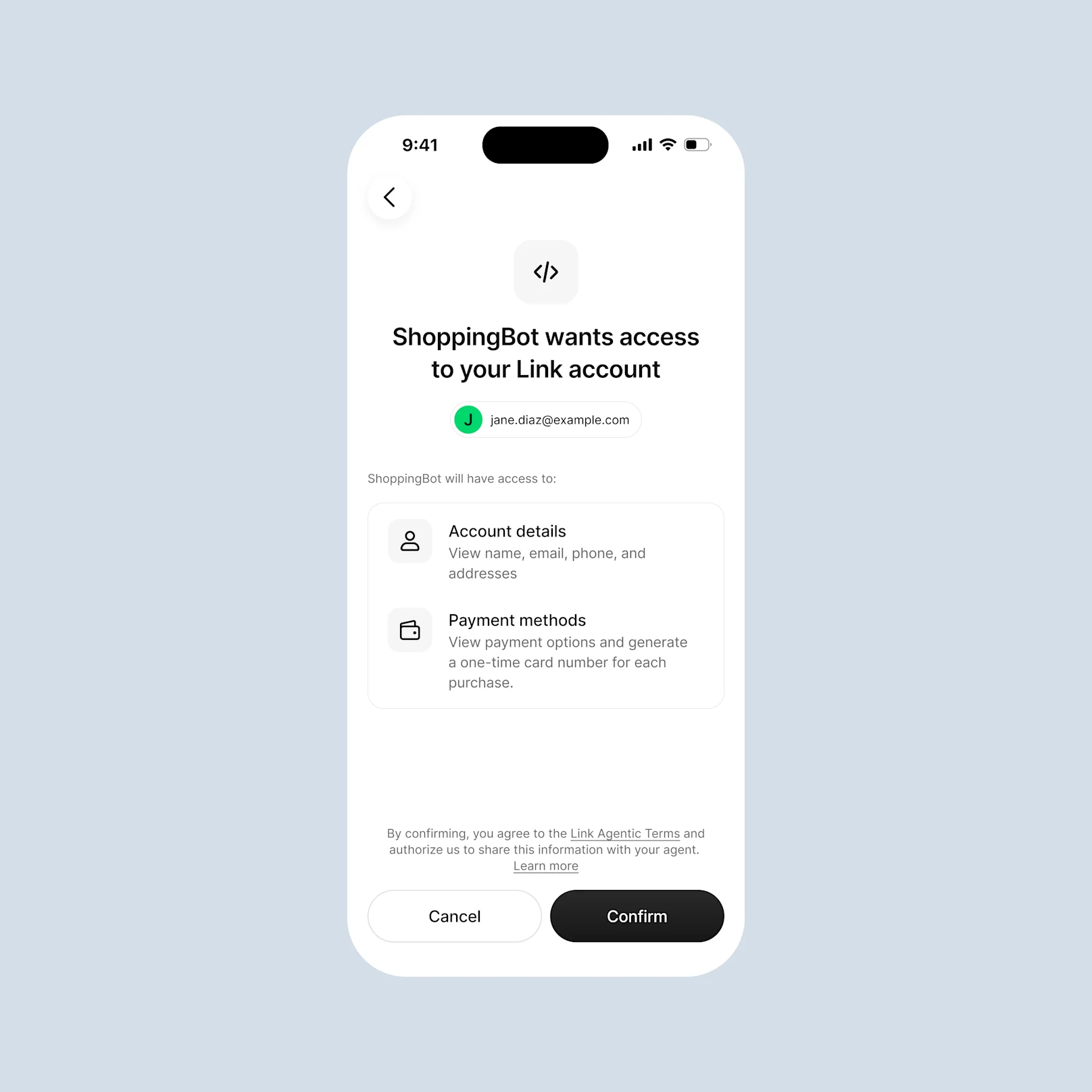
Imagine you are building a shopping agent that recommends apparel to your consumers. First, the consumer grants your agent access to their Link wallet via a standard OAuth flow.
Blog > Giving AI agents the ability to pay > Image 1

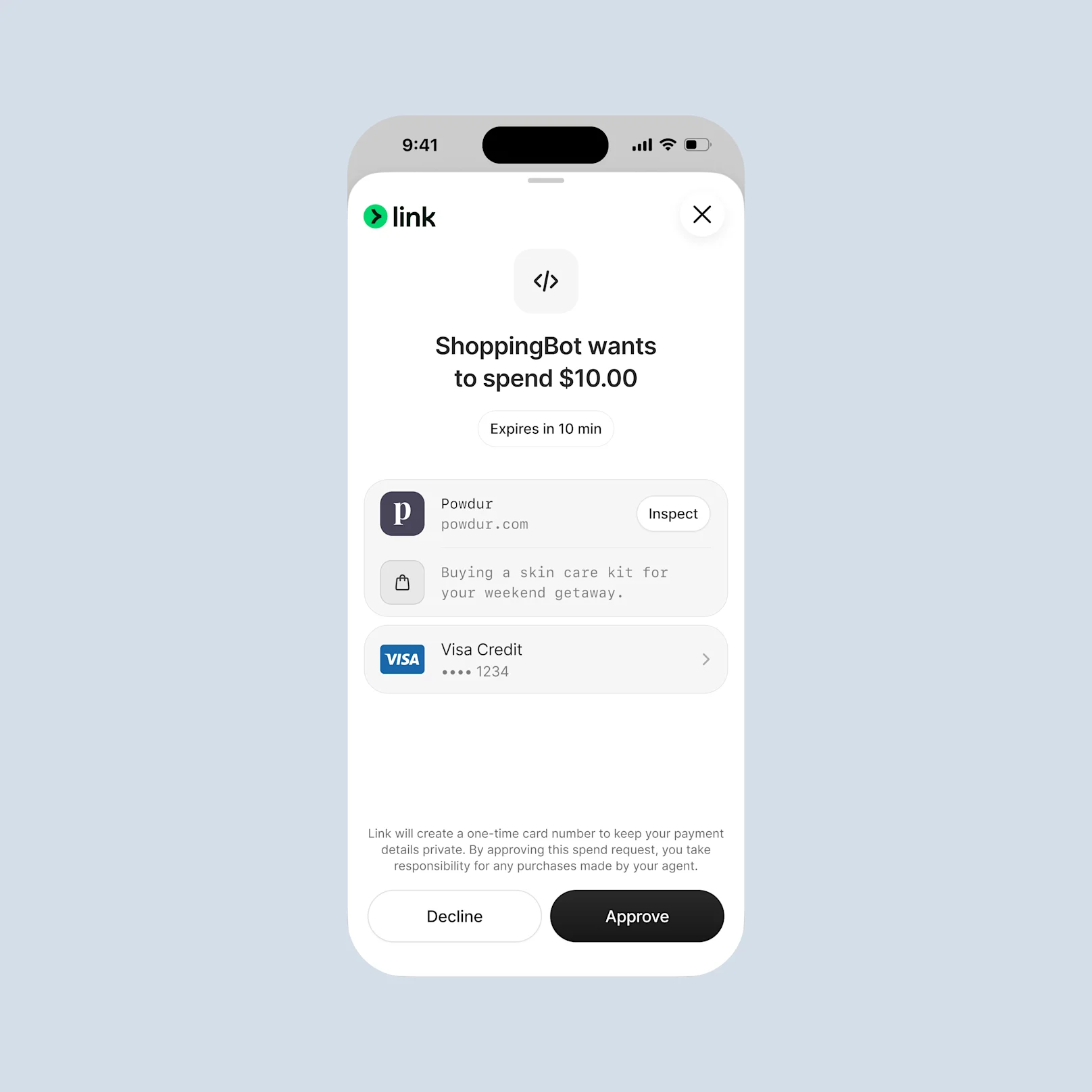
Once your agent has access, it can create a spend request to get either a one-time-use card or an SPT to complete the transaction. Your agent provides context on the transaction, so the person can understand and approve the request. In both card and machine-native flows, the payment credential can be scoped with controls like amount, currency, and merchant. Support for agentic tokens, stablecoins, and other payment types are coming soon.

The consumer gets a notification and approves the spend request in Link (on the web, or in the Link iOS or Android app). Today, each request requires the person’s review before the credential is shared with your agent. We’re planning on expanding these controls to let people set spending limits, and choose when agents can act without additional approval. 
Blog > Giving agents the ability to pay > Image 2

After approval, Link returns the one-time-use card or SPT to your agent for it to complete the purchase. The person can track agent spending and manage connected agents directly in Link.

Stripe Issuing for agents

Link’s wallet for agents is built directly on top of Stripe’s Issuing primitives. For businesses that want to build and customize their own agentic wallets and cards, Issuing for agents gives developers access to the full set of Issuing APIs to power agentic spending and custom financial workflows for agents and their users.

Businesses can design user-facing experiences to fit their product, including onboarding, fund flows, and spending controls. They can define when and how agents move funds, set permissions at the card level, introduce fraud controls at transaction authorization, and gain visibility into historical and real-time card activity. 

Issuing for agents provides the underlying infrastructure for these experiences, from single-use virtual cards and fund storage to spending controls, transaction monitoring, and advanced fraud tools. This infrastructure supports a range of use cases: 

  • Developers can use agents to automate their own business spend, allowing them to create programmatic workflows and recurring purchases.
  • Fintech providers can embed agent-issued cards to control and reconcile spend for expense management in real time.
  • Vertical SaaS platforms can issue agent cards to SMB customers, letting agents automate spend under the platform’s own brand.
  • Marketplaces can issue cards to sellers, so their agents can automate supplier payments, logistics, and fulfillment purchases.

Get started

Get started today with Link’s wallet for agents, and read our docs to learn more about Issuing for agents.