






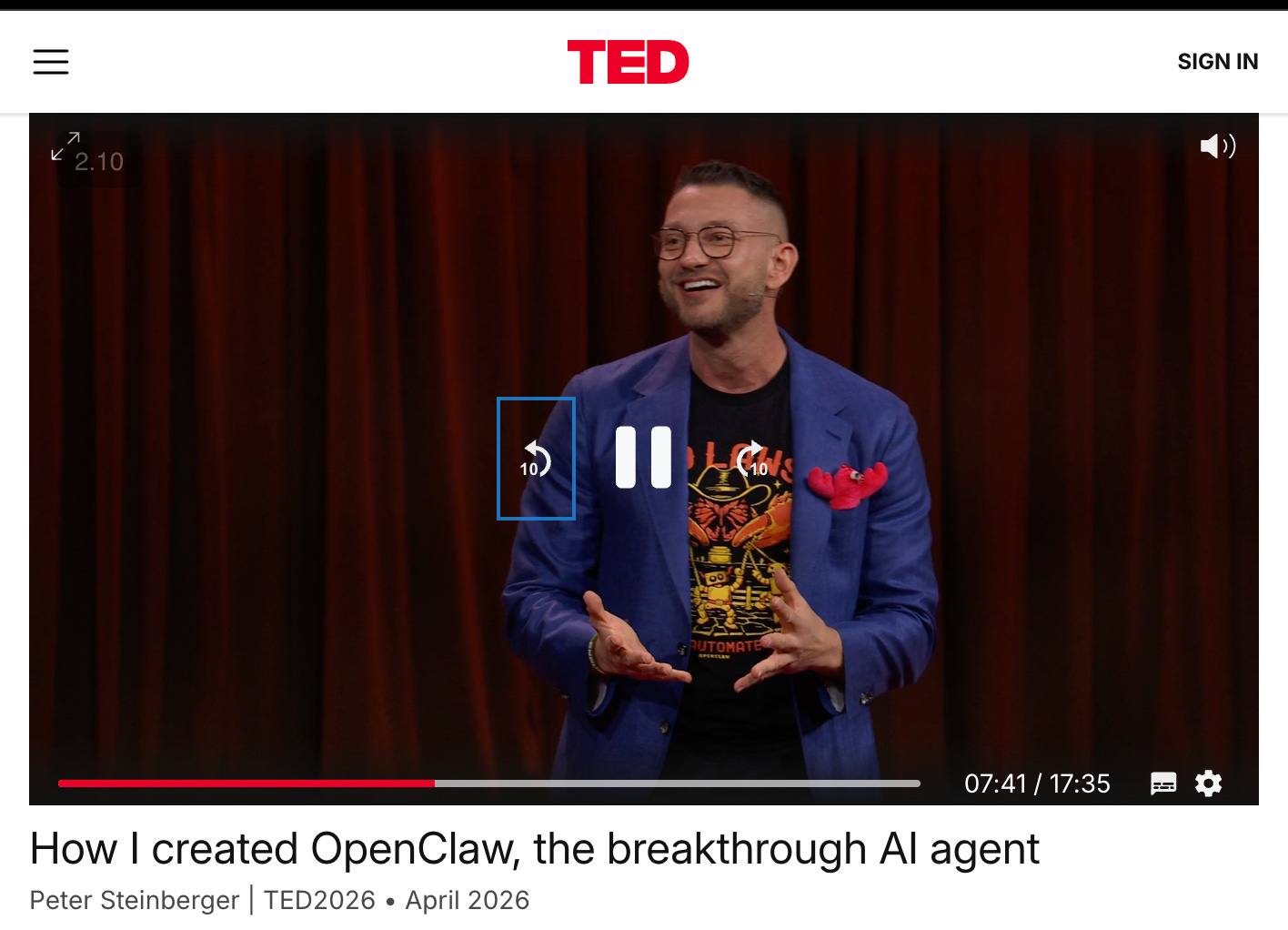
In an opportune coinciding of big three letter conferences, the TED talk and the AIE talks of Peter Steinberger dropped today. To the general public, the inspiring story of OpenClaw was delightfully told onstage, which recaps all the highs:
To the engineering audience, it was more sober, talking about the unprecedented levels of security incidents (60x more reports than curl, at least 20% of skill contributions malicious) and scaling issues involved in maintaining the fastest growing open source project in history:
An AMA moderated by me is included at the end.
Contrast them, thoughts welcome.
AI News for 4/16/2026-4/17/2026. We checked 12 subreddits, 544 Twitters and no further Discords. AINews’ website lets you search all past issues. As a reminder, AINews is now a section of Latent Space. You can opt in/out of email frequencies!
Anthropic’s Claude Opus 4.7 and Claude Design rollout
Claude Design launched as Anthropic’s first design/prototyping surface: @claudeai announced Claude Design, a research-preview tool for generating prototypes, slides, and one-pagers from natural-language instructions, powered by Claude Opus 4.7. The launch immediately framed Anthropic as moving beyond chat/coding into design tooling; multiple observers called it a direct shot at Figma/Lovable/Bolt/v0, including @Yuchenj_UW, @kimmonismus, and @skirano. The market reaction itself became part of the story, with @Yuchenj_UW and others noting Figma’s sharp drawdown after the announcement. Product details surfaced via @TheRundownAI: inline refinement, sliders, exports to Canva/PPTX/PDF/HTML, and handoff to Claude Code for implementation.
Opus 4.7 looks stronger overall, but the rollout was noisy: third-party benchmark posts were broadly favorable. @arena put Opus 4.7 #1 in Code Arena, +37 over Opus 4.6 and ahead of non-Anthropic peers there; the same account also had it at #1 overall in Text Arena with category wins across coding and science-heavy domains here. @ArtificialAnlys reported a near three-way tie at the top of its Intelligence Index—Opus 4.7 57.3, Gemini 3.1 Pro 57.2, GPT-5.4 56.8—while also placing Opus 4.7 first on GDPval-AA, their agentic benchmark. They also noted ~35% fewer output tokens than Opus 4.6 at higher score, and introduction of task budgets plus full removal of extended thinking in favor of adaptive reasoning. But user experience was mixed in the first 24 hours: @VictorTaelin reported regressions and context failures, @emollick said Anthropic had already improved adaptive thinking behavior by the next day, and @alexalbert__ confirmed that many initial bugs had been fixed. There were also complaints about product stability in Design itself from @theo and account-level safety issues from the same account here.
Cost/efficiency discussion became almost as important as raw quality: @scaling01 claimed ~10x fewer tokens for some ML problem runs versus prior high-end models while maintaining similar performance, while @ArtificialAnlys placed Opus 4.7 on the price/performance Pareto frontier for both text and code. Not every benchmark agreed on absolute leadership—e.g. @scaling01 noted it still trails Gemini 3.1 Pro and GPT-5.4 on LiveBench—but the consensus from these posts is that Anthropic materially improved the model’s agentic utility and efficiency.
Computer use, coding agents, and harness design
Computer-use UX is becoming a mainstream product category: OpenAI’s Codex desktop/computer-use updates drew unusually strong practitioner reactions. @reach_vb called subagents + computer use “pretty close” to AGI in practical feel; @kr0der, @HamelHusain, @mattrickard, and @matvelloso all emphasized that Codex Computer Use is not just flashy but fast, able to drive Slack, browser flows, and arbitrary desktop apps, and may be the first genuinely usable computer-use platform for enterprise legacy software. @gdb explicitly framed Codex as becoming a full agentic IDE.
The field is converging on “simple harness, strong evals, model-agnostic scaffolding”: several high-signal posts argued that reliability gains now come more from harnesses than from chasing the very largest models. @AsfiShaheen described a three-stage financial analyst pipeline—router / lane / analyst—with strict context boundaries and gold sets for each stage, arguing that many bugs were actually instruction/interface bugs. @AymericRoucher extracted the same lesson from the leaked Claude Code harness: simple planning constraints plus a cleaner representation layer outperform “fancy AI scaffolds.” @raw_works showed an even starker example: Qwen3-8B scored 33/507 on LongCoT-Mini with dspy.RLM, versus 0/507 vanilla, arguing the scaffold—not fine-tuning—did “100% of the lifting.” LangChain shipped more of these patterns into product: @sydneyrunkle added subagent support to deepagents deploy, and @whoiskatrin announced memory primitives in the Agents SDK.
Open-source agent stacks continue to proliferate: Hermes Agent remained a focal point. Community ecosystem overviews from @GitTrend0x highlighted derivatives like Hermes Atlas, Hermes-Wiki, HUDs, and control dashboards. @ollama then shipped native Hermes support via ollama launch hermes, which @NousResearch amplified. Nous and Kimi also launched a $25k Hermes Agent Creative Hackathon @NousResearch, signaling a push from coding/productivity into creative agent workflows.
Agent research: self-improvement, monitoring, web skills, and evaluation
A cluster of papers pushed agent robustness and continual improvement forward: @omarsar0 summarized Cognitive Companion, which monitors reasoning degradation either with an LLM judge or a hidden-state probe. The headline result is notable: a logistic-regression probe on layer-28 hidden states can detect degradation with AUROC 0.840 at zero measured inference overhead, while the LLM-monitor version cuts repetition 52–62% with ~11% overhead. Separate work on web agents from @dair_ai described WebXSkill, where agents extract reusable skills from trajectories, yielding up to +9.8 points on WebArena and 86.1% on WebVoyager in grounded mode. And @omarsar0 also highlighted Autogenesis, a protocol for agents to identify capability gaps, propose improvements, validate them, and integrate working changes without retraining.
Open-world evals are becoming a serious theme: several posts argued current benchmarks are too narrow. @CUdudec endorsed open-world evaluations for long-horizon, open-ended settings; @ghadfield connected this to regulation and “economy of agents” questions; and @PKirgis discussed CRUX, a project for regular open-world evaluations of AI agents in messy real environments. On the measurement side, @NandoDF proposed broad NLL/perplexity-based eval suites over out-of-training-domain books/articles across 2500 topic buckets, though that sparked debate about whether perplexity remains informative after RLHF/post-training from @eliebakouch, @teortaxesTex, and others.
Document/OCR and retrieval evals also got more agent-centric: @llama_index expanded on ParseBench, an OCR benchmark centered on content faithfulness with 167K+ rule-based tests across omissions, hallucinations, and reading-order violations—explicitly reframing the bar from “human-readable” to “reliable enough for an agent to act on.” In retrieval, @Julian_a42f9a noted new work showing late-interaction retrieval representations can substitute for raw document text in RAG, suggesting some RAG pipelines may be able to bypass full-text reconstruction.
Open models, local inference, and inference systems
Qwen3.6 local/quantized workflows were a practical bright spot: @victormustar shared a concrete llama.cpp + Pi setup for Qwen3.6-35B-A3B as a local agent stack, emphasizing how viable local agentic systems now feel. Red Hat quickly followed with an NVFP4-quantized Qwen3.6-35B-A3B checkpoint @RedHat_AI, reporting preliminary GSM8K Platinum 100.69% recovery, and @danielhanchen benchmarked dynamic quants, claiming many Unsloth quants sit on the Pareto frontier for KLD vs disk space.
Consumer-hardware inference keeps improving: @RisingSayak announced work with PyTorch/TorchAO enabling offloading with FP8 and NVFP4 quants without major latency penalties, explicitly targeting consumer GPU users constrained by memory. Apple-side local inference also got a showcase with @googlegemma, which demoed Gemma 4 running fully offline on iPhone with long context.
Inference infra updates worth noting: @vllm_project highlighted MORI-IO KV Connector with AMD/EmbeddedLLM, claiming 2.5× higher goodput on a single node via a PD-disaggregation-style connector. Cloudflare continued its agent/AI-platform push with isitagentready.com @Cloudflare, Flagship feature flags @fayazara, and shared compression dictionaries yielding dramatic payload reductions such as 92KB → 159 bytes in one example @ackriv.
AI for science, medicine, and infrastructure
Scientific discovery and personalized health were prominent applied themes: @JoyHeYueya and @Anikait_Singh_ posted about insight anticipation, where models generate a downstream paper’s core contribution from its “parent” papers; the latter introduced GIANTS-4B, an RL-trained model that reportedly beats frontier models on this task. On the health side, @SRSchmidgall shared a biomarker-discovery system over wearable data whose first finding was that “late-night doomscrolling” predicts depression severity with ρ=0.177, p<0.001, n=7,497—notable because the model itself named the feature. Separately, @patrickc argued current coding agents are already highly useful for personalized genome interpretation, describing <$100 analysis runs that surfaced a roughly 30× elevated melanoma predisposition plus follow-on interventions.
Large-scale compute buildout remains a core meta-story: @EpochAIResearch surveyed all 7 US Stargate sites and concluded the project appears on track for 9+ GW by 2029, comparable to New York City peak demand. @gdb framed Stargate as infrastructure for a “compute-powered economy,” while @kimmonismus put today’s annual global datacenter capex at roughly 5–7 Manhattan Projects per year in inflation-adjusted terms.
Top tweets (by engagement)
Claude Design / Anthropic product expansion: @claudeai launches Claude Design, by far the day’s biggest pure-AI product launch signal.
Model benchmarking / rankings: @ArtificialAnlys on Opus 4.7 tying for #1 overall and leading GDPval-AA.
Coding agents / computer use: @cursor_ai doubles Composer 2 limits in the new agents window and @HamelHusain on Codex Computer Use.
Open-source agents: @ollama ships native Hermes Agent support.
Applied AI in medicine: @patrickc on coding agents for genome analysis and personalized prevention.
Infra / power scaling: @EpochAIResearch on Stargate’s 9+ GW trajectory.
此内容由惯性聚合(RSS阅读器)自动聚合整理,仅供阅读参考。 原文来自 — 版权归原作者所有。