




惯性聚合 高效追踪和阅读你感兴趣的博客、新闻、科技资讯
阅读原文 在惯性聚合中打开

推荐订阅源

WordPress大学
WordPress大学
Microsoft Azure Blog
MongoDB | Blog
MongoDB | Blog
小众软件
小众软件
Apple Machine Learning Research
O
OpenAI News
酷 壳 – CoolShell
酷 壳 – CoolShell
The GitHub Blog
The GitHub Blog
CTFtime.org: upcoming CTF events
Exploit-DB.com RSS Feed
博客园 - 聂微东
Engineering at Meta
Engineering at Meta
W
WeLiveSecurity
Hacker News: Ask HN
Hacker News: Ask HN
大猫的无限游戏
大猫的无限游戏
Vercel News
Vercel News
D
Docker
F
Full Disclosure
AI
AI
罗磊的独立博客
博客园 - 【当耐特】
U
Unit 42
S
SegmentFault 最新的问题
Stack Overflow Blog
Stack Overflow Blog
cs.AI updates on arXiv.org
P
Palo Alto Networks Blog
博客园_首页
H
Help Net Security
量子位
月光博客
月光博客
Threat Intelligence Blog | Flashpoint
K
KPMG report finds enterprise disconnect between AI and its ROI | CIO
博客园 - 司徒正美
F
Fortinet All Blogs
D
DataBreaches.Net
B
Blog RSS Feed
Webroot Blog
Webroot Blog
TaoSecurity Blog
TaoSecurity Blog
S
Secure Thoughts
爱范儿
爱范儿
I
InfoQ
钛媒体:引领未来商业与生活新知
钛媒体:引领未来商业与生活新知
www.infosecurity-magazine.com
Attack and Defense Labs
Application and Cybersecurity Blog
C
CERT Recently Published Vulnerability Notes
Martin Fowler
Martin Fowler
Blog — PlanetScale
Blog — PlanetScale
让小产品的独立变现更简单 - ezindie.com
S
Securelist

Hacker News - Newest: "AI"

AI can't read an investor deck AI as an attorney? Student uses ChatGPT, Gemini to sue UW over alleged racial discrimination Hacking MCP Servers in AI Systems – The Rug Pull: Tool Changes After Approval GitHub - MeepCastana/KubeezCut: Free Web based video editor GitHub - GenAI-Gurus/awesome-eu-ai-act: Curated tools, official sources, OSS, templates, and guides for EU AI Act compliance. Can AI judge journalism? A Thiel-backed startup says yes, even if it risks chilling whistleblowers Coming soon: 10 Things That Matter in AI Right Now DARPA built an AI to fact-check enemy weapons claims What explains heterogeneity in AI adoption? When AI Meets Muscle: Context-Aware Electrical Stimulation Promises a New Way to Guide Human Movements - Department of Computer Science AI Changed How We Build. It Did Not Change What Matters. Linux rules on using AI-generated code - Copilot is OK, but humans must take 'full responsibility for the… Meta spins up AI version of Mark Zuckerberg to engage with employees Code Mode: Let Your AI Write Programs, Not Just Call Tools | TanStack Blog GitHub - Delavalom/graft: Go framework for building AI agents. Type-safe tools, multi-provider (OpenAI, Anthropic, Gemini, Bedrock), zero vendor SDKs. India's TCS tops estimates, says new AI models did not dent services demand Gen Z's fading AI hype Strong feeling: we are in a folded AI reality GitHub - machinarii/total-recall-catalog: A reference catalog of latest knowledge retrieval, memory & RAG systems GitHub - mensfeld/code-on-incus: Give each AI agent its own isolated machine with root, Docker, and systemd. Active defense detects and stops threats automatically.. Quantization, LoRA, and the 8% Problem: Benchmarking Local LLMs for Production AI Iran war: We spoke to the man making Lego-style AI videos that experts say are powerful propaganda Powell, Bessent discussed Anthropic's Mythos AI cyber threat with major U.S. banks GitHub - immartian/bellamem: Persistent belief-graph memory for AI agents. Retrieves decisive context by importance — not recency, not RAG, not /compact. recursive-mode: The Repo-Native Operating System for AI Engineering After the attack on Sam Altman's home, will AI CEO's go on the offensive? The biggest advance in AI since the LLM Opus 4.6 vs GPT 5.4 One Prompt Unity World Generation Test “AI polls” are fake polls Client Challenge Can AI be a 'child of God'? Inside Anthropic's meeting with Christian leaders How to Switch AI Chatbots and Why You Might Want To GitHub - MattMessinger1/agentic_refund_guardrail: Safe refund policy layer for AI agents — Python + TypeScript. Same behavior, shared tests. Adam/papers/emergent_values_whitepaper.md at master · strangeadvancedmarketing/Adam Ask HN: How do you stop playing 20 questions with your AI coding tools How far can automation and AI support psychotherapy? - @theU GitHub - stagas/rtdiff: realtime git diff gui and AI-assisted commits A Mac Studio for Local AI — 6 Months Later A History of the Early Years of AI at the University of Edinburgh Why AI Coding Tools Still Feel Stuck on Localhost MSN AI Datacenters Are Becoming Strategic Targets twitter.com Penn Researchers Use AI to Surface Unreported GLP-1 Side Effects in Reddit Posts Show HN: MoodSense AI (ML and FastAPI and Gradio, Deployed on Hugging Face) Moodsense Ai - a Hugging Face Space by aman179102 AI models are terrible at betting on soccer—especially xAI Grok GitHub - xialeistudio/echoic GitHub - HimashaHerath/github-dev-wrapped: AI-powered weekly GitHub activity reports deployed to GitHub Pages GitHub - alejandrobalderas/claude-code-from-source: Architecture, patterns & internals of Anthropic's AI coding agent — reverse-engineered from source maps AI and Tech brief: Ireland ascendant GitHub - Titovilal/context0: Context0 - Never Surrender Training for a Marathon with an AI Coach: What Worked and What Didn't Cyber Pulse: Agentic Intel - Apps on Google Play I Built an AI PR Reviewer That Catches Bugs by Not Looking for Bugs Gen Z workers are so fearful AI will take their job they’re intentionally sabotaging their company’s AI rollout | Fortune How AI Is Reimagining the Game of Golf–For Both Players and Courses GitHub - nattergabriel/reseed: A CLI tool for managing and distributing agent skills across projects Is SVG the final frontier? My AI workflow evolved from prompts to a near-autonomous workflow MLSharp Help - 3DGS Viewer & Generator I put my cognitive field based AI's runtime on GitHub Is Numble the first AI-proof game? A3: Kubernetes for autonomous AI agent fleets | Emergent Principles Deepali Vyas ("The Elite Recruiter") GitHub - msmarkgu/RelayFreeLLM: A restful API designed to route user prompts to various AI model providers. Unionized ProPublica staff are on strike over AI, layoffs, and wages Unleashing the Advantage of Quantum AI We're heading for an AI-fueled 'dementia crisis,' brain scientist warns The AI-Assisted Breach of Mexico's Government Infrastructure [pdf] GitHub - stef41/lmscan: 🔍 Detect AI-generated text and fingerprint which LLM wrote it. Open-source GPTZero alternative. Zero dependencies, works offline. MSN GitHub - visionscaper/collabmem: Enabling long-term collaboration with Agentic AI - building up episodic and world model memory over time with in-context awareness We gave an AI a 3 year retail lease in SF and asked it to make a profit | Andon Labs AI Code is Hollowing Out Open Source, and Maintainers are Looking the Other Way What leaked "SteamGPT" files could mean for the PC gaming platform's use of AI AI is the boss at this retail store. What could go wrong? GitHub - Wuzu11517/agentic-proxy: Local proxy meant to help reduce With Drones, Geophysics and ArtificiaI Intelligence, Researchers Prepare to Do Battle Against Land Mines A Single Operator, Two AI Platforms, Nine Government Agencies: The Full Technical Report 在 Steam 上购买 FriedrichAI: Offline AI 立省 10% GitHub - inevolin/resume-cli: Hit Claude usage limits? Resume any AI coding session elsewhere. Switch tools at zero friction. GitHub - atripati/ark: AI Runtime Kernel — a context operating system for AI agents. Eliminates tool bloat, loads only what’s needed, and gives LLMs their reasoning space back. How to Build a Secure AI PR Reviewer with Claude, GitHub Actions, and JavaScript This Startup Wants You to Pay Up to Talk With AI Versions of Human Experts Intel Arc Pro B70 Brings 32GB VRAM to Local AI for $949 WordPress 7.0: The Good, the AI, and the Still Missing AI on the couch: Anthropic gives Claude 20 hours of psychiatry IatroBench: Pre-Registered Evidence of Iatrogenic Harm from AI Safety Measures AI Agents Know About Supabase. They Don't Always Use It Right. The history and future of AI at Google, with Sundar Pichai Inside an AI‑enabled device code phishing campaign How Meta Used AI to Map Tribal Knowledge in Large-Scale Data Pipelines AI for Systems: Using LLMs to Optimize Database Query Execution Forecasting the Economic Effects of AI Introducing Tinker: Play with AI, bring your ideas to life AI sheds light on an ancient gaming mystery People really hate AI but not as much as Iran—or Democrats | Fortune What is an AI Product Engineer? Phoebe Gates wants her $185 million AI startup to succeed with 'no ties to my privilege or my last name': 'I have a chip on my shoulder' | Fortune
The Incompatibilities Between Generative AI and Art: Q&A with Ted Chiang
georgecmu · 2026-05-20 · via Hacker News - Newest: "AI"

Humanities for AI

12 August 2025

Speaker at a podium addressing a full lecture hall, with a large projected slide behind them reading The Incompatibility Between Generative AI and Art.

Ted Chiang presenting his talk at Princeton. March 2025. (Photo: Ali Nugent)

This past year, the Center for Digital Humanities celebrated its tenth anniversary with the theme “Humanities for AI.” Through this series of events, projects, and conversations, we explore how humanistic values and approaches are crucial to developing, using, and interpreting the field of AI.

As part of this initiative, we were thrilled to welcome award-winning writer Ted Chiang to Princeton on March 18 to present his talk “The Incompatibilities Between Generative AI and Art” with support from the AI Lab, Humanities Initiative, and Princeton Public Library. In this talk, he expanded on points from his essay “Why A.I. Isn’t Going to Make Art” in The New Yorker (August 2024). To delve deeper into topics such as artistic self-expression and the role of choice, as well as the tension between art and commerce, we invited Chiang to respond to a set of questions related to AI and its impact on humanities scholarship.

What does Humanities for AI mean to you?

The goal of universities is to produce graduates who can be more than just workers at widget factories, and studying the humanities is an essential part of that. Capitalism's goal is to turn the entire world into a widget factory, and AI is a powerful tool for achieving that. So I see Humanities for AI as an attempt to wrest the technology from the hands of capitalism and find uses for it other than extracting economic value from people.

In your opinion, has speculative fiction influenced the rise of generative AI?

Not directly. What we think of as generative AI only started around 2020 with programs like GPT-3 and DALL-E, and it wasn't something that even people working in AI had anticipated; they simply discovered that their programs had some unexpected capabilities and decided to lean into them. While there have been science-fiction stories about machine-generated fiction and art in the past — some of which seem eerily prescient in retrospect — I don't think anyone working in AI was aware of them or drawing inspiration from them.

If we zoom out from generative AI to consider AI more broadly, then I'd say speculative fiction has had a big role. The idea of the singularity — a point in time when machine intelligence exceeds human intelligence — was popularized by the science fiction writer Vernor Vinge. Vinge had an enormous influence on the Extropian community in the 1990s, and that community influenced AI research in the 2000s. I think it's also important to note that it was a non-fiction essay of Vinge's that was most influential, rather than his fiction. The practice of presenting fictional scenarios as non-fiction has now become the norm in Silicon Valley.
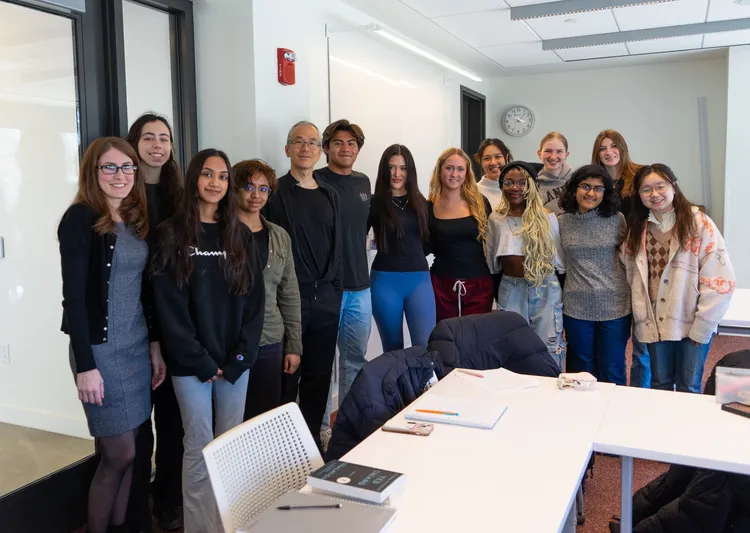
Group of people standing together in a classroom beside tables with notebooks and a whiteboard in the background

Chiang visits Dr. Naydan's first-year seminar, "Speculative Fiction: From Pygmalion to ChatGPT." Spring 2025. (Photo: Carrie Ruddick)

It's hard for me to imagine a scenario where AI helps writers do good work.

Do you envision scenarios where AI positively influences creative writing? What conditions do such possibilities require?

It's hard for me to imagine a scenario where AI helps writers do good work. Writing involves very little overhead; it's not like making a movie, where your budget determines what possibilities are available to you. You can write with a pencil and paper and do pretty much the same work as with a typewriter or a word processor. When you write, your medium is sentences, and I don't know what it would look like to have a technology that gives you greater control over sentences. Because of that, writing is relatively unaffected by advances in technology. This is also why I don't think the word processor has had a significant impact on creative writing; whatever changes we've seen in the novel over the last fifty years have probably been due to other cultural factors. I've read the claim that novels have gotten longer because of word processing, but I think even that has more to do with shifts in the publishing industry than with the increased ease of typing.

There might be certain creative possibilities opened up by explicitly using LLMs to write about LLMs, but I don't see that becoming a widespread practice. There's a form of visual art called scanography, which relies on the effects made possible by digital scanners. Without intending any insult, I think it's fair to say that scanography is a niche genre. I'd say that generative AI has comparable potential for creative writing.

Using ChatGPT to write your essays is like bringing a forklift into the weight room.

What advice do you have for college students who face the prospect of using generative AI in their studies?

Everyone should think carefully about using generative AI simply because the technology is built on environmental destruction, labor exploitation, and IP theft. College students should think extra carefully about it because, even if those other issues were magically resolved, using generative AI is largely incompatible with the purpose of education. In the talk I gave, I said, "When you’re a student at a university, you should think of yourself as an athlete in training, and the job you'll do after you graduate is the sport you will compete in. You don’t know specifically which sport you will play, and neither do your professors. What your professors do know is that strength training will help you. That’s what essay writing is; it’s strength training for the brain. Using ChatGPT to write your essays is like bringing a forklift into the weight room; you are never going to improve your cognitive fitness that way." Let me expand on that. Building strength requires exertion; if anyone offers you an exercise program that involves no exertion at all, you know it's not going to be effective. The improvements that come from doing cognitive exercise are not as rapid as those that come from physical exercise, but they are just as real. Writing an essay is hard because it forces you to use your brain in ways you haven't before, and that is precisely why it's useful. Your job is not to turn in completed assignments; it's to learn how to think. Turning in completed assignments can help you learn how to think, but only if you're the one who completed them.

Your job is not to turn in completed assignments; it's to learn how to think.
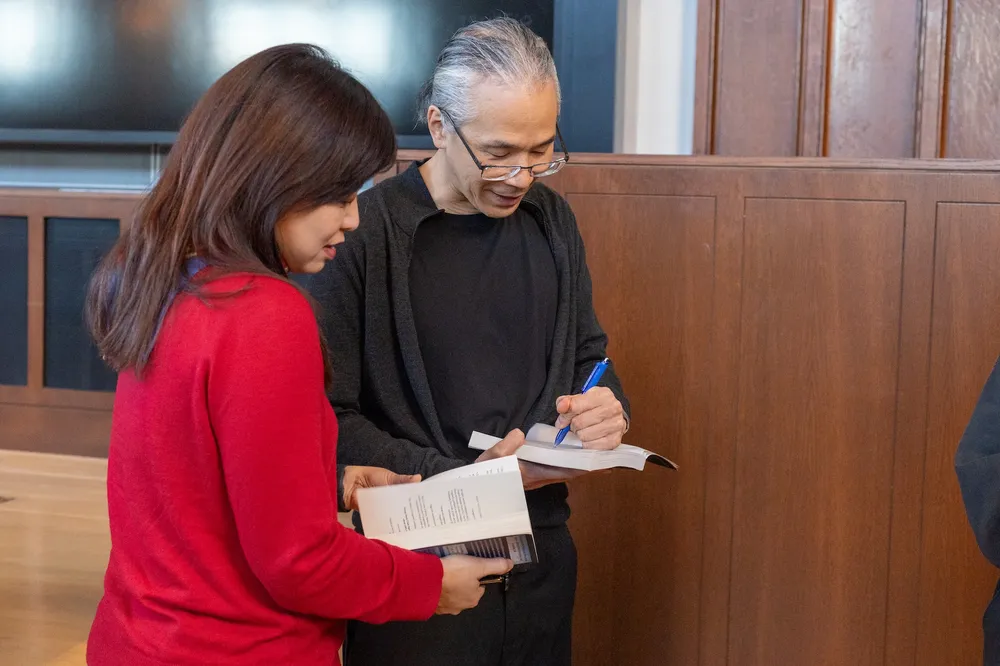
Person signing a book with a pen while another person holds an open copy beside them, standing indoors near a wood-paneled wall.

Chiang signing books at the end of the talk. March 2025. (Photo: Ali Nugent)

You ended your talk with a call for people to go out and create something meaningful to themselves or someone else. What is a creation you have read, seen, or experienced recently that has been meaningful to you?

The TV series ANDOR really impressed me. I don't particularly care about the STAR WARS universe; the only reason I tried this series was because Tony Gilroy was involved. In terms of craft, the series is a marvel; the dialogue, performances, production design, and music are all excellent. But completely separate from that, I think it's a remarkable depiction of what's involved in fighting fascism. Critics have said that one reason for the original STAR WARS' popularity was that, in the post-Vietnam era, it allowed Americans to feel good about themselves again by reminding them of "just wars" like the American Revolution or World War Two. What ANDOR does is more complicated and subversive. In the original movie, you could read the Empire as being a stand-in for Nazi Germany, but in ANDOR, it's hard for me to read the Empire as being anything other than a stand-in for the United States.
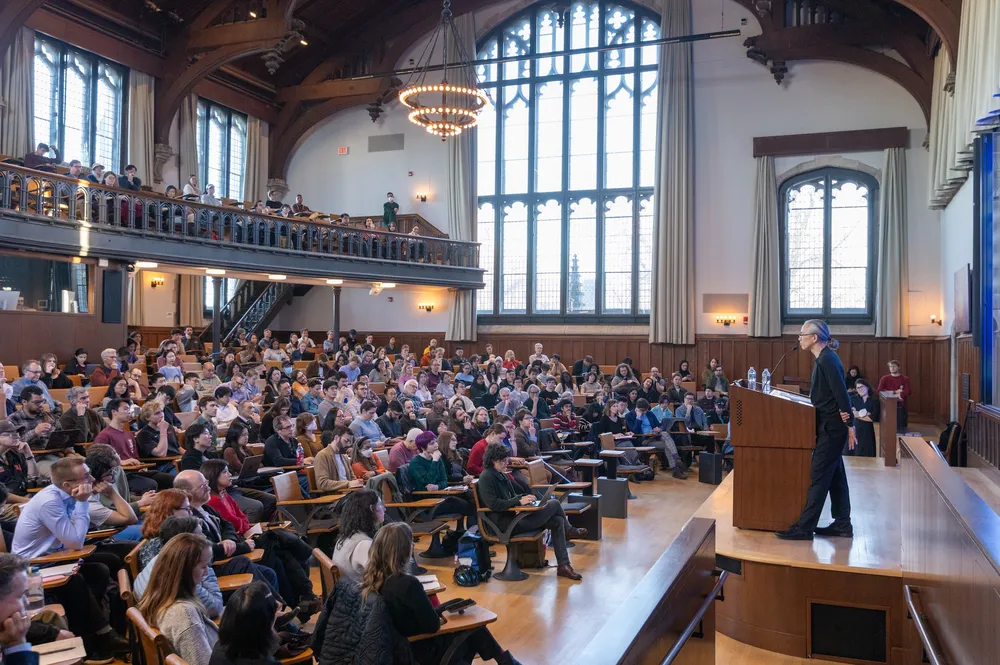
Speaker at a podium addressing a large audience seated in a grand, wood‑beamed lecture hall with tall arched windows and a balcony.

Chiang speaking to a packed McCosh Hall. March 2025. (Photo: Ali Nugent)

About Ted Chiang

Ted Chiang's fiction has won four Hugo Awards, four Nebula Awards, six Locus Awards, and the PEN/Malamud Award and has been reprinted in The Best American Short Stories. His first collection, Stories of Your Life and Others, has been translated into twenty-one languages, and the title story was the basis for the Oscar-nominated film Arrival. The New York Times chose his second collection, Exhalation, as one of the 10 Best Books of 2019. As a 2023 TIME100 Most Influential Person in AI, Chiang is described as “perhaps the world’s most celebrated living science-fiction author.”

Course
Teal graphic with abstract figures and a floating “Ask anything” search bar interface showing icons for search, reasoning, and image creation

Lecture

Stylized blue and yellow halftone portrait of a person wearing glasses, shown with horizontal scanlines and abstract background elements.