











Quick housekeeping note: I’ve added a lot of new dashboards and datasets for paying subscribers over the past few months—covering movies, music, TV, podcasts, and more—so I’ve launched a new directory to help browse the full collection. Check out the new Dashboards & Datasets directory here.
For the chronically online, the term “brain rot” is an affliction that defines our present moment: the product of a media ecosystem built on low-effort, hyper-stimulating content. Given the concept’s ever-growing relevance, I assumed its origin was also fairly recent—coined offhandedly by some BuzzFeed writer. But upon further research, I was surprised to learn that humanity’s struggle with “brain rot” dates back to the 19th century.
Published in 1854, Henry David Thoreau’s Walden includes a passage in which the author laments a society-wide softening of the mind. Ever the snob, Thoreau compares the public’s appetite for trivial ideas to an English potato blight: “While England endeavors to cure the potato-rot,” he asks, “will not any endeavor to cure the brain-rot, which prevails so much more widely and fatally?”
One hundred and seventy years later, Oxford named brain rot its 2024 Word of the Year, narrowly beating out demure and romantasy. Well done, Henry David Thoreau. The term’s usage exploded in 2023, as large language models went mainstream and AI-generated content flooded the internet, with the worst of this garbage commonly dismissed as “AI slop.” The brain rot of 1854 concerned cheap literature and carnivalesque entertainment; the brain rot of 2026 is something newer, faster, and unnervingly synthetic. And as AI slop spreads across beloved social media platforms, so too does this metaphorical rot.
So today, we’ll investigate the prevalence of AI slop in modern media and the economic incentives that may help tame its spread.
OpenAI launched ChatGPT on November 30, 2022. Prior to this milestone, the world’s understanding of machine intelligence was limited to AOL Instant Messenger bots, Microsoft’s Clippy, and 2001: A Space Odyssey. OpenAI’s major breakthrough was not simply building a powerful large language model, but making the technology accessible through a conversational interface. This overly agreeable bot could answer follow-up questions, admit mistakes, challenge faulty assumptions, and write a limerick about my dad’s favorite baseball player in the style of Dr. Seuss.
ChatGPT adeptly mimicked literature and speech, enabling its users to outsource one of humanity’s most annoying obligations: creating meaning by sequencing words into sentences, and then arranging those sentences into paragraphs.
Four years later, it appears human expression (or, rather, synthetic human expression) should require some additional friction.
According to a longitudinal study from the growth marketing agency Graphite, nearly half of newly published digital content appears to be AI-generated.
This chart comes with two caveats:
Graphite advertises itself as an AI-powered SEO agency, so its bleak portrait of content decay also supports its core business. Gross!
This graph would probably look different if weighted by web traffic—because human-created work still accounts for an outsized share of what people actually read.
Even if this chart is off by a factor of two, the underlying trend remains alarming.
This chart belongs to a canonical genre of data visualization, which I like to call “ChatGPT launched, and then a line goes up and to the right.”
Take literature, for example, where monthly Amazon e-book releases nearly tripled following ChatGPT’s introduction, a trend that roughly corroborates the Graphite study.
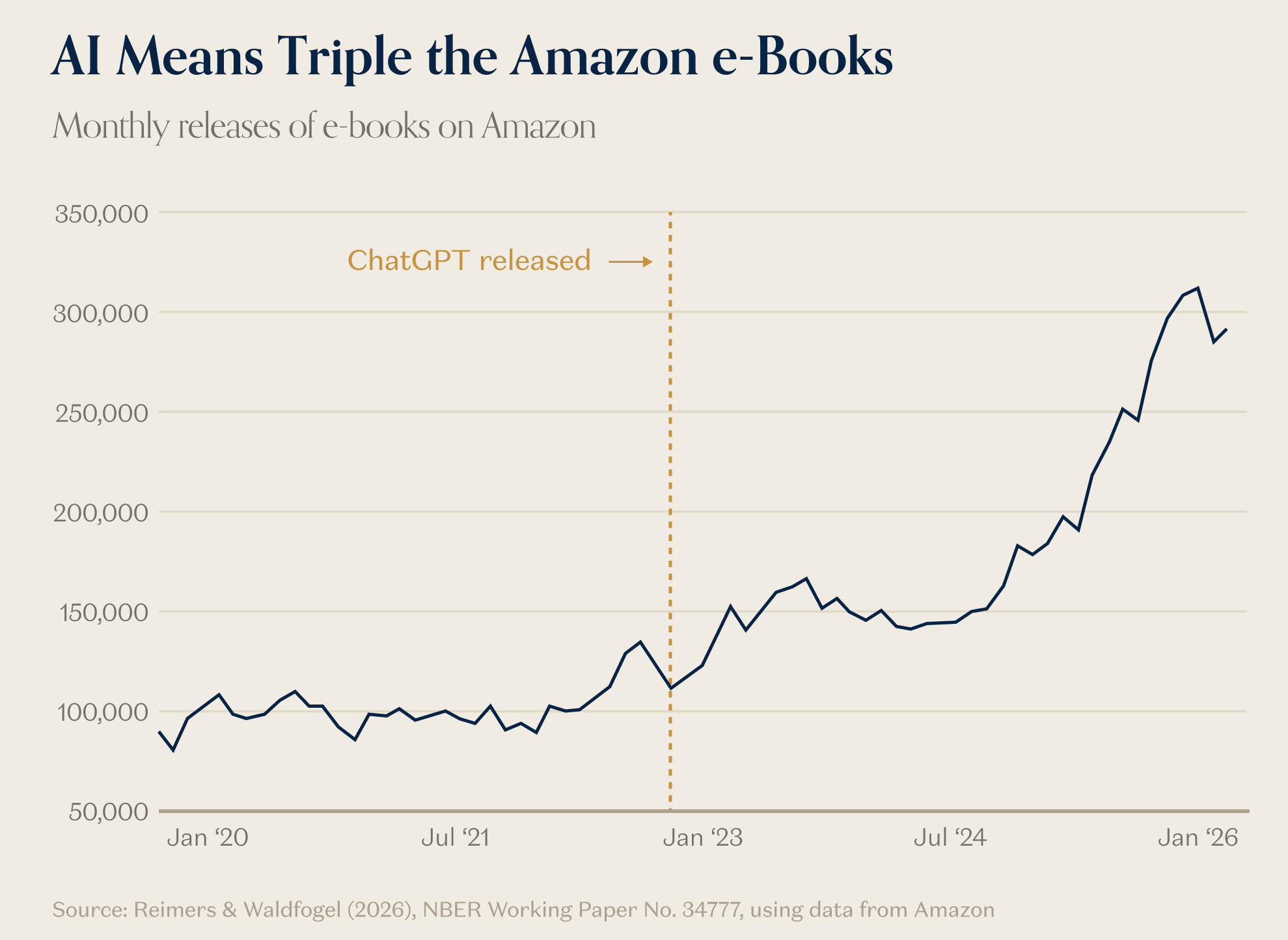
The reach of AI-produced text extends well beyond amateur authors peddling slop or SEO bloggers gaming search algorithms. Academia, a field tasked with expanding the boundaries of human knowledge, has also embraced machine intelligence. One Nature analysis measured the growing ratio of rejected to accepted scientific papers, offering another example of an LLM-induced supply shock: as writing becomes easier, submissions rise, and rejection rates follow. Here again, we see the same basic pattern—a near-tripling of productivity.
While the sheer volume of AI-generated text is concerning, it’s hard to tell how many of these synthetic articles, e-books, or papers are actually being consumed.
The same cannot be said of algorithmic social media feeds, where transitory engagement can snowball into widespread virality. According to a comprehensive study from video production firms Kapwing and NeoMam Studios, around 33% of all YouTube short-form videos qualify as brain rot (nonsensical, low-quality, but not necessarily AI-generated), while 21% are ostensibly AI-created.
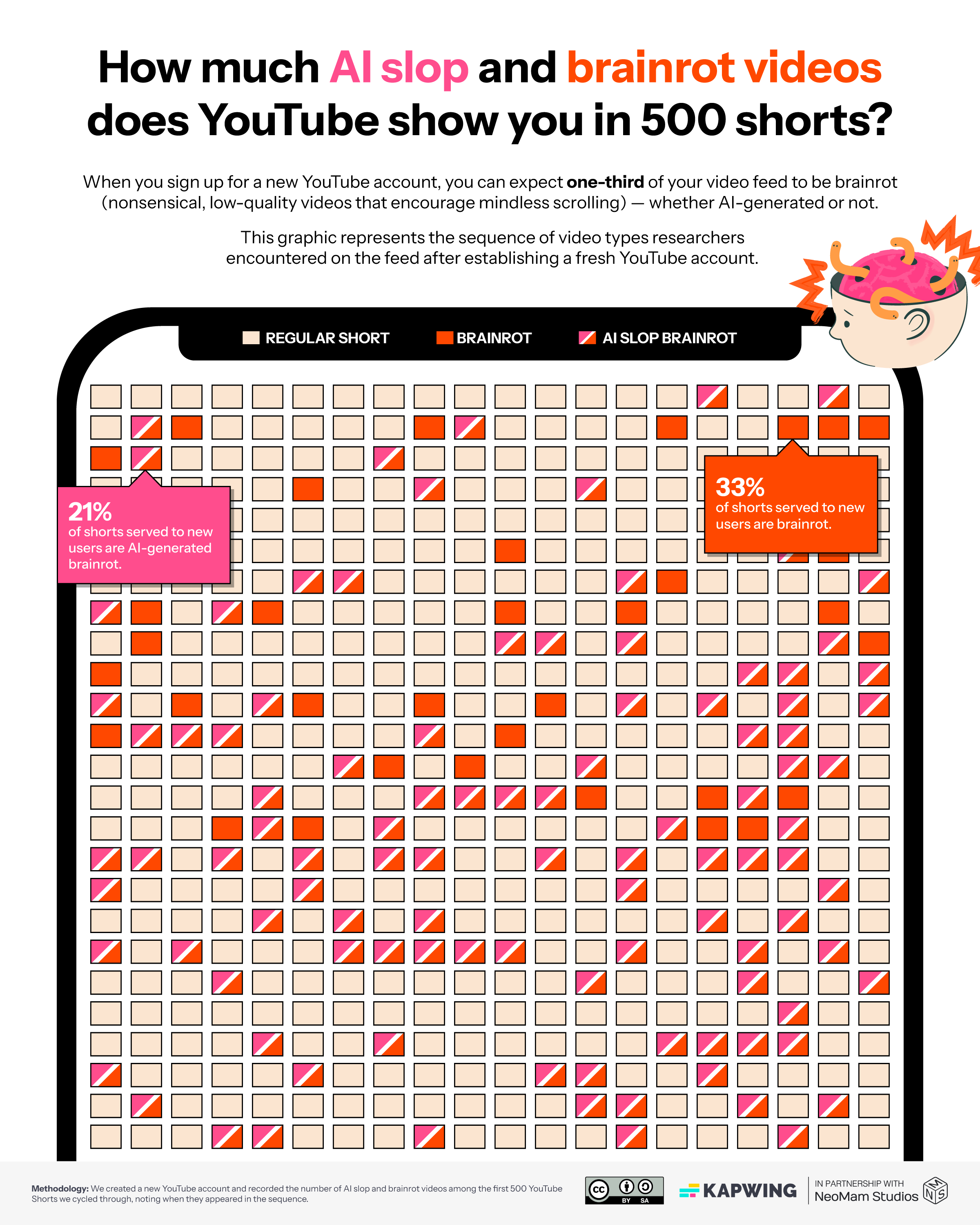
This figure likely reflects the prevalence of slop across all short-form video platforms (including TikTok and Instagram), since these services have essentially converged on the same app design via ruthless copying.
At first glance, this study offers a glimpse into a post-truth media doom loop: Users fall prey to AI slop; social media platforms benefit from increased engagement, which, in turn, begets more slop. Ten years from now, every piece of online video content will be entirely synthetic, and digital life will be completely disconnected from our lived reality.
And that may well be true, though I have hope, and this hope comes in the form of an unlikely pro-truth ally: advertisers. Yes, as in the corporate marketers who gave us the GEICO gecko, Jake from State Farm, and Jared from Subway.
According to the same YouTube Shorts study, this nascent economy of video slop-spamming is already quite lucrative, with some channels collecting up to $4M in annual advertising revenue.
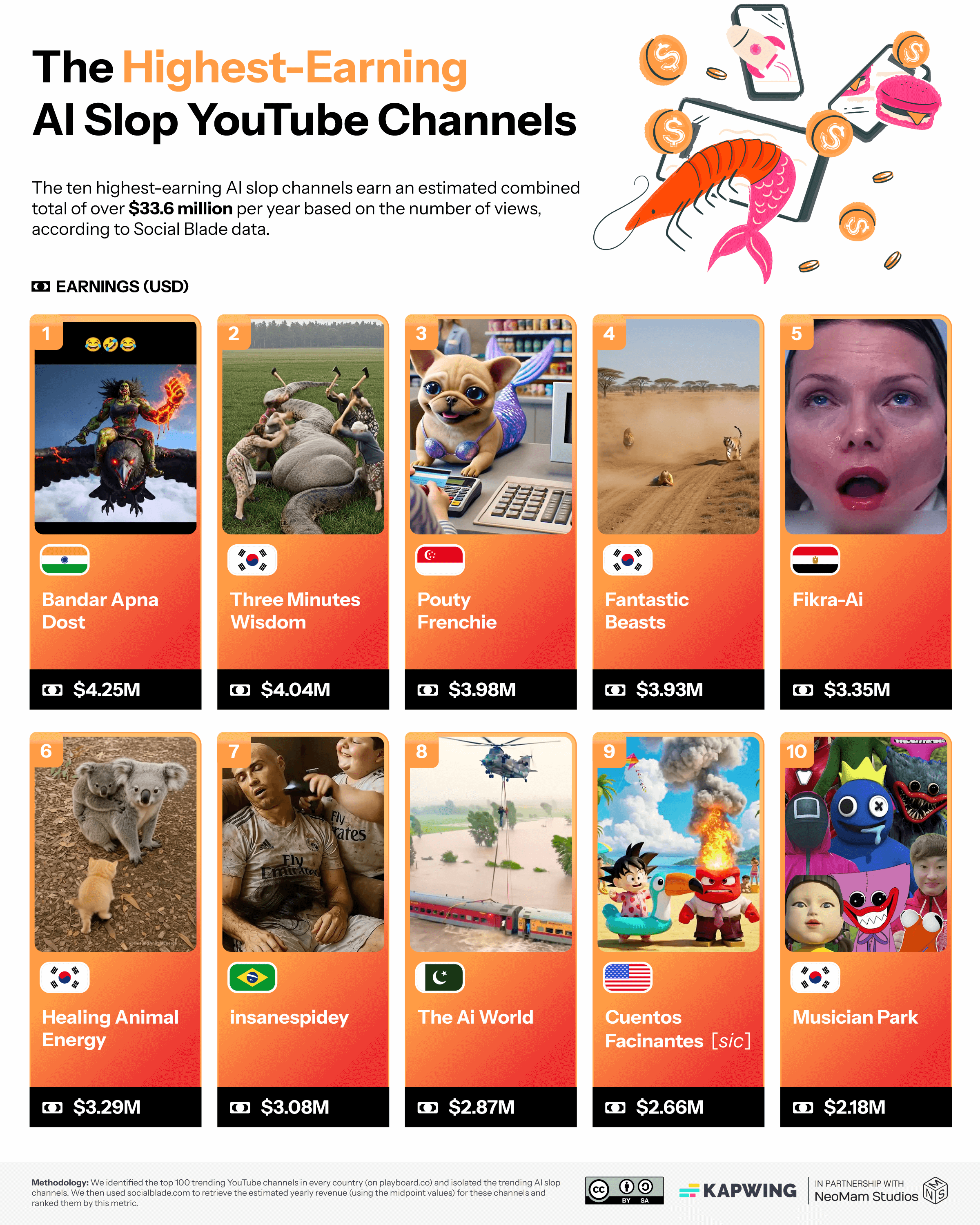
How could any of this be a good thing? If people are making millions of dollars from synthetically generated video, won’t that simply lead to more brain rot? Probably.
But these figures also mean that major advertisers like State Farm, GEICO, and Subway have allocated precious ad dollars to videos featuring seven-fingered humans and Komodo Dragons speaking Portuguese. At some point, these advertisers will require their promotions to air alongside non-GMO short-form video content.
A recent Digiday report captured this highly specific marketing anxiety: slop websites are increasingly appearing in programmatic ad networks, placing major brands alongside low-quality, AI-generated spam.
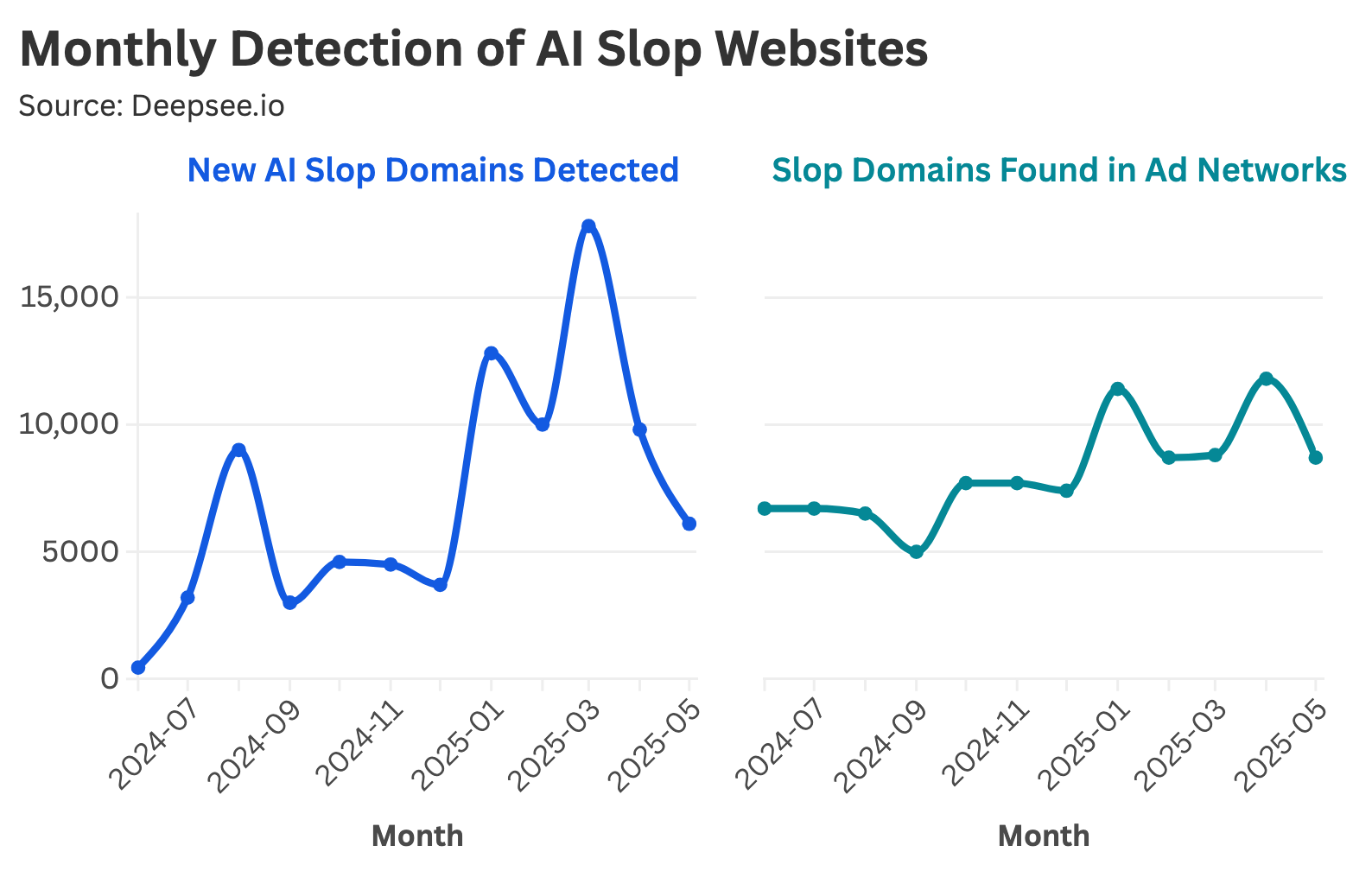
To be clear, I have little sympathy for programmatic ad buyers. But their demand for ROI and positive brand association does create an economic incentive for platforms to verify the humanity of larger accounts. Perhaps corporate marketers will induce some semblance of quality control, if not for consumers, then at least for the advertisers paying to reach them.

If left unchecked, substandard product quality can do more than damage a single company; it can undermine faith in an entire medium. Consider the video game market of the early 1980s, a fledgling industry that tested the limits of consumer tolerance.
In the 1970s, Atari brought video gaming to the mainstream, starting with arcade games and later transitioning to consumer hardware. Atari’s overnight success opened the door to a chaotic wave of third-party development, as its consoles were flooded with low-effort games from opportunistic publishers like Quaker Oats, Purina, Johnson & Johnson, and Kool-Aid. Soon, the Atari ecosystem became a dumping ground for rushed movie tie-ins, barely functional curiosities, and low-grade cash grabs. It was during this period that the term “shovelware” emerged, which, in many ways, was the 1980s gaming equivalent of brain rot: cheap, low-effort entertainment that eroded trust in the platform.
The most infamous Atari disaster was an E.T. the Extra-Terrestrial game developed in just a few weeks for the holiday season. The game sold so poorly that Atari buried truckloads of unsold inventory in a landfill in New Mexico.
By 1984, the North American console market collapsed, and Atari was sold off by its corporate overseer, setting the company on a path toward dissolution just five years later. Nintendo later revived the gaming industry by implementing strict quality standards for third-party developers, as evidenced by its “Nintendo Seal of Quality.”
Contained within this single parable is both a cautionary tale about the hazards of subpar quality control and a solution to widespread slop-ification. The medium may be different, but the principles of a functional consumer marketplace remain the same—whether the product is video games or social media feeds.
After 35 years of chaotic expansion, the internet still runs on two basic business models: direct payment (through purchases and subscriptions) and advertising. In both cases, low-effort products may flourish briefly, but they rarely win out in the long term. Consumers can only be tricked into purchasing low-grade spam so many times, and advertisers will eventually pull spending if their offerings are marketed alongside shrimp-Jesus hallucinations and an incoherent cat telenovela where the characters speak a nonexistent language.
Which brings us to the concept of Maximum Allowable Slop (MAS), a term I just coined and one that will hopefully be my great contribution to the internet. Platforms like YouTube and Instagram will never fully eliminate AI garbage; the genie is out of the bottle. However, there exists a hypothetical tipping point of slop pervasiveness at which users lose interest, advertisers lose confidence, and platforms begin to lose money. Social media sites will have to do everything they can to stay below that threshold.
To return to Henry David Thoreau’s 170-year-old question, “Will not any endeavor to cure the brain-rot?”—the answer, surprisingly, may be the free market. In the end, TikTok and YouTube will be forced to regulate their own ecosystems to ensure humanity does not exceed the maximum tolerable dose of brain rot. Which sounds like an exceptionally mediocre utopia.
Become a paying subscriber for interactive dashboards, free datasets, and to support independent journalism.
The Stat Significant Dataset Hub (Updated Weekly): a collection of free datasets across movies, music, TV, and economics.
Interactive Data Hubs:
Streaming TV: what people are watching on television.
Movies: the films watched in theaters and on TV, plus historical trends.
Music: the songs, artists, and styles dominating Spotify and TikTok.
Social Media: what’s trending on Google, Reddit, TikTok, and YouTube.
Wikipedia: the top pages trending on Wikipedia.
*Note: For best results, open this link in a web browser while logged in to your Substack account.
This post is public so feel free to share it.
Want to promote your data tool or media publication to Stat Significant’s 25,800 readers? Email daniel@statsignificant.com
Need help with a data problem? Book a free data consultation
Connect with me on LinkedIn if you want to chat about a data project.
Like movies? Follow me on Letterboxd