






My six-year-old is at that stage of his life where he tries to find words which rhyme. As I was thinking about this post, I blurted out, “History rhymes”.
He asked, “Rhymes with what?”
I said “It rhymes with history.”
He said, unimpressed, “Dad. That’s the same word.”
I leant back on my chair, took a deep breath and sighed, “Son, that is the travesty of it”.
Irked, he replied “Tra-ves-ty? That does not rhyme either!”
It is May 24, 1844. Alfred Vail taps out a message and sends it sixty miles down copper wire. Samuel Morse receives it and taps the same words back: “What hath God wrought”. Prior to this, the invention of telegraph, the fastest a message could travel was the speed of a horse.
Western Union strung telegraph wire across an entire continent. Its valuation grew from $385,000 in 1858 to $41 million by 1876. To put that in perspective: when the U.S. government bought the entire territory of Alaska from Russia in 1867, it cost $7.2 million. Within a decade, Western Union was worth nearly six Alaskas. The press crowned it the inevitable master of the age.
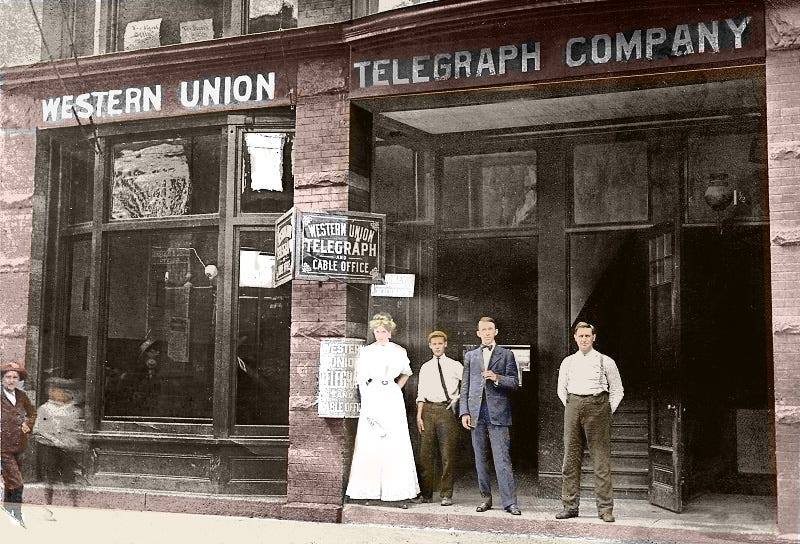
And yet. For every $1 of value created by Western Union, the businesses that used those telegraph wires created roughly $50. Railroads coordinated schedules across thousands of miles. Brokers routed orders to the NYSE. The Associated Press was born to fill those wires with words and sell them to a news-hungry nation.
Western Union built the miracle. Everyone else cashed in on it.
But the very railroads that made Western Union rich were about to play the same subordinate role for someone else.
Railroad stocks and bonds totaled $2.5 billion in 1871. By the early 1900s, $20 billion. The press crowned railroads the inevitable masters of the age.
Then a former bookkeeper from Cleveland looked at the tracks and saw something different.
John D. Rockefeller was not interested in laying iron rail; he was interested in the leverage of what moved along it. He negotiated railroad shipping rates so aggressively, that his competitors could not match his prices even if their refineries were inherently more efficient. By 1890, Standard Oil’s assets exceeded $100 million. By 1912, it became the first company in history valued at over $1 billion, when the entire stock market was worth $16 billion.
The telegraph was infrastructure; the railroad exploited it. The railroad was infrastructure; Standard Oil exploited it. History doesn’t repeat. But God, does it rhyme.
But the chain didn’t stop at Standard Oil. It seldom does.
Standard Oil built the massive distribution network of refineries, pipelines, and storage tanks. That fuel distribution network became the infrastructure that allowed the automobile industry to scale. Ford and GM became the giants of the next era. The highways built to move those cars became the infrastructure for an entirely new economy: McDonald’s at every exit ramp, Walmart in every mid-size town, FedEx connecting it all overnight. None of them built the highways. They just understood them better than anyone else.
Many winners eventually became the next era’s infrastructure, often without realizing it. And at each turn, the press was busy crowning the current winner the inevitable master of the age.
AOL reached $222 billion in 1999, the 4th largest company in the United States, behind only Microsoft, GE, and Cisco. The AOL-Time Warner merger closed at $350 billion, the largest deal in history at that point. Whoever owns the pipe owns the century, they said. The pipe became a commodity. Google is worth $4 trillion. Amazon approaches $3 trillion. AT&T, Verizon, and Comcast combined: $400 billion. Less than a tenth of what was built on top of their pipes.
This time, the infrastructure builders seemed to have read the history. Google, Microsoft and Amazon climbed the stack deliberately, capturing enormous value not just as pipe-layers but as application builders. AWS, Azure, and Google Cloud together generate over a quarter-trillion dollars a year, growing at 18-30% annually. It looked like they had finally cracked it, infrastructure that also captured the application layer.
And yet. Google had DeepMind. It had the best AI researchers in the world. Google researchers published the Transformer architecture in 2017. All the ingredients were there.
Instead, two hyper-focused startups moved fastest. As of mid-2026, Anthropic’s annualized revenue run rate has crossed $47 billion, and OpenAI’s stands at roughly $33 billion. Both numbers are moving so fast that they may already be out of date by the time you read this. They are barely five years old, growing faster than the cloud ever did.
The model makers also seem to be learning from history and climbing up the stack. But like we saw with the cloud providers, even when you know the history and act deliberately, surprises still emerge. Time and again, infrastructure builders have enabled others to create enormous value on top of their platforms.
The innovator’s dilemma may be less a law of business than a recurring temptation.
Today, the press is crowning the model makers the inevitable masters of this age. The question everyone is asking: who will win AI? This is probably the wrong question. It assumes the chain stops here. But history suggests it never has.
The right question probably is: what is AI enabling that we cannot yet see? Who is going to use OpenAI and Anthropic the way they used AWS and Azure’s compute? What company is sitting quietly right now, seeing these models the way Rockefeller saw the railroad, not as the prize, but as the lever? We don’t know yet. What we do know is that OpenAI, Anthropic, and Google are aware of the history. They are building models, and cautiously extending into applications. But their primary bet is still on the model layer. History suggests the biggest winner may not be any of them. It will be whoever picks up these models and does to an industry what Rockefeller did to oil. But rarely have the incumbents been this aware of the trap or this well armed to escape it.
The jury is still out.
My son recently pointed out that mystery rhymes with history. He’s right. It does. I’ll let him figure out what rhymes with future.
Maybe you can help.