


Connect servers
Connect to self-hosted machines, VPS instances, cloud VMs, or clusters over SSH.





A local-first AI native 1 file PaaS.Start with one file, then deploy static sites, local projects, Git repos, Docker, and Compose apps. Click through yourself, or let agents use MCP / skill.
Blueprint marketplace
Start with these common apps, or browse more official Blueprints in the marketplace.

Self-host OpenClaw with provider keys and optional Ollama.
Small Supabase-style backend with Postgres.
Workflow automation service with Postgres-backed state.
Planned connectorsComing soon
These connectors cover team notifications, DNS and edge routing, repository events, and error monitoring so deploy context stays on the same Appaloft path.
Coming soon
Coming soon
Deploy notices
Approval nudges
Failure summaries
Status
Coming soon
Surface
Channels
Events
Deploys
CLI
Install the appaloft command, then deploy, check status, and roll back from your local terminal. No Appaloft backend or Docker setup is required just to start from the CLI.
appaloft deploy
Install the CLI
$ brew install appaloft/tap/appaloft
Works on macOS and Linux. The desktop app is available with brew install --cask appaloft/tap/appaloft-desktop.
$ appaloft deploy
🔎 detect  package.json / Dockerfile / compose.yaml
🧭 plan    web:3000 + worker + postgres
🚀 run     upload -> build -> start
✅ verify  HTTPS, health, activity
🌐 done    live URL ready
MCP
MCP is Appaloft's formal tool transport. Connect through the hosted Appaloft Cloud control plane, or run a local MCP entrypoint on your own machine or self-hosted control plane.
Both modes reuse the same Appaloft operation catalog. Cloud adds sign-in, team permissions, and audit; local mode stays close to the CLI profile, environment, and self-hosted endpoint on your machine.
Log in once, then the agent uses Appaloft Cloud with your team permissions. Best for team projects, Blueprint installs, audit, and the remote control plane.
For Codex CLI and Codex Desktop. Restart Codex after install to load the Appaloft tools.
appaloft auth mcp login
appaloft auth mcp codex install
GitHub integration
A GitHub Action can call the deploy path after code changes. GitHub App integration handles repository authorization, environment selection, and deploy status updates.
GitHub Action
name: appaloft-deploy
on:
  push:
    branches: [main]
jobs:
  deploy:
    runs-on: ubuntu-latest
    steps:
      - uses: actions/checkout@v4
      - uses: appaloft/deploy-action@v1
        with:
          server: ${{ secrets.APPALOFT_SERVER }}
          token: ${{ secrets.APPALOFT_TOKEN }}
GitHub App
Repo install
Environment
Status check
Core capabilities
Connect servers, define resources, bind dependencies, deploy, and check health from the same console.
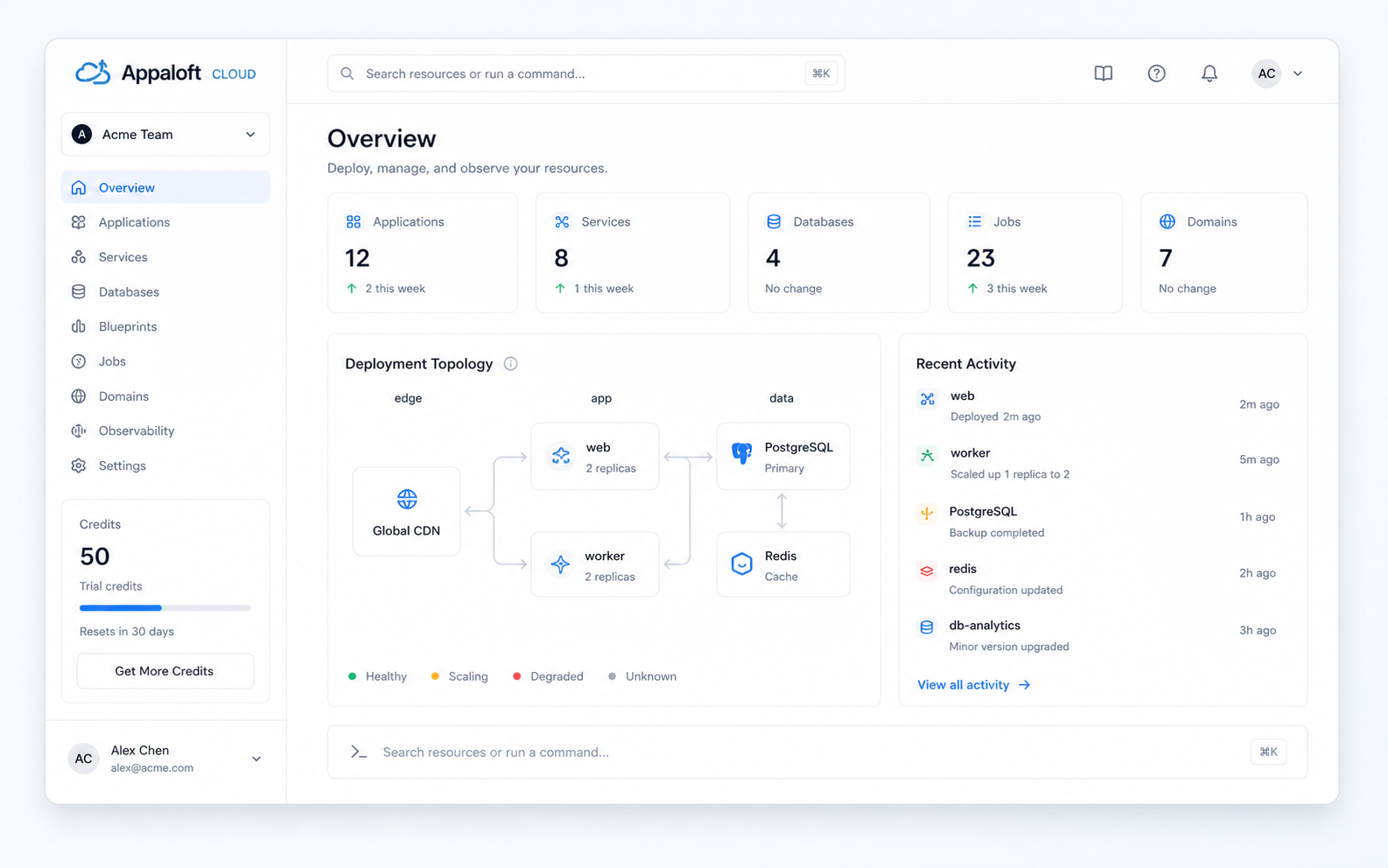
Connect to self-hosted machines, VPS instances, cloud VMs, or clusters over SSH.
Declare Web, Worker, Cron, and Job resources with runtime options and ports.
Attach databases, caches, and storage through Resource Bindings.
Deploy through one path with tracked changes and rollback. Successful deploys only.
Manage domains, HTTPS, health checks, alerts, and recent activity.
Pricing
Appaloft Cloud subscriptions are applied to the current organization. Collaborators are not the main billing axis; capacity is based on servers and static storage.
Free is limited to 1 hosted static site. Paid plans include unlimited hosted static sites and control capacity through publish size, file count, and retained storage.
Add servers or retained static storage monthly.
AI skill
Run this command in your terminal. Back in your editor, ask AI to deploy the current repo. The live URL and logs come back in chat.
Terminal command
$ npx skills add appaloft/appaloftWorks with AI hosts that support skills.
此内容由惯性聚合(RSS阅读器)自动聚合整理,仅供阅读参考。 原文来自 — 版权归原作者所有。