










Nithin Coca

 Getty Images
A decision made 70 years ago to reforest vast swathes of Japan with just two kinds of tree has come back to haunt the country.
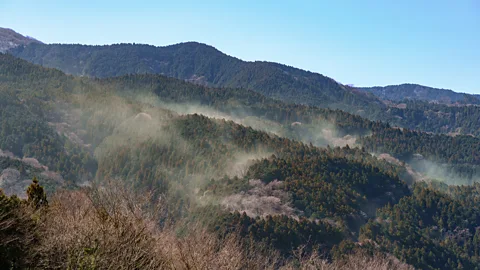
In February, videos showing what looked like waves of smoke blowing off an evergreen forest went viral in Japan. It wasn't smoke – it was pollen, and the videos were a warning to tens of millions of residents of the archipelago nation: prepare your masks and allergy medicine.
Every spring (which is already arriving earlier in Japan due to climate change) you'll see people of all ages wearing masks on the streets of cities across the country. The reason: hay fever, driven by all the pollen.
Pollen allergies have become a national health issue in Japan – Noriko Sato
As well as the discomfort, these allergies can lead to sleep loss and poor concentration, and sufferers are more likely to experience other conditions such as asthma and food allergies. At the peak of Japan's hay fever season, the economic impact from both sick days and lower consumer spending is estimated at $1.6bn (£1.2bn) per day.
So why does Japan have such bad allergies? The reason has little to do with poor health or pollution, or even the natural environment, but decisions made by leaders more than 70 years ago in the decades after World War Two.
An overlooked crisis
During the war, oil and gas shortages led Japan to turn to the nation's most abundant natural resource – forests – as a source of fuel for home and industry. The result was widespread deforestation of natural forests, with the mountains around major cities like Tokyo, Osaka and Kobe completely stripped bare of trees.
"After World War Two, many of Japan's mountains became barren, causing disasters in various regions," says Noriko Sato, a professor and forestry researcher at Kyushu University in Fukuoka, Japan. (Bare mountains can increase the incidence of landslides and flooding). "Large-scale afforestation was carried out by public works, funded by tax revenues, to prevent soil erosion."
Aiming for rapid reforestation, the government chose to plant reams of only two different native, fast-growing evergreen species that could quickly reforest landscapes and provide wood for future use in construction: the Japanese cedar, sugi, and the Japanese cypress, hinoki.
 Getty Images
The problem is, sugi and hinoki trees also produce large amounts of lightweight pollen which can easily drift into cities. It's this pollen, often released all at once from the monoculture plantations, that is responsible for most seasonal allergies in Japan. The issue has become all the worse since these trees release ever more pollen after maturing at 30 years of age – now the case for nearly all of them.
"Pollen allergies have become a national health issue in Japan," says Sato. "Addressing this problem is urgent."
In 2023, Japan declared allergies a national social problem and the central government set out an ambitious plan – reduce pollen by 50% in 30 years. As a first step, it aims to reduce the forest areas covered with high-pollen sugi trees by 20% by 2033.
But swapping out forests covering over 2% of Japan in 10 years is a massive endeavour. Plus, simply cutting these trees down won't be enough – they also need to be replaced with new forests to avoid soil erosion or accidentally undercutting Japan's own climate targets.
Return to life
Walking through sugi or hinoki plantation forests is eerie – all the trees are the same height and there are few birds or insects. The ground is spongy with dry needles, and there's little light or sound.
Across Japan, forests can be found right by cities. Japanese even has a word for the transition area between city and forest: satoyama.
 Alamy
Alamy
Still, even before the 2023 government declaration, some local actors and non-profits had begun efforts to turn these forests into biodiverse ecosystems, and some are already seeing the benefits. The small town of Nishiawakura, Okayama, for example, has created an entire economy around reducing the 84% of its forests made up only of hinoki and sugi, turning wood into heat for eel farms as well as chopsticks and timber.
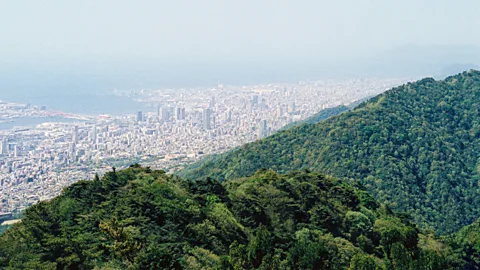
In 2020, Kobe, a larger port city in central Japan with a dense urban core and vast forests within its city limits, began an effort to turn more than 180 hectares (445 acres) of plantation back into natural broadleaf forests in a 15-year cycle.
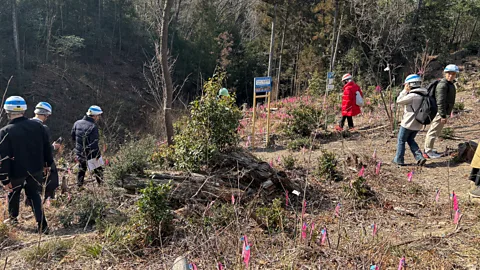
Every year, an area is selectively clear-cut, removing sugi, hinoki but also other invasive species like bamboo. Broadleaf trees are left, and with more sun coming through to the ground, they grow back, along with other new seedlings either planted by staff or brought by birds or animals.
With its scheme now about halfway done, local government workers say they have been pleasantly surprised by how quickly biodiversity has returned.
"Our wildlife monitoring is showing more animals and insects returning, including badgers, pond turtles, many species of frogs, and rare insects too, which is encouraging," says Atsushi Okada, head of the Kobe City Environmental Bureau.
As well as addressing the pollen issue, the scheme aims to fulfil the Kobe's pledge to increase its protected areas to 30% of all land by 2030. More diverse forests should also protect the city against the landslides and natural disasters poised to become more frequent due to climate change, says Daisuke Tochimoto, a forester with the City of Kobe.
As for the cut trees, they are used for heating, furniture production and Japanese white charcoal, a smoke-free barbeque fuel which could also be used in industrial processes. The hope is that, over time, the project can become financially sustainable and not reliant on public funds, says Okada.
An epic challenge
Similar projects are beginning in other parts of Japan. One project in Hotani, Osaka, is now restoring wetlands and grasslands. And the largest effort aims to turn 10,000 hectares (25,000 acres) of plantation forests in Gunma prefecture to meadows and mixed deciduous woodland.
 City of Kobe
Smaller-scale projects are also common, says Akira Mori, a professor of biodiversity and ecosystem services at the University of Tokyo, pointing to dozens of initiatives around Japan.
Since the goal of removing 20% of the high-pollen sugi plantations was announced, the country has designated approximately 980,000 hectares (2.4 million acres) of sugi plantation forests as areas for focused logging and replanting. Still, not all of this is being turned into broadleaf forests: some of it is fresh plantations, often planted with low-pollen or pollen free sugi.
Japan's ministry of agriculture, forestry and fisheries tells the BBC it plans to track the progress toward its targets for the reduction of high-pollen sugi-planted forests, but did not provide any numbers on progress so far.
And even if it achieves the goal, 80% of the plantation forests will remain. So Japan is also trying other ways to tackle hay fever.
Pollen data and forecasts, for example, are being used to better understand of where dispersion is likely, allowing authorities to selectively cut down the worst offending forests, and researchers are even looking at spraying trees with solutions to suppress pollen. In 2023, one forecasting company distributed thousands of pollen-detecting robots – whose eyes go different colours depending on pollen levels – across Japan.
A careful transition
 FPCJ
FPCJ
In 2011, though, Japan set a goal of relying less on forestry imports, and has seen its domestic wood use grow from 26% in 2010 to nearly 42% in 2020. Japan's forestry ministry says promoting the growing demand for sugi wood is another countermeasure it is taking against pollen sources, alongside improving its forestry productivity and workforce.
Of course, if Japan is going to exploit its forests, it has to avoid the same mistakes made in Southeast Asia, where cheap wood means the clear-cutting of tropical forests. Junichi Mishiba, forest project coordinator at the non-profit Friends of the Earth Japan, worries that more incentives to cut down trees is leading to bad environmental practices. "There is an increase in clear-cut areas resulting from policies promoting harvesting," he says.
Data on its impact is not yet available, but Mori argues the support is not enough, with municipalities often lacking the capacity and expertise to design and monitor such changes to forests. A 2023 report by the Forest Declaration Assessment noted that in recent years, only 30-40% of Japan's newly harvested land has been replanted.
Japan's forestry ministry says that it has since improved its methodology on how it calculates this harvesting area, and now calculates the figure to be approximately 50-60%.
Good forest management will be essential, agrees Mika Akesaka, an associate professor of economics at Kobe University. Leaving felled trees unmanaged, for example, can increase landslide risk and reduce water retention capacity, she says.
Mishiba, though, fears that by focusing only on seasonal allergies rather than wider ecological indicators, Japan is once again prioritising short-term solutions. The country needs to think 50 or even 100 years ahead, he says, considering biodiversity, climate and the role of the people who will live alongside these forests.
Japan's forestry ministry tells the BBC its forest planning system "requires that forest management be carried out with due consideration for the multiple functions of forests", therefore "no harm to the performance of [these forest] functions will be done by this policy initiative".
Climate threat
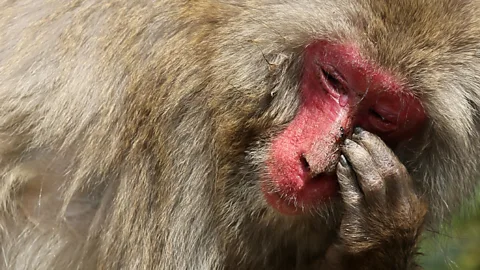
Urgency to act is also growing because of another unplanned factor – climate change. Around the world, temperature and weather shifts are impacting pollen spread and Japan saw its earliest pollen dispersal ever in 2025.
 Getty Images
"Pollen dispersal is greatly influenced by weather conditions such as temperature and wind," says Mai Sato, a spokesperson with the Japan Weather Association (JWA), a forecasting company which releases regular pollen forecasts to the public.
More like this:
Still, since 2004 Japan has seen a declining trend in the yearly amount being absorbed which it attributes to the maturity of its forests. Research has shown that since ageing trees absorb less carbon, thinning forests of old trees and planting new, younger and more diverse species will be essential to keeping Japan's forests an effective carbon sink.
Japan's forestry ministry says it is thoroughly replanting sites where sugi forests have been harvested with low-pollen cedar seedlings or other tree species. "Through this, we will continue to sustainably demonstrate the multiple functions of forests, including their role as a carbon sink, and contribute to Japan's climate targets," it says.
Before the 1960s, Japan didn't even have a word for hay fever. Japanese cedar pollinosis was first identified in 1963 and, according to researchers at the time, was new to the country. The hope is that with the return of more natural, diverse forests, Japan can one day go back to enjoying its springs – without the sneezes.
--
*This article was updated with a response from Japan's ministry of agriculture, forestry and fisheries on 20/5/26.