


惯性聚合 高效追踪和阅读你感兴趣的博客、新闻、科技资讯
阅读原文 在惯性聚合中打开

推荐订阅源

GbyAI
GbyAI
博客园 - 三生石上(FineUI控件)
罗磊的独立博客
P
Proofpoint News Feed
博客园_首页
Threat Intelligence Blog | Flashpoint
D
Darknet – Hacking Tools, Hacker News & Cyber Security
月光博客
月光博客
L
LINUX DO - 热门话题
C
CERT Recently Published Vulnerability Notes
H
Hacker News: Front Page
让小产品的独立变现更简单 - ezindie.com
Cyber Security Advisories - MS-ISAC
G
Google Developers Blog
博客园 - 【当耐特】
C
Cisco Blogs
博客园 - 叶小钗
Apple Machine Learning Research
T
Tor Project blog
C
CXSECURITY Database RSS Feed - CXSecurity.com
The Last Watchdog
The Last Watchdog
腾讯CDC
P
Palo Alto Networks Blog
F
Full Disclosure
S
SegmentFault 最新的问题
Simon Willison's Weblog
C
Cyber Attacks, Cyber Crime and Cyber Security
Recent Announcements
P
Privacy & Cybersecurity Law Blog
Security Archives - TechRepublic
PCI Perspectives
PCI Perspectives
A
About on SuperTechFans
www.infosecurity-magazine.com
The Register - Security
IT之家
IT之家
人人都是产品经理
人人都是产品经理
博客园 - 司徒正美
T
Tailwind CSS Blog
OSCHINA 社区最新新闻
OSCHINA 社区最新新闻
I
InfoQ
Webroot Blog
Webroot Blog
S
Security Affairs
T
The Blog of Author Tim Ferriss
T
Threat Research - Cisco Blogs
量子位
Hugging Face - Blog
Hugging Face - Blog
F
Fortinet All Blogs
美团技术团队
Cyberwarzone
Cyberwarzone
CTFtime.org: upcoming CTF events

Cheriton School of Computer Science

Cheriton students receive the Queen Elizabeth II Graduate Scholarship in Science and Technology | Cheriton School of Computer Science | University of Waterloo Pascal Poupart awarded $170k NSERC Alliance Grant to develop an agentic system to automate internal workflows | Cheriton School of Computer Science | University of Waterloo Computer science students receive Ontario Graduate Scholarships | Cheriton School of Computer Science | University of Waterloo A wide web of words | Cheriton School of Computer Science | University of Waterloo Q&A with Professor Dan Brown: Exploring societal, ethical and legal questions surrounding generative AI | Cheriton School of Computer Science | University of Waterloo Waterloo computer scientists receive more than $1.3M in federal funding | Cheriton School of Computer Science | University of Waterloo Ahmed Alquraan wins 2026 Cheriton Distinguished Dissertation Award | Cheriton School of Computer Science | University of Waterloo Technovation Girls Waterloo celebrates two milestones | Cheriton School of Computer Science | University of Waterloo Dave Tompkins receives 2026 Faculty of Mathematics Award for Distinction in Teaching | Cheriton School of Computer Science | University of Waterloo Victor Zhong, Jimmy Lin awarded $1.64M NSERC Alliance grant to develop deep research agents for natural science research and development | Cheriton School of Computer Science | University of Waterloo Computer scientists develop zero-shot algorithm for de novo sequencing of post-translationally modified peptides | Cheriton School of Computer Science | University of Waterloo Yaoliang Yu wins 2026 Faculty of Mathematics Golden Jubilee Research Excellence Award | Cheriton School of Computer Science | University of Waterloo Cheriton School of Computer Science faculty members receive 2025 Outstanding Performance Awards | Cheriton School of Computer Science | University of Waterloo Nikhita Joshi awarded prestigious Governor General’s Gold Medal | Cheriton School of Computer Science | University of Waterloo Systems and networking researchers win NOMS 2026 Best Paper Award | Cheriton School of Computer Science | University of Waterloo Gautam Kamath and collaborators awarded 2026 Gödel Prize | Cheriton School of Computer Science | University of Waterloo Computer science students win prestigious Faculty of Mathematics Doctoral Prizes | Cheriton School of Computer Science | University of Waterloo Jian Zhao receives 2025 Early Career Research Award from CS Can | Info Can | Cheriton School of Computer Science | University of Waterloo Technovation Waterloo presents girl-powered-apps | Cheriton School of Computer Science | University of Waterloo Computer Science PhD alumna Claudia Maria Bauzer Medeiros receives 2026 ACM Presidential Award | Cheriton School of Computer Science | University of Waterloo Ryusuke Sugimoto receives multiple prestigious dissertation awards | Cheriton School of Computer Science | University of Waterloo Mars Xiang and Max Jiang jointly win 2026 Germain-Erdős Undergraduate Award in Mathematical Research | Cheriton School of Computer Science | University of Waterloo Raouf Boutaba appointed Canada Research Chair in Network Intelligence | Cheriton School of Computer Science | University of Waterloo Marina Meila appointed Canada Research Chair in Reliable Structure Discovery | Cheriton School of Computer Science | University of Waterloo Coding Art into Masterpieces | Cheriton School of Computer Science | University of Waterloo Software engineering researchers win ACM SIGSOFT Distinguished Paper Award at FORGE 2026 | Cheriton School of Computer Science | University of Waterloo
Gautam Kamath and colleagues receive runner-up 2026 Caspar Bowden PET Award | Cheriton School of Computer Science | University of Waterloo
Joe Petrik · 2026-07-24 · via Cheriton School of Computer Science

Professor Gautam Kamath and his international collaborators from industry and academia have received the runner-up Caspar Bowden Award at PETS 2026, the 26th Privacy Enhancing Technologies Symposium, held this year in Calgary from July 20 to 25.

Established in 2003, the Caspar Bowden Award for Outstanding Research in Privacy Enhancing Technologies recognizes researchers who have made outstanding contributions to the theory, design, implementation, or deployment of privacy enhancing technologies.

Their paper, Differentially Private Fine-tuning of Language Models, demonstrates that advances in natural language processing, parameter efficiency, privacy accounting, and large language models can be combined to enable private fine-tuning of models with performance that approaches that of non-private models.

The paper was described as a landmark contribution to privacy-preserving machine learning that has challenged conventional wisdom about differentially private machine learning while transforming both research and practice in the field. The work identified foundation model fine-tuning as an appropriate setting for differential privacy, developed an effective parameter-efficient framework for differential privacy–preserving adaptation, and solved several major barriers to practical private training within a single approach. The resulting framework achieves state-of-the-art empirical performance, has led to real-world deployments at Microsoft and other organizations, and has inspired a large body of follow-up research.
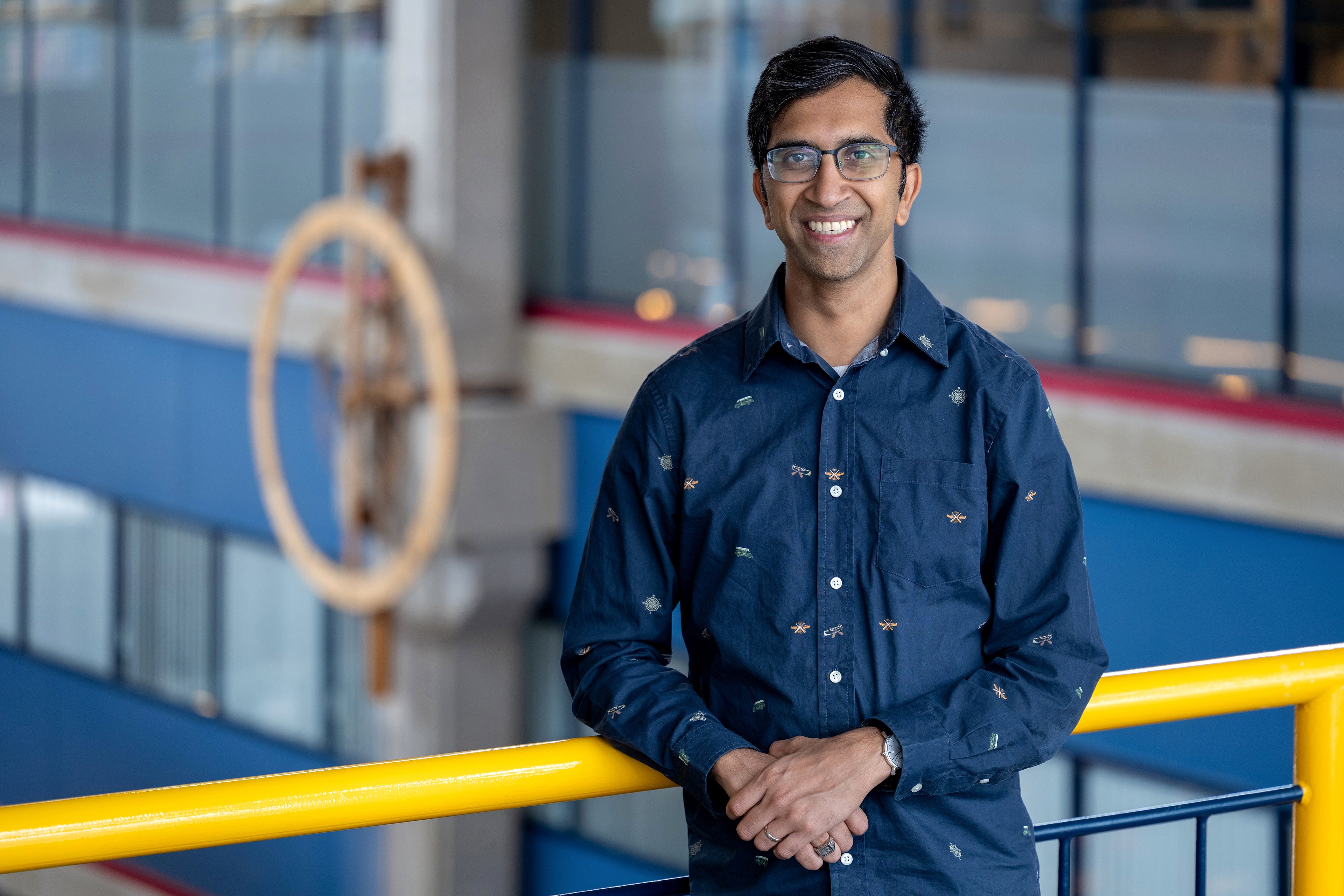
Professor Gautam Kamath in the Davis Centre by analogue clock

Gautam Kamath is an Assistant Professor at the Cheriton School of Computer Science. An expert in algorithms, statistics and machine learning, his research focuses on modern data analysis under constraints such as differential privacy and robustness. He has received numerous awards and honours, including the 2026 Gödel Prize, the 2026 Presburger Award, a 2025 Ontario Early Researcher Award, and the 2023 Faculty of Mathematics Golden Jubilee Research Excellence Award. He was named a Canada CIFAR AI Chair in 2023.

His research has earned multiple distinguished paper honours, including the Best Paper Award at the 2024 International Conference on Machine Learning and the 2024 Caspar Bowden Award for Outstanding Research in Privacy Enhancing Technologies, marking the second time his work has been recognized at PETS. As of July 2026, his publications have been cited more than 7,100 times, with an h-index of 41, according to Google Scholar.

More about this award-winning research

When trained using conventional methods, deep learning models can leak sensitive information about the data on which they are trained. To address this issue, models can instead be trained to guarantee differential privacy, a rigorous notion of data privacy that limits the influence of any individual training point on the final model. While differential privacy is one of the few approaches that can provide machine learning models with strong privacy guarantees, it often comes at a cost of reduced test accuracy. A commonly cited explanation is that differentially private training requires substantially more data. Acquiring additional data, however, can be difficult, especially where privacy is a prime concern.

Transformer-based large language models have enabled significant advances in natural language processing, achieving state-of-the-art accuracy across a wide range of tasks. These models are first pre-trained on a large and diverse public dataset and then fine-tuned for each task of interest using a much smaller task-specific dataset. This two-stage approach can be adapted to solve tasks in private learning, helping address the data shortage issue by leveraging the scale of the public pre-training dataset.

Despite their success, task-specific fine-tuning introduces challenges. In the non-private setting, the immense size of large language models makes it impractical to fine-tune the full model and store a separate copy of the parameters for hundreds of downstream tasks. Differential privacy introduces additional overheads in computation, memory use, and accuracy. A recent line of work in the non-private literature has proposed parameter-efficient methods to alleviate the issues of storage and computational cost for fine-tuning. The main focus of the award-winning paper was to explore public pre-training and private fine-tuning on large transformer-based language models.

The researchers’ primary contribution was to show that this paradigm could support rigorous privacy guarantees while only experiencing a modest drop in model utility. Their key findings are the following —

  • State-of-the-art utility and privacy. Empirical evaluation of algorithms revealed that they achieve state-of-the-art accuracy versus privacy trade-offs, improving upon the previous best approaches. More importantly, for any fine-tuning tasks the utility of models trained with differential privacy approached that of non-private models.
  • Larger models are better. Previous research has shown that larger language models achieve better accuracy for downstream tasks. While the power of large models has been established in the non-private setting, the researchers found that this phenomenon persists under differential privacy. Their empirical results show that fine-tuning the biggest models achieves the best accuracy.
  • Simpler, sparser, and faster. Differential privacy can significantly increase computational and memory overheads. The large number of parameters contributes to the high cost of training large language models, which can increase training time by up to two orders of magnitude under privacy. The parameter-efficient approach the researchers employed partially offset this issue. As only a small fraction of the total number of parameters is updated, training becomes more computationally and memory efficient. Furthermore, as in the non-private setting, this framework leads to a modular design, where a single large pre-trained model can be augmented with lightweight modifications for downstream tasks.

To learn more about the award-winning research on which this article is based, please see Da Yu, Saurabh Naik, Arturs Backurs, Sivakanth Gopi, Huseyin A. Inan, Gautam Kamath, Janardhan Kulkarni, Yin Tat Lee, Andre Manoel, Lukas Wutschitz, Sergey Yekhanin, Huishuai Zhang. Differentially Private Fine-tuning of Language Models. Journal of Privacy and Confidentiality, vol. 14 (2) 2024.