


perhaps because my post-graduate training and career afterward has almost entirely focused on optimizing a “loss function” defined as the “average” loss of individual data instances within a large amount “data” set by “mechanistically” adjusting the parameters of a large predictor, my own thought process itself also started to resemble this process; think of an objective function, that is measurable, and figure out a systematic way to optimize this objective function. although it was not long after this started that i began to question this whole process; it probably helped that i was diagnosed with a thyroid cancer (pretty rare and unpredictable for a man in his mid-30’s), that i was diagnosed with ramsey hunt syndrome (just rare on its own) and that the whole world suddenly felt like collapsing with covid-19 pandemic. of course, because i am a machine learning researcher and a data scientist (i even became a “health statistician” recently,) i should’ve known better about uncertainty and sometimes impossibility of computation, but this notion of optimization for a rational decision was simply too attractive and shiny.
in fact, when we hear about optimizing an average loss function (or some form of risk) to inform a rational decision, we must focus on what are not being said. it only applies to problems where an objective function can be precisely specified and measured, but we often fool ourselves by creating an incorrect proxy and declaring it to be the perfect objective. it only applies to problems where the level of uncertainty is so low that the resulting optimum is crisp and unique, but we often fool ourselves by ignoring an enormous amount of uncertainty arising from the unimaginable complexity of the world surrounding us. the outcome, a so-called rational decision, is at the population level (“on average”) but each of us foolishly believes it applies to each and every one of us at the individual level. these are probably the more important aspects of optimization-driven decision making than what are often being said and forced upon us. these hidden aspects-impossible objectives, uncertainty and statistical nature- are however uncomfortable and genuinely challenging to deal with, and therefore, we decide to look at the bright side, declare our decisions as rational and strive to making ever more rational decisions every day.
why do i suddenly complain about this here? because this nebulous thought i’ve had but couldn’t articulate it until now has now been clearly, carefully and thoughtfully articulated by Ben Recht, a professor and a world-renowned scholar in machine learning, optimization, decision theory, you name it, at UC Berkeley, in his new book <the Irrational Decision>. this book was just published, and immediately after the book launch party i attended a couple of weeks ago, i ordered it myself:
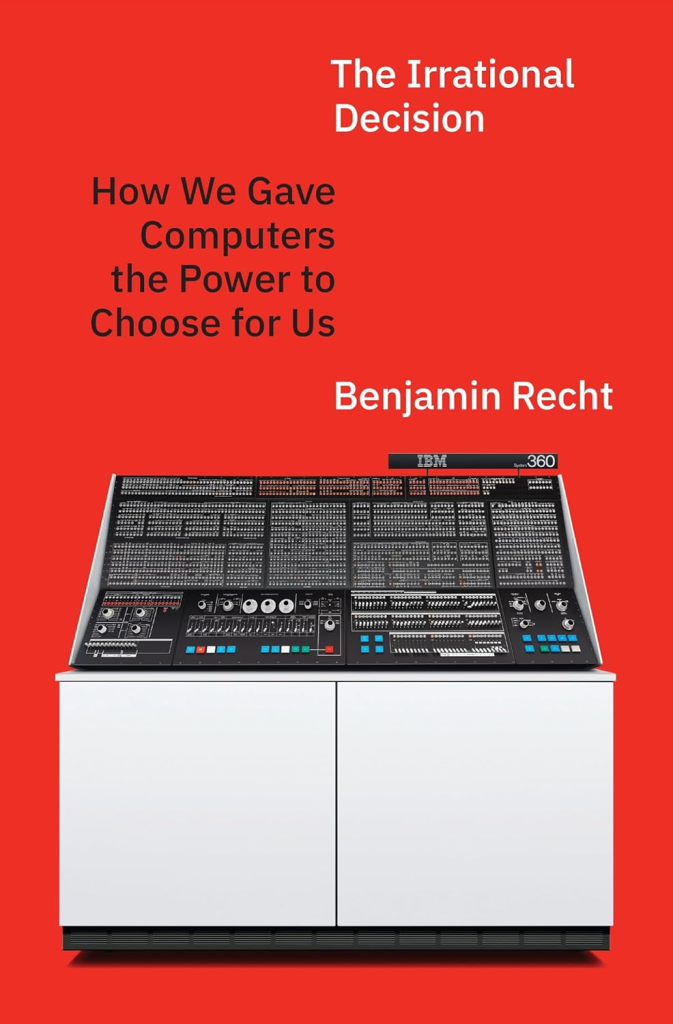
i could finish the whole book in a few hours over two days and thoroughly enjoyed it. this is not a book that has dramatic up’s and down’s nor that tells us fantastic stories about computers or artificial intelligence (AI). the stories are fantastic indeed, but they are delivered in a calm manner, which has been lacking way too much in the field of machine learning, computer science and artificial intelligence. this book covers the genesis of many influential foundational areas upon which optimization-driven decision making has been built, and if you are not in the field of computer science or adjacent fields, you will get perhaps the most calm and down-to-earth genesis story of modern computer-based decision making. of course, if you majored in or are working in these fields, you should know much of (if not all of) the historical facts in this book, although it is still very interesting how those developments especially in 1940-60’s are tied together and connect back (forward?) to the modern era and modern practices.
i won’t spoil anyone about the actual content, but reading this book made me know more about myself. i now understand better why i have always been so allergic to effective alturism, techno-solutionism, AI absolutists (for the lack of a better term) and bureaucracy. so, thank you, ben!
i will finish the post with this one quote from the book:
Machines can make decisions. Only people can choose.