惯性聚合 高效追踪和阅读你感兴趣的博客、新闻、科技资讯
阅读原文 在惯性聚合中打开

推荐订阅源

J
Java Code Geeks
钛媒体:引领未来商业与生活新知
钛媒体:引领未来商业与生活新知
H
Hackread – Cybersecurity News, Data Breaches, AI and More
腾讯CDC
F
Fortinet All Blogs
I
InfoQ
Jina AI
Jina AI
有赞技术团队
有赞技术团队
A
About on SuperTechFans
Stack Overflow Blog
Stack Overflow Blog
小众软件
小众软件
Recent Announcements
aimingoo的专栏
aimingoo的专栏
雷峰网
雷峰网
B
Blog RSS Feed
C
Check Point Blog
Y
Y Combinator Blog
博客园 - 聂微东
云风的 BLOG
云风的 BLOG
Cyber Security Advisories - MS-ISAC
Hugging Face - Blog
Hugging Face - Blog
Microsoft Security Blog
Engineering at Meta
Engineering at Meta
G
Google Developers Blog

Heroku Dev Center Articles

Migrating from the Nginx Buildpack to Front-End Web CNB | Heroku Dev Center Migrating from create-react-app-buildpack to Front-End Web CNB | Heroku Dev Center Deploying Front-End Web Apps on Heroku | Heroku Dev Center Understanding Heroku User Roles and Permissions | Heroku Dev Center Choosing the Right Apache Kafka on Heroku Plan | Heroku Dev Center Provisioning Apache Kafka on Heroku | Heroku Dev Center Managing Topics and Partitions on Apache Kafka on Heroku | Heroku Dev Center Apache Kafka on Heroku Version Support | Heroku Dev Center Changing the Plan of an Apache Kafka on Heroku Cluster | Heroku Dev Center Connecting to an Apache Kafka on Heroku Cluster | Heroku Dev Center Apache Kafka on Heroku Metrics Logs | Heroku Dev Center Heroku GitHub Enterprise Cloud Integration Using GitHub Apps | Heroku Dev Center Heroku Connect for Independent Software Vendors (ISV) | Heroku Dev Center Managed Inference and Agents API with Claude Opus 4.8 | Heroku Dev Center Heroku-26 Stack | Heroku Dev Center Connection Limits on Heroku Postgres Advanced (Limited GA) | Heroku Dev Center Heroku Postgres Advanced (Limited GA) | Heroku Dev Center Migrating to Heroku Postgres Advanced (Limited GA) | Heroku Dev Center Heroku Postgres Advanced Quotas (Limited GA) | Heroku Dev Center Manage Instance Pools on Heroku Postgres Advanced (Limited GA) | Heroku Dev Center Provisioning Heroku Postgres Advanced (Limited GA) | Heroku Dev Center Getting Started with Heroku Postgres Advanced (Limited GA) | Heroku Dev Center Usage and Billing on Heroku Postgres Advanced (Limited GA) | Heroku Dev Center
How the Front-End Web Cloud Native Buildpack Works | Hero...
2026-09-04 · via Heroku Dev Center Articles

Table of Contents [expand]

  • How It Works
  • Caching

Last updated September 03, 2026

The Heroku Front-End Web Cloud Native Buildpack (CNB) is designed with open, standard primitives to help front-end web developers deliver production-quality apps built with any front-end framework.

This guide covers how the CNB works on Heroku. For instructions on how to use the buildpack, see Deploying Front-End Web Apps on Heroku.

How It Works

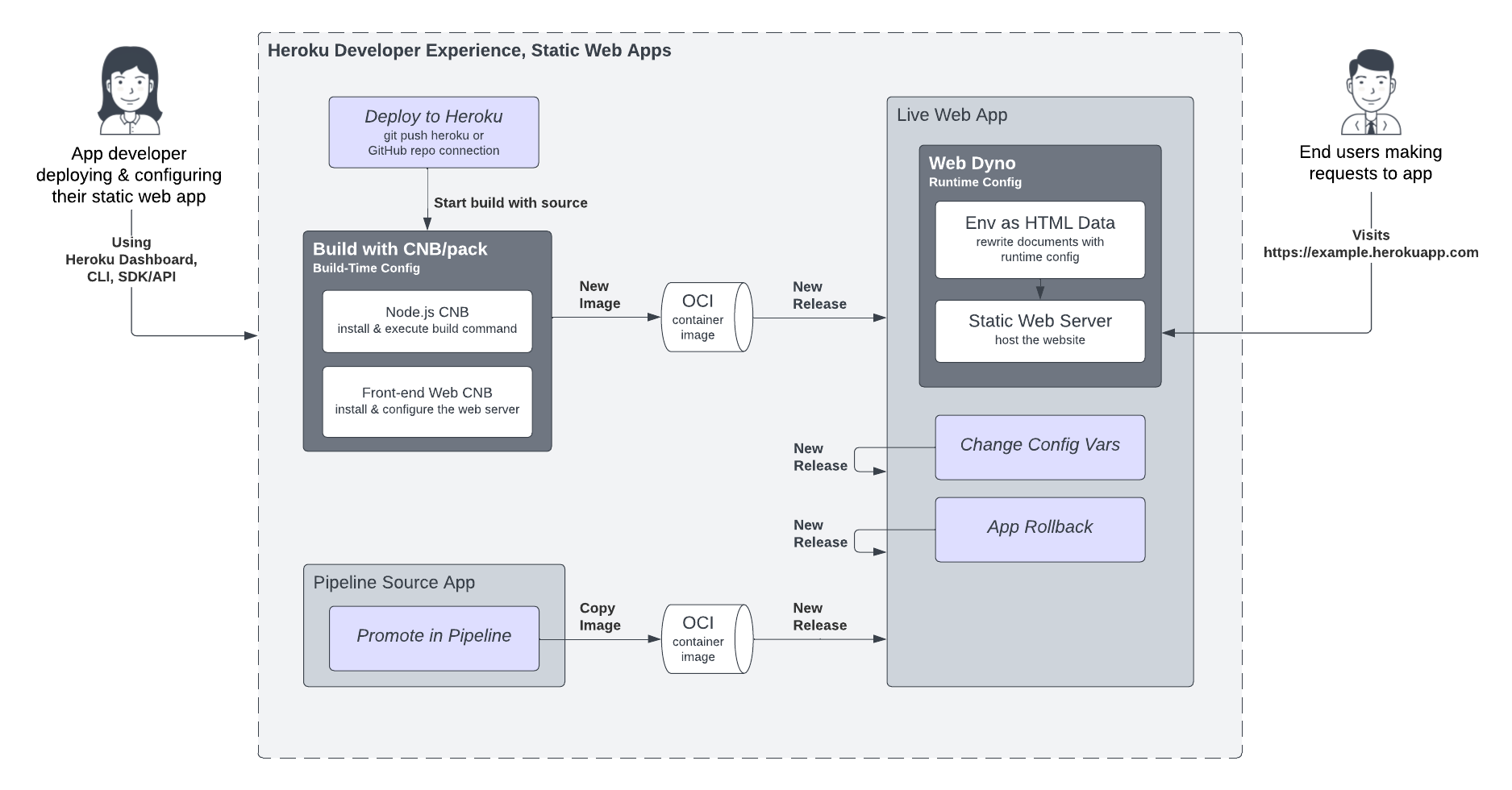
On Heroku, the project.toml file and config vars set the CNB configuration. Heroku front-end web apps support two distinct phases of configuration, during the build process and then at runtime when the web server launches.

  • Using the CNB build plan, other buildpacks can compose configuration for the static web server to support “zero-config” deployment of specific front-end frameworks.
  • CNBs produce standard OCI images, enabling local development with pack/Docker, and deployment to Heroku’s CNB stack.
  • The optional JavaScript/Node.js build environment is powered by the heroku/nodejs CNB with support for npm, pnpm, and yarn package managers.
  • At launch, runtime config vars are injected as standard HTML Data attributes, enabling browser apps to easily pick up configuration changes with only a server restart, so no rebuild is required
  • The web server runs in Heroku dynos to deliver sites to end users, providing streamlined, purpose-built capabilities for static web apps. The server is implemented with Caddy.

Architecture Diagram

Caching

Websites deployed with the Front-End Web buildpack are hosted directly in Heroku dynos. The static web server running on Heroku handles all requests from the internet. While this works great for development and small-scale production deployment, you can enhance website performance and resiliency to traffic spikes with well-crafted cache-control headers and a content delivery network (CDN), such as Cloudflare or Fastly.