



惯性聚合 高效追踪和阅读你感兴趣的博客、新闻、科技资讯
阅读原文 在惯性聚合中打开

推荐订阅源

Y
Y Combinator Blog
博客园 - 叶小钗
GbyAI
GbyAI
H
Hackread – Cybersecurity News, Data Breaches, AI and More
Stack Overflow Blog
Stack Overflow Blog
Jina AI
Jina AI
Microsoft Security Blog
T
Tailwind CSS Blog
S
SegmentFault 最新的问题
freeCodeCamp Programming Tutorials: Python, JavaScript, Git & More
博客园 - 聂微东
Google DeepMind News
Martin Fowler
Martin Fowler
有赞技术团队
有赞技术团队
Hugging Face - Blog
Hugging Face - Blog
N
Netflix TechBlog - Medium
B
Blog
MongoDB | Blog
MongoDB | Blog
钛媒体:引领未来商业与生活新知
钛媒体:引领未来商业与生活新知
让小产品的独立变现更简单 - ezindie.com
V
V2EX
雷峰网
雷峰网
Apple Machine Learning Research
人人都是产品经理
人人都是产品经理

Help Net Security

Police arrest 10 suspected members of Black Axe cybercrime gang ShinyHunters claims it stole 1.4 million records from Udemy Sevii unveils Cyber Swarm Defense Mode to stop AI-driven attacks at scale Alleged Chinese hacker extradited to US over cyberattacks targeting COVID-19 research Cequence Agent Personas bring granular control and governance to enterprise AI agents NowSecure MARI gives enterprises evidence-based visibility into third-party mobile app risk The metrics killing your SOC, and what to use instead US state privacy fines reached $3.425 billion in 2025 Canada’s first SMS blaster case leads to three arrests Linux storage management tool Stratis 3.9.0 adds online encryption and cache-less pool startup TLS Connect gives SMBs a right-sized automated tool to manage TLS certificates Aptori expands its platform with autonomous offensive testing to reduce security bottlenecks Your IAM was built for humans, AI agents don’t care The AI criminal mastermind is already hiring on gig platforms 25 open-source cybersecurity tools that don’t care about your budget Product showcase: LuLu reveals unauthorized outbound connections from Mac apps Week in review: Claude Mythos finds 271 Firefox flaws, Vercel breach Users advised to drop passwords and make room for passkeys - Help Net Security Indirect prompt injection is taking hold in the wild - Help Net Security Compromised everyday devices power Chinese cyber espionage operations - Help Net Security New Cisco firewall malware can only be killed by pulling the plug - Help Net Security Meta is overhauling how you sign in, manage settings, and protect your accounts - Help Net Security Ubuntu 26.04 LTS delivers memory-safe system tools and live patching for Arm servers - Help Net Security OpenAI’s GPT-5.5 is out with expanded cybersecurity safeguards - Help Net Security AI is speeding up nation-state cyber programs - Help Net Security A study of 1,000 Android apps finds a privacy policy logging gap - Help Net Security IT spending to hit $6.31 trillion record, thanks to AI - Help Net Security Where AI in CI/CD is working for engineering teams - Help Net Security With AI's help, North Korean hackers stumbled into a near-undetectable attack - Help Net Security Hacker with a special interest in breaching sports institutions ends behind bars - Help Net Security
Mavenir turns NOC knowledge into automation for autonomou...
Industry News · 2026-06-23 · via Help Net Security

Mavenir has announced its Agentic Service Assurance Framework, a TM Forum IG1251/IG1453-aligned, multi-agent system that automates complex network operations across multiple domains without replacing existing systems.

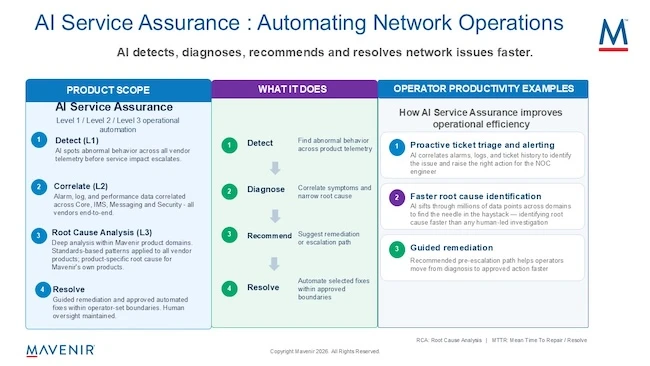
The framework pairs an Intent Orchestrator with a multi-layer agentic ecosystem in which AI helps detect, diagnose, recommend, and resolve network faults, improving operator productivity and accelerating the path to autonomous network operations.
Mavenir Agentic Service Assurance Framework

Network operations across 5G, cloud-native, and IP domains are expensive, fragmented, and increasingly difficult to manage at scale. Assurance systems fire alarms but rarely diagnose root causes. Experienced engineers retire, taking decades of institutional knowledge with them.

Multi-vendor environments generate siloed data that no single tool can correlate. AI tools that reason only over static data models cannot fill that gap. Mavenir’s answer is architectural: a multi-layer, multi-agent framework that learns from how networks are actually operated and automates what skilled engineers do.

At the core of the framework is the Intent Ops engine: a system that observes how NOC teams actually work, learns the patterns behind successful resolution, and converts proven human workflows into repeatable, explainable automation templates with built-in guardrails.

Unlike approaches that reason only over static data models, Intent Ops actively captures institutional expertise from live NOC operations and from third-party vendor teams, publishing vetted automations to a continuously growing orchestration catalog. Every workflow is validated against a human baseline before autonomous execution. The result: the network runs on operators’ best knowledge, not a frozen snapshot of it.

The framework helps deliver cross-domain monitoring, context-aware correlation, and domain-intelligence-driven root-cause analysis across domains, with closed-loop remediation on Mavenir products. Integration with existing OSS AI agents is achieved via the Agent-to-Agent (A2A) protocol defined in IG1453, preserving operators’ existing investments while extending automation reach across the full network stack.

Retaining operational control across geographically distributed, cloud-native networks is one of the most pressing challenges operators face today. Mavenir’s framework helps address this directly with AI-driven workflows spanning deployment topology, application health, interface health, and service status, each backed by trusted, auditable remediation actions.

The framework’s priorities map directly to operator demand. Recent industry research ranks AI-driven trace and log analysis, cross-domain fault correlation, and automated diagnosis of complex interconnect issues as the top operational priorities. These are precisely the capabilities Mavenir’s Agentic Service Assurance Framework delivers.

Framework highlights

  • Standards-native architecture (IG1251/IG1453): Multi-agent architecture and A2A communication built natively to TM Forum IG1251 and IG1453, which is the industry’s definitive specifications for autonomous networks and agent interoperability.
  • Intent Orchestration: Operators express desired outcomes as natural-language or voice intent. The platform interprets, plans, executes, and validates end-to-end, continuously refining automation as network conditions evolve.
  • Intent Ops Knowledge Capture: Actively learns from live NOC team workflows and third-party vendor operations, converting proven human expertise into a continuously growing, vendor-neutral automation catalog.
  • Multi-vendor, multi-domain: Spans L1 monitoring to L3 remediation across heterogeneous networks without replacing incumbent systems.
  • Closed-loop validation: Every automated workflow is validated using pre-validated workflows before autonomous execution, ensuring consistency, accuracy, and a full audit trail. Mavenir closes the loop; it does not just recommend.

“Every operator I talk to is wrestling with the same paradox: their networks are becoming more complex while the operational expertise to run them is retiring. Intent Ops solves that paradox directly. It captures what your best engineers know, validates it, and makes it available to the entire operations organization, autonomously and at scale. This is how you build a network that genuinely runs itself,” said Bejoy Pankajakshan, EVP, Chief Technology & Strategy Officer, Mavenir.

“Operators need practical routes to autonomous networks that work across complex, multi-vendor environments. Intent-based operations and knowledge capture aligned to TM Forum’s frameworks can help turn proven NOC expertise into scalable automation. Mavenir’s approach shows the direction the industry needs: open, standards-based autonomy operators can trust,” added Andy Tiller, EVP Member Products, TM Forum.