
惯性聚合 高效追踪和阅读你感兴趣的博客、新闻、科技资讯
阅读原文 在惯性聚合中打开

推荐订阅源

D
Docker
酷 壳 – CoolShell
酷 壳 – CoolShell
博客园 - Franky
奇客Solidot–传递最新科技情报
奇客Solidot–传递最新科技情报
A
About on SuperTechFans
博客园 - 【当耐特】
Microsoft Security Blog
H
Hackread – Cybersecurity News, Data Breaches, AI and More
The GitHub Blog
The GitHub Blog
雷峰网
雷峰网
博客园_首页
freeCodeCamp Programming Tutorials: Python, JavaScript, Git & More
IT之家
IT之家
博客园 - 叶小钗
Google DeepMind News
aimingoo的专栏
aimingoo的专栏
博客园 - 聂微东
B
Blog RSS Feed
H
Help Net Security
Recent Announcements
阮一峰的网络日志
阮一峰的网络日志
D
DataBreaches.Net
L
LangChain Blog
Vercel News
Vercel News

Help Net Security

Police arrest 10 suspected members of Black Axe cybercrime gang ShinyHunters claims it stole 1.4 million records from Udemy Sevii unveils Cyber Swarm Defense Mode to stop AI-driven attacks at scale Alleged Chinese hacker extradited to US over cyberattacks targeting COVID-19 research Cequence Agent Personas bring granular control and governance to enterprise AI agents NowSecure MARI gives enterprises evidence-based visibility into third-party mobile app risk The metrics killing your SOC, and what to use instead US state privacy fines reached $3.425 billion in 2025 Canada’s first SMS blaster case leads to three arrests Linux storage management tool Stratis 3.9.0 adds online encryption and cache-less pool startup TLS Connect gives SMBs a right-sized automated tool to manage TLS certificates Aptori expands its platform with autonomous offensive testing to reduce security bottlenecks Your IAM was built for humans, AI agents don’t care The AI criminal mastermind is already hiring on gig platforms 25 open-source cybersecurity tools that don’t care about your budget Product showcase: LuLu reveals unauthorized outbound connections from Mac apps Week in review: Claude Mythos finds 271 Firefox flaws, Vercel breach Users advised to drop passwords and make room for passkeys - Help Net Security Indirect prompt injection is taking hold in the wild - Help Net Security Compromised everyday devices power Chinese cyber espionage operations - Help Net Security New Cisco firewall malware can only be killed by pulling the plug - Help Net Security Meta is overhauling how you sign in, manage settings, and protect your accounts - Help Net Security Ubuntu 26.04 LTS delivers memory-safe system tools and live patching for Arm servers - Help Net Security OpenAI’s GPT-5.5 is out with expanded cybersecurity safeguards - Help Net Security AI is speeding up nation-state cyber programs - Help Net Security A study of 1,000 Android apps finds a privacy policy logging gap - Help Net Security IT spending to hit $6.31 trillion record, thanks to AI - Help Net Security Where AI in CI/CD is working for engineering teams - Help Net Security With AI's help, North Korean hackers stumbled into a near-undetectable attack - Help Net Security Hacker with a special interest in breaching sports institutions ends behind bars - Help Net Security
Meta adds proof-based security to encrypted backups
Anamarija Po · 2026-05-05 · via Help Net Security

Meta has updated its infrastructure for protecting password-based and end-to-end encrypted backups, introducing over-the-air fleet key distribution for Messenger and a commitment to publishing evidence of secure fleet deployments.

How encrypted backups work

These updates build on the company’s HSM-based Backup Key Vault, which provides end-to-end encrypted backups for WhatsApp and Messenger. The system protects users’ backed-up message history with a recovery code stored in tamper-resistant hardware security modules (HSMs) that are inaccessible to Meta, cloud storage providers, or third parties. The vault operates as a geographically distributed fleet across multiple data centers and uses majority-consensus replication for resilience.

Meta has offered end-to-end encrypted messaging since 2016, while backups stored in cloud services did not receive the same level of protection. The updated system strengthens this model by ensuring that only users can decrypt stored data.

When end-to-end encrypted backups are enabled in WhatsApp, the client generates a unique 256-bit encryption key using a built-in cryptographically secure pseudorandom number generator. The key remains on the client and is never transmitted unencrypted.

Decrypting a backup requires this key. The client encrypts and registers the key material with WhatsApp, creating a record in the HSM-based Backup Key Vault tied to the device. This process uses the OPAQUE protocol, allowing the key to be stored with a password without revealing the password to the vault. The key can be retrieved only if the user proves knowledge of the password, ensuring that only the user can access and decrypt the backup.

Over-the-air key distribution

Users validate the HSM fleet’s public key to confirm authenticity before establishing a session. In WhatsApp, these keys are hardcoded. For Messenger, Meta distributes fleet public keys over the air as part of the HSM response. They are delivered in a validation bundle signed by Cloudflare and counter-signed by Meta, providing independent cryptographic proof of authenticity. Cloudflare also maintains an audit log of these bundles.
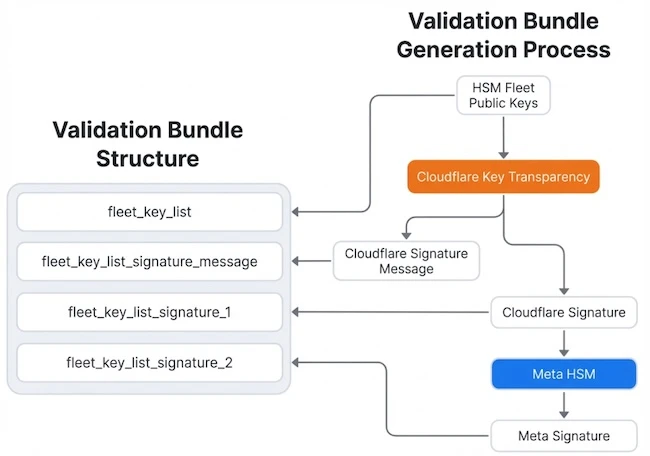
Meta encrypted backups

Over-the-air key distribution (Source: Meta)

Deployment verification and transparency

Meta will publish evidence of the secure deployment of each new HSM fleet, allowing users to verify deployments by following the steps in the Audit section of the Security of End-To-End Encrypted Backups whitepaper.

“Transparency in the deployment of our HSM fleet is essential to demonstrating that the system operates as designed and that Meta cannot access users’ encrypted backups,” the company said.

Meta also provides the open-source mbt CLI for independently verifying artifacts in its binary transparency log. It uses Cloudflare’s Ed25519 public key as a trust anchor and validates SHA-256 digests, signatures, and consistency against Cloudflare’s Key Transparency auditor.