
惯性聚合 高效追踪和阅读你感兴趣的博客、新闻、科技资讯
阅读原文 在惯性聚合中打开

推荐订阅源

J
Java Code Geeks
Stack Overflow Blog
Stack Overflow Blog
B
Blog RSS Feed
C
Check Point Blog
D
Docker
Y
Y Combinator Blog
Recent Announcements
Google DeepMind News
MongoDB | Blog
MongoDB | Blog
博客园_首页
Apple Machine Learning Research
量子位
有赞技术团队
有赞技术团队
IT之家
IT之家
大猫的无限游戏
大猫的无限游戏
D
DataBreaches.Net
M
MIT News - Artificial intelligence
B
Blog
阮一峰的网络日志
阮一峰的网络日志
freeCodeCamp Programming Tutorials: Python, JavaScript, Git & More
腾讯CDC
让小产品的独立变现更简单 - ezindie.com
V
V2EX
月光博客
月光博客

Help Net Security

Police arrest 10 suspected members of Black Axe cybercrime gang ShinyHunters claims it stole 1.4 million records from Udemy Sevii unveils Cyber Swarm Defense Mode to stop AI-driven attacks at scale Alleged Chinese hacker extradited to US over cyberattacks targeting COVID-19 research Cequence Agent Personas bring granular control and governance to enterprise AI agents NowSecure MARI gives enterprises evidence-based visibility into third-party mobile app risk The metrics killing your SOC, and what to use instead US state privacy fines reached $3.425 billion in 2025 Canada’s first SMS blaster case leads to three arrests Linux storage management tool Stratis 3.9.0 adds online encryption and cache-less pool startup TLS Connect gives SMBs a right-sized automated tool to manage TLS certificates Aptori expands its platform with autonomous offensive testing to reduce security bottlenecks Your IAM was built for humans, AI agents don’t care The AI criminal mastermind is already hiring on gig platforms 25 open-source cybersecurity tools that don’t care about your budget Product showcase: LuLu reveals unauthorized outbound connections from Mac apps Week in review: Claude Mythos finds 271 Firefox flaws, Vercel breach Users advised to drop passwords and make room for passkeys - Help Net Security Indirect prompt injection is taking hold in the wild - Help Net Security Compromised everyday devices power Chinese cyber espionage operations - Help Net Security New Cisco firewall malware can only be killed by pulling the plug - Help Net Security Meta is overhauling how you sign in, manage settings, and protect your accounts - Help Net Security Ubuntu 26.04 LTS delivers memory-safe system tools and live patching for Arm servers - Help Net Security OpenAI’s GPT-5.5 is out with expanded cybersecurity safeguards - Help Net Security AI is speeding up nation-state cyber programs - Help Net Security A study of 1,000 Android apps finds a privacy policy logging gap - Help Net Security IT spending to hit $6.31 trillion record, thanks to AI - Help Net Security Where AI in CI/CD is working for engineering teams - Help Net Security With AI's help, North Korean hackers stumbled into a near-undetectable attack - Help Net Security Hacker with a special interest in breaching sports institutions ends behind bars - Help Net Security
Open-source privacy proxy masks PII before prompts reach ...
Sinisa Marko · 2026-05-01 · via Help Net Security

Enterprise developers routinely send prompts to external large language models that contain customer emails, support transcripts, and other identifying information, often without a sanitization layer between the application and the API. Dataiku has released Kiji Privacy Proxy, an open-source local gateway that detects and masks personally identifiable information before requests leave the network.
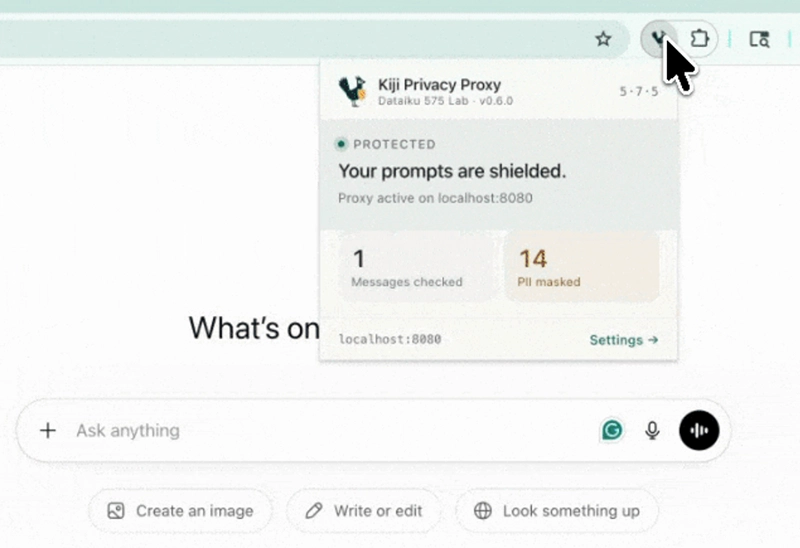
PII privacy proxy

The tool sits between local applications and external AI APIs such as OpenAI and Anthropic. Inbound requests pass through a machine learning model that flags 16 or more categories of PII, including email addresses, phone numbers, Social Security numbers, credit card numbers, and IP addresses. It substitutes detected entries with realistic dummy values, forwards the masked request to the upstream API, and restores the original values in the response so the calling application receives output that matches its input.

Local inference and deployment options

PII detection runs on a quantized DistilBERT model executed through ONNX Runtime on the user’s machine, with no calls to outside services for the detection step itself. Latency stays under 100 milliseconds for most requests, according to the project documentation. The base model achieved a 94 percent F1 score on an industry benchmark dataset.

Distribution covers three form factors. macOS users install a native Electron desktop application that configures Proxy Auto-Config so Safari and Chrome route traffic through Kiji on port 8081 without manual environment variables. Linux users run a standalone server binary and set HTTP_PROXY and HTTPS_PROXY values. A separate Chrome extension routes web requests through the proxy for users who interact with services like ChatGPT through a browser.

Compliance drivers

Sending PII to a third-party API can trigger obligations under GDPR, HIPAA, and CCPA, and many enterprises restrict what data may leave the corporate perimeter. A 2026 Dataiku survey of 600 CIOs found that 85 percent had seen AI projects delayed or blocked because of gaps in traceability or explainability, with privacy concerns a significant factor.

Kiji Privacy Proxy is available for free on GitHub.

Must read:

Subscribe to the Help Net Security ad-free monthly newsletter to stay informed on the essential open-source cybersecurity tools. Subscribe here!