




惯性聚合 高效追踪和阅读你感兴趣的博客、新闻、科技资讯
阅读原文 在惯性聚合中打开

推荐订阅源

F
Fortinet All Blogs
罗磊的独立博客
IT之家
IT之家
freeCodeCamp Programming Tutorials: Python, JavaScript, Git & More
月光博客
月光博客
博客园 - Franky
博客园 - 聂微东
博客园_首页
爱范儿
爱范儿
量子位
博客园 - 三生石上(FineUI控件)
G
Google Developers Blog
Martin Fowler
Martin Fowler
小众软件
小众软件
OSCHINA 社区最新新闻
OSCHINA 社区最新新闻
Cyber Security Advisories - MS-ISAC
Y
Y Combinator Blog
Vercel News
Vercel News
腾讯CDC
Microsoft Azure Blog
Hugging Face - Blog
Hugging Face - Blog
奇客Solidot–传递最新科技情报
奇客Solidot–传递最新科技情报
The Cloudflare Blog
Engineering at Meta
Engineering at Meta

Help Net Security

Police arrest 10 suspected members of Black Axe cybercrime gang ShinyHunters claims it stole 1.4 million records from Udemy Sevii unveils Cyber Swarm Defense Mode to stop AI-driven attacks at scale Alleged Chinese hacker extradited to US over cyberattacks targeting COVID-19 research Cequence Agent Personas bring granular control and governance to enterprise AI agents NowSecure MARI gives enterprises evidence-based visibility into third-party mobile app risk The metrics killing your SOC, and what to use instead US state privacy fines reached $3.425 billion in 2025 Canada’s first SMS blaster case leads to three arrests Linux storage management tool Stratis 3.9.0 adds online encryption and cache-less pool startup TLS Connect gives SMBs a right-sized automated tool to manage TLS certificates Aptori expands its platform with autonomous offensive testing to reduce security bottlenecks Your IAM was built for humans, AI agents don’t care The AI criminal mastermind is already hiring on gig platforms 25 open-source cybersecurity tools that don’t care about your budget Product showcase: LuLu reveals unauthorized outbound connections from Mac apps Week in review: Claude Mythos finds 271 Firefox flaws, Vercel breach Users advised to drop passwords and make room for passkeys - Help Net Security Indirect prompt injection is taking hold in the wild - Help Net Security Compromised everyday devices power Chinese cyber espionage operations - Help Net Security New Cisco firewall malware can only be killed by pulling the plug - Help Net Security Meta is overhauling how you sign in, manage settings, and protect your accounts - Help Net Security Ubuntu 26.04 LTS delivers memory-safe system tools and live patching for Arm servers - Help Net Security OpenAI’s GPT-5.5 is out with expanded cybersecurity safeguards - Help Net Security AI is speeding up nation-state cyber programs - Help Net Security A study of 1,000 Android apps finds a privacy policy logging gap - Help Net Security IT spending to hit $6.31 trillion record, thanks to AI - Help Net Security Where AI in CI/CD is working for engineering teams - Help Net Security With AI's help, North Korean hackers stumbled into a near-undetectable attack - Help Net Security Hacker with a special interest in breaching sports institutions ends behind bars - Help Net Security
Intel 471 speeds threat hunting and remediation with Retr...
Industry New · 2026-05-06 · via Help Net Security

Intel 471 has announced Retroactive Threat Detections (RTD), a new capability within its Verity471 platform. RTD helps security teams quickly understand the impact of new threats on their environments. This transforms static intelligence reports into actionable answers within minutes, enabling faster confirmation of compromise and remediation.
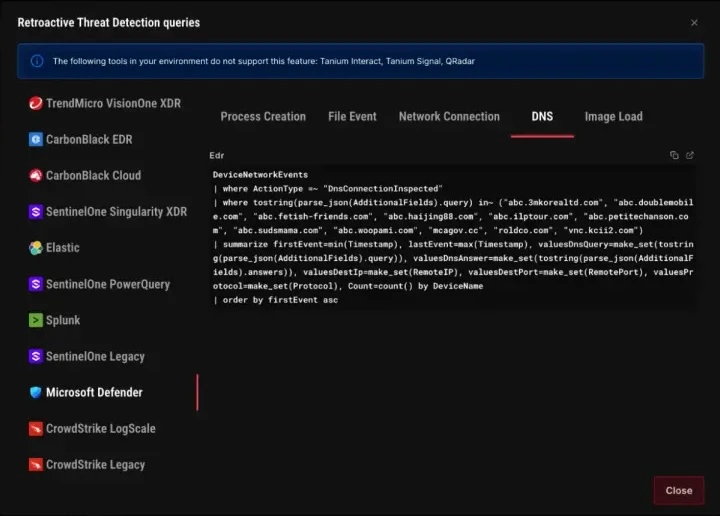
Intel 471 Retroactive Threat Detection

RTD generated query configured for multiple tools, delivered within the Verity471 report to retain CTI context. (Source: Intel 471)

When a new threat surfaces, every CISO faces the same question: “Were we affected?” Answering this has historically meant pulling analysts off other work to manually extract indicators, build custom queries for each detection tool, and search historical logs across platforms. This process delays response, extends attacker dwell time, and ties up the most experienced people on the team. RTD eliminates the manual work, dynamically translating IOCs into ready-to-run detection queries tailored for all major endpoint detection and response (EDR) and Security Information and Event Management (SIEM) platforms.

“The question every security team gets when a new threat breaks is around if they were hit and how fast they knew,” said Brandon Hoffman, Chief Product and Strategy Officer at Intel 471. “RTD’s ability to immediately turn intelligence workflows into detections that are executable across the entire security stack, immediately answers this question and dramatically shortens this window of uncertainty so teams can act fast.”

RTD enables teams to confirm past intrusions, escalate response against an active threat, or trigger a proactive threat hunt. Because RTD queries are built on Intel 471’s proprietary adversary intelligence, customers get actionable, proprietary intelligence that can be immediately operationalized across their core EDR and SIEM platforms, something that off-the-shelf feeds simply can’t produce.

“Our customers don’t need more intelligence, they need intelligence that immediately transfers into defensive action,” said Michael DeBolt, President and Chief Intelligence Officer of Intel 471. “RTD is how we help them do that, with measurable improvements in response time and analyst productivity.”

RTD is exclusively available to Verity471 customers and comes on the heels of Intel 471’s Cyber Threat Exposure Bundle launch, which combines Attack Surface Exposure, Third-Party Exposure and Brand Exposure into a single solution.