





A Google expert explains what it means to take a full-stack approach to AI and why it’s been the foundation of our AI work for so long.
General summary
Google expert Richard Seroter explains that a "full-stack" AI approach integrates every layer of technology—from hardware and models to user interfaces—into one cohesive system. This strategy improves reliability, lowers costs, and simplifies development by removing the need to stitch together disparate parts from multiple vendors. You can start building today using Google AI Studio for prototypes, the Gemini Enterprise Platform for automation, or the Antigravity platform for complex agent builds.
Summaries were generated by Google AI. Generative AI is experimental.

Your browser does not support the audio element.
Listen to article
This content is generated by Google AI. Generative AI is experimental
[[duration]] minutes
If you’ve spent any time lately reading about AI or using AI tools, you’ve probably heard about “full-stack” AI and app development. Our unique full-stack approach to AI lets us deliver powerful, cost-efficient products to expert developers and everyday users alike. But what exactly does it mean when a technology system is "full-stack”? We asked Google expert Richard Seroter, who leads developer experience at Google Cloud, to explain it — and why it enables Google to bring helpful AI to billions of people.
First things first: What exactly do you do at Google?
I originally came to Google as a product manager, and I’ve been leading our developer relations and technical writing teams for about three years now. My team, now inclusive of product engineering for languages and frameworks along with our Open Source Programs Office, and I help software developers successfully build with Google Cloud products. We do a lot of different things, from building the programming languages and frameworks that developers use, to meeting directly with the community to share best practices, to running the technical writing team that crafts our documentation. Ultimately, our entire focus is on giving developers the confidence that they can get things done with Google products.
Given our topic today, I would imagine that means you’re helping developers use our full-stack technology.
I am, yes!
Let’s define that term. Where does the phrase “full-stack” come from, and what does it mean when we’re talking about tech?
When the term "full-stack" originally came out in software development a decade or so ago, people were usually thinking about applications. Historically, building an app required multiple specialized teams: a front-end developer to build beautiful user interfaces, a back-end developer to handle server-side logic and a dedicated database team.
The concept of a "full-stack engineer" emerged to describe a developer who could work across all of these functions independently. Instead of constantly handing off components from one person to another, a full-stack engineer could take an idea from a rough concept all the way to a fully running piece of software.
So it started with apps, and now it’s on to AI?
Right. We’ve taken that exact same end-to-end principle and applied it to AI. If you’re trying to deliver value with AI, you can either buy a bunch of disparate parts from different vendors and try to stitch them together yourself, or you can look for an integrated system where everything you need is already connected.
What disparate parts can someone stitch together to make a full AI stack?
An intentional AI stack needs a cohesive combination of layers to get a job done: compute infrastructure, an AI model, an orchestration platform and the user interfaces. At Google, we’ve deliberately invested in every single layer. We provide the hardware like Tensor Processing Units (TPUs), frontier models developed by Google DeepMind like the Gemini family of models, the Gemini Enterprise Agent Platform and the interfaces people use daily, like Maps and Gmail. We’ve essentially done the hunting for you and put all the necessary components right inside the box.
Did we know we wanted to have a full-stack approach way back when Google first started working on AI?
It was absolutely a deliberate, decades-long strategy. For instance, our bet on custom TPUs is already over 10 years old. We recognized early on that there’s massive value in owning our own supply chain and raw infrastructure when serving up the world's most important internet services. Owning that thread throughout the entire stack lets us deliver a level of service, performance and reliability that's very hard to achieve if you're at the mercy of multiple parties.
On the flip side, does adopting a full-stack platform limit builders in some way?
That’s a very fair concern, but locking people in doesn't align with our ethos. No company does open source quite like Google; we regularly give away foundational technology and source code that the entire industry depends on.
We like to describe our AI platform as "opinionated but extensible" and "batteries included” — meaning everything you need to build and run an application is ready to go out of the box. However, if you want to use another company’s AI model instead of Gemini, or hook up different software instead of Google Workspace, you can plug those right in. We want you to use our products every day based on the completeness of our platform, not because we forced you into a closed choice.
Besides simplicity, what are some other benefits to working with full-stack AI?
Because Google manages the entire stack — literally from running the underlying infrastructure all the way up to delivering Gmail — there's massive system reliability. If a technical failure happens at one layer, our ownership of the platform allows us to catch it and handle it at another layer easily, rather than waiting for an external provider to fix it. There's also an economic advantage. Since we aren't paying third-party vendors for anything, customers don't have to absorb those fees, which means we can offer remarkably competitive pricing.
If I want to build something using only Google’s full-stack AI technology, what’s the best way to start?
We want to make technology accessible to billions of people who don't have an engineering degree, so we try to provide clear front doors depending on what you're trying to achieve. I usually recommend three starting points:
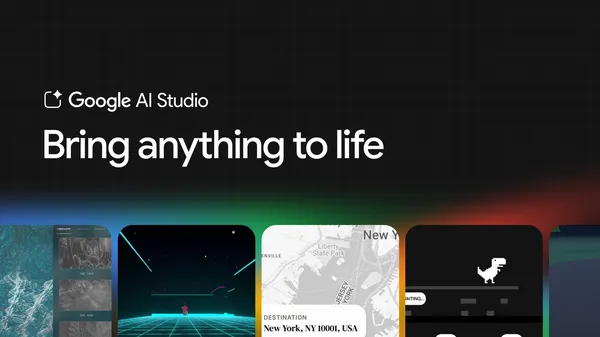
If you want to take a creative idea and quickly build a prototype web application, Google AI Studio is an incredible place to start. You can build a prototype in just a few minutes and deploy it directly to Cloud Run — our Cloud-based platform that runs apps — with the click of a single button.
If you’re looking for a low-code option to automate your day-to-day work, try Gemini Enterprise Platform. You can build workflows to clean up your inbox or parse complex spreadsheets without ever having to write or even look at a single line of code.
For those looking to orchestrate more complex application or agent builds, the Antigravity platform is incredibly powerful. Its rich surfaces allow you to build sophisticated systems without requiring advanced programming knowledge.
So whatever you’re trying to make and whatever level of developer skill you have, there’s a Google full-stack tool ready to help you?
That’s the idea!