





The rain in Yongquan Village in China’s deep south was torrential on May 16. Dirt roads were turned to sludge, and its waterways swelled with ferocious speed.
Early evening, after hours of back-breaking work, 15 casual farm laborers loaded onto a gray five-seater pickup truck to return to their home over the hills. Most of them would never make it.
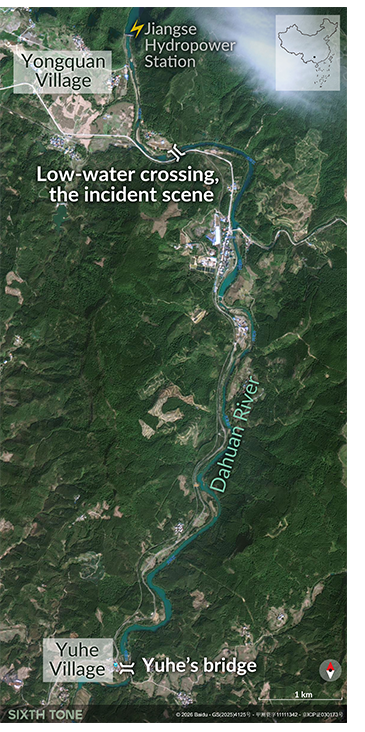
As the vehicle attempted to use a narrow low-water crossing over the Dahuan River, it’s believed to have been swept away by the rushing water. Five made it to shore alive; the others all drowned.
With employment opportunities scarce in this rural area of the southern Guangxi Zhuang Autonomous Region, planting and harvest seasons are bumper times for casual work gangs, often loosely organized groups of family members from a single tiny community.
Yet as these periods also fall within the rainy season, these workers not only must endure harsh weather conditions but also often risk their lives on overcrowded vehicles traversing flooded roads and fast-flowing waterways, sometimes for as little as 160 yuan ($30) a day.
After the incident, Guangxi authorities held an emergency meeting calling for a reassessment of such structures for hidden dangers and to ensure the use of warning posts, protective facilities, and control checkpoints.
Wave of destruction
Wei Kangming received a call about the incident around 8 p.m., as several of his relatives had been on the truck. Setting off from downtown Luoyang Town, he immediately headed for the scene, but stopped his car after about 14 kilometers at Yuhe Village when he noticed a crowd of people gathered near a bridge.
One told him that, moments earlier, they had seen a woman struggling in the rapidly flowing water, clinging desperately to a white plastic bucket and crying for help. They had attempted to throw her two inflated rubber rings, but she was unable to grab them and vanished under the surface.
The businessman later learned it was a relative from his village. That night, braving heavy rain with only a flashlight, Wei joined others in looking for survivors, hacking through steep, overgrown terrain in the pitch dark. “We searched both banks,” he says, but they heard no more cries for help.
By around 11 a.m. on May 19, the bodies of all 10 missing people and the sunken pickup truck had been recovered. More than 700 people had been mobilized for the search, covering a 30-kilometer stretch of river, according to Xinhua News Agency.
After speaking to the survivors, Wei believes the truck was suddenly struck by surging water while attempting to use the 100-meter-long, 4-meter-wide crossing, which has no guardrails and is lower in elevation at the southern end, where the incident occurred. The vehicle likely drifted sideways for about 50 meters before becoming submerged, he says.
Ten people had been seated in the truck bed at the time, and as the tragedy unfolded, some huddled in a tight embrace, unable to break free.
The work gang’s leader, Meng Chaosheng, was not in the vehicle, but his sister-in-law and daughter-in-law were. Both died. His 29-year-old niece survived after using two empty lunchboxes as floatation devices and catching hold of a tree branch. She was carried on the current for 2 kilometers before finally being able to swim to shore, a domestic news outlet reported.
Wei says that another woman, who couldn’t swim, had initially clung to her husband in panic, but loosened her grip after thinking of their child, hoping that at least one parent would survive. Fortunately, her husband was able to carry her safely to shore.
When Wei saw the salvaged truck by the roadside, he noticed marks on the front wheels, suggesting there was severe friction with the bridge deck. He speculates that the surging water initially struck the trunk with force.
Bad conditions
The 15 laborers who boarded the pickup had been part of a 28-strong gang from a small community hired to intercrop sweet potatoes in Huanjiang County’s camellia oil tree forest, according to state broadcaster China Central Television. The others had chosen to travel home on their own.
In the days following, authorities detained Meng and his nephew, the vehicle’s driver, and launched a full investigation into the cause of the incident.
Locals say the Dahuan River dries up in winter but swells rapidly in summer due to high precipitation in the mountains, creating swift currents. Low-water crossings, or submersible bridges, typically stand 30 to 50 centimeters above a river’s average water level and are designed to allow floodwater to overflow the deck in heavy rain. According to rules issued by China’s Ministry of Transport, such crossings should be closed to traffic as soon as the warning posts indicate the water level has risen to within 30 centimeters of the deck, well before it is fully submerged.
Data from the Guangxi Meteorological Observatory shows Huanjiang received 137.2 millimeters of rain in just nine hours — torrential levels — between 8 a.m. and 5 p.m. on May 15..
To handle the deluge, on May 15, the Jiangse Hydropower Station, about 2 kilometers upstream of the incident, opened its sluice gates to discharge floodwater at fluctuating flow rates. Plant manager Huang Jinqiao told local media that staff had warned several family representatives in the area that the discharge would last at least two days.
With the upstream flood discharge and continuous heavy rain, the low-water crossing was at risk of being submerged at any time on May 16.
Lost for words
Local workers have endured the risks for years. Most young people in Huanjiang leave the area to seek better employment opportunities, usually becoming gig workers in the neighboring Guangdong province. Those who stay rely on casual jobs at forest farms, particularly eucalyptus plantations.
“If it doesn’t rain, there might be tree-planting jobs for a dozen days a month,” says Wei Kangming. “But it’s not stable work.”
Most farms are remote, connected by only dirt roads. “We might go to work if it’s only drizzling,” says Wei Kai, a migrant worker from Yongquan who used to be part of Meng’s crew. “Since roads are slippery, we felt it would be safe to take a pickup truck to and from home.”
Wei Kai says that his family, like Meng’s, originated in Guangxi’s so-called “Dashi mountainous area” — a karst landscape characterized by exposed bedrock and severe shortages of water and arable land — before migrating to Huanjiang sometime in the 1990s.
Although still relatively arid, their new home allowed them to grow rice and cultivate forest land. However, flat land comes at a premium. Depending on the terrain, land-use prices in a single village today can range from 400 to 700 yuan per mu, a traditional Chinese unit equivalent to 0.07 hectares. Most farms remain small-scale.
With almost every household working its own fields and industry profits too slim to attract outside workers, Huanjiang has constantly struggled with labor shortages.
For instance, the rains in May left many corn and sugarcane fields severely waterlogged, but planters found it nearly impossible to hire people to help drain them — largely as everyone was busy attempting to save their own crops.
One typical example of the local working model is a woman who plants mulberries and rears silkworms. She predominantly sells silk but also tops up her income by helping sugarcane farmers in other villages with fertilizing, weeding, and harvesting, earning up to 5 yuan per kilogram of cane cut.
Those taking odd jobs are mostly middle-aged and elderly villagers, and the dearth of options means some planters are forced to outsource to more costly workers who ride motorcycles from neighboring Libo County across the border in southwestern Guizhou province.
Migrant worker Wei Kai, who knew many of those who perished in the Dahuan River on May 16, says he is conflicted about the tragedy.
When he was in school, he would ride in Meng’s truck to work in the forest, earning pocket money to pay his tuition. Meng had been organizing gangs for 20 years, and some people trust him deeply, Wei says. Yet those who died were his friends and neighbors.
He says it is a feeling he has no idea how to express.
Reported by Ge Mingning, Chen Lei, Yi Youyang, and Yuan Keying.
A version of this article originally appeared in The Paper. It has been translated and edited for brevity and clarity, and is republished here with permission.
Translator: Eunice Ouyang; editors: Wang Juyi and Hao Qibao.
(Header image: Visuals from The Paper, Xinhua, and CCTV News, reedited by Sixth Tone)
此内容由惯性聚合(RSS阅读器)自动聚合整理,仅供阅读参考。 原文来自 — 版权归原作者所有。