








DeepSeek R1DeepSeek R1 8B
The author encountered an infinite loop in a Map iteration during Simstate 2.0 development. The loop occurred when iterating a Map storing React component observers. The root cause was modifying the Map during iteration: calling an observer triggered component re-renders, which unsubscribed (deleted) and resubscribed (re-added) the same function key within the loop. Though the key (function) remained identical, reinsertion during iteration caused the Map to treat it as new, perpetuating the loop. This behavior, dangerous in most languages, arises in JavaScript when altering a Map mid-iteration. The solution involved recognizing indirection-induced complexity and avoiding such mutations during iteration.
由Azure AI部署的DeepSeek-R1模型推理
I accidently encountered a problem during the development of the 2.0 version of simstate: During an iteration of a set of observers stored in a ES6 Map, which contained only one element, an infinite loop occurred.
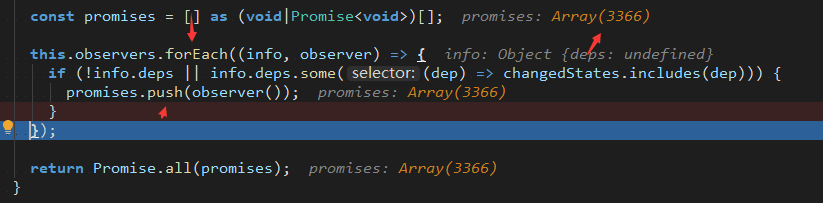
This problem confused me quite a lot. It had been confirmed that this Map had only one element and the element remained unchanged between and inside loops, and the all elements in promises array were the same.
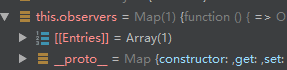
My first thought was data race. It might be true for other languages with real multi-threading capability, but this is JavaScript: it is single thread only, and so there would be no such concurrent related problems.
Using a function as the key of Map seemed weird for other programming languages, since most Map-like data structure (like HashMap in Java, Dictionary in C# and unordered_map in C++) requires the key to be hashable, and functions are not, at least in the surface. However, MDN clearly states that any value (both objects and primitive values) may be used as a key. The following code works well, which proves that functions, too, can be used as keys in a Map.
const data = [];
const map = new Map();
function a() { console.log("a"); }
map.set(a, "123");
map.forEach((value, key) => key()); // aAfter some investigation, the call to observer caught my eyes.
observer() will trigger the re-render of observer component and make the updated state available for end-user. To simplify implementation, every time the component is re-rendered, the component will unsubscribe (delete an entry from a Map) to the stores it subscribes to, and re-subscribe (set an entry in a Map) during the render.
StoreConsumer.tsx omitting some unrelated code
export default class StoreConsumer extends React.Component<Props, State> {
  // ...
  instances = new Set<Store<any>>();

  // ...
  private unsubscribeAll() {
    this.instances.forEach((store) => {
      // highlight-next-line
      store.unsubscribe(this.update);
    });
  }

  useStore = <ST extends StoreType<any>>(storeType: ST, dep?: Dependency<ST>): InstanceType<ST> => {
    // ...
    // highlight-next-line
    store.subscribe(this.update, dep);
    // ...
  }

  render() {
    return (
      <SimstateContext.Consumer>
        {(map) => {
          // ...
          // highlight-next-line
          this.unsubscribeAll();
          this.instances.clear();
          return this.props.children({ useStore: this.useStore });
        }}
      </SimstateContext.Consumer>
    );
  }
}
Store.ts omitting unrelated code
subscribe(observer: Observer, dep?: Dependency) {
  // highlight-next-line
  this.observers.set(observer, { dep, shouldUpdate: getChecker(dep) });
}

unsubscribe(observer: Observer) {
  // highlight-next-line
  this.observers.delete(observer);
}
The call to observer (observer()), happened during the iteration of the Map, alters the Map itself!
This is a dangerous action. It has become a common sense not to do so in most programming languages, since it might cause unexpected behaviors, which is exactly what happened here.
In this case, when deleting an entry and re-add an entry during the iteration, even if they are the equal, the item will be considered as a new item, which results in an infinite loop.
You may reproduce the case with the following code snippet. Note that since it runs indefinitely, consider running the script in a CLI environment (instead of browser) where you can kill the process to end the execution with ease.
const map = new Map();
function obs() { map.delete(obs); map.set(obs, 1); console.log("obs called"); }
map.set(obs, 1);
map.forEach((value, key) => key());
// endless "obs called"This is quite a simple problem, and the cause is also easy to understand for most programmers. However, it still confused me for quite a while. After it, I realized that some bugs might seem strange and difficult to debug, but it doesn't mean the cause is complicated: sometimes it is the indirections on top of all the root that adds to the difficulty. During debugging, it is a good way to track down the code execution flow, and in this process the cause may just reveal itself.
此内容由惯性聚合(RSS阅读器)自动聚合整理,仅供阅读参考。 原文来自 — 版权归原作者所有。