惯性聚合 高效追踪和阅读你感兴趣的博客、新闻、科技资讯
阅读原文 在惯性聚合中打开

推荐订阅源

V
Visual Studio Blog
Y
Y Combinator Blog
让小产品的独立变现更简单 - ezindie.com
Apple Machine Learning Research
爱范儿
爱范儿
IT之家
IT之家
量子位
小众软件
小众软件
freeCodeCamp Programming Tutorials: Python, JavaScript, Git & More
有赞技术团队
有赞技术团队
罗磊的独立博客
S
SegmentFault 最新的问题
博客园_首页
N
Netflix TechBlog - Medium
月光博客
月光博客
Cyber Security Advisories - MS-ISAC
aimingoo的专栏
aimingoo的专栏
T
Tailwind CSS Blog
M
MIT News - Artificial intelligence
A
About on SuperTechFans
The Cloudflare Blog
酷 壳 – CoolShell
酷 壳 – CoolShell
腾讯CDC
MyScale Blog
MyScale Blog

BBC News

Three arrested over burglaries against high-profile athletes Coffee machines, fountain pens and Grand Theft Auto: How Murrell spent the money Cheese Rolling 2026: Tom Kopke among winners in Gloucestershire Cardiff M4 service station crash sees three injured Nuno meeting Hammers hierarchy over future Police fire shots in air to disperse angry crowds at DR Congo Ebola treatment centre World Cup 2026: Spain squad includes Lamine Yamal but no Real Madrid players Opta's Premier League team of the season - Raya, Gabriel, Saliba, Fernandes, Haaland, Anderson, Rice The painstaking work to uncover Peter Murrell's crimes Three arrested over shooting outside Sheffield's One Four One bar Clashes as Venezuelan prisoners protest over alleged mistreatment The questions raised by the Murrell embezzlement controversy At least 19 taken to hospital after 'strong smell' reported at Tokyo mall Welsh World War Two soldier's cigarette case found in Netherlands Radio 1 Big Weekend: Olivia Dean headlines and other highlights Premier League predictions: How accurate were BBC Sport pundits? Premier League season review: Phil McNulty's verdict & pre-season predictions Former SNP chief executive Peter Murrell admits embezzling party funds Anger grows after China's deadliest coal mining disaster in years Enhanced Games: Kristian Gkolomeev swims record 50m freestyle time on opening day Li Jiaying: China launches first Hong Kong astronaut into space Deal with US not imminent, Iran says Americast - The political fight for American men - BBC Sounds Wayne Rooney: Chelsea's European absence will make their big Premier League threat Oil prices slide on hopes of US-Iran peace deal Bridget Phillipson to ask competition watchdog to review hidden childcare costs How Saudi Arabia's spending spree reached the end of the line Canadian Grand Prix 2026: Kimi Antonelli takes control of title battle Newspaper headlines: 'I don't make bad deals' and 'now you're Gunner believe us' Why millions of workers are taking second jobs to cope
Simpler, older version of Stonehenge found three miles fr...
Alison Francis · 2026-06-18 · via BBC News

Alison Francis,Senior Science Journalistand

Rebecca Morelle,Science Editor

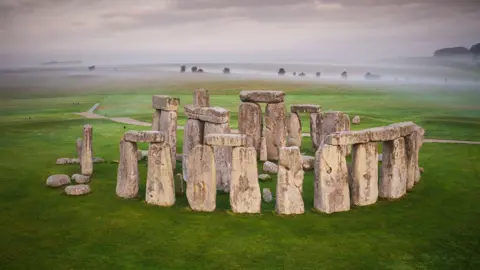
English Heritage The image shows Stonehenge. There is a misty sky behind with the full circles of the ancient monument in the foreground. Four sets of two large upright stones, each with another large stone resting across the top, which make up part of the outer circle.  The even larger stones of the inner area are visible above those of the outer circle. Green grass surrounds the monument on all sides.  English Heritage

The huge stones at Stonehenge mark the movements of the Sun

Archaeologists believe they have discovered an earlier, much simpler version of Stonehenge about 3 miles (5km) away from the prehistoric monument.

All that remains of the older structure is two holes in the ground, but the team says they held wooden posts that lined up with the Sun on the summer and winter solstices - the longest and shortest days of the year - in the same way as Stonehenge.

The site has been dated to about 5,000 years old, which predates Stonehenge by 500 years.

Artefacts were also found at the site, including pottery, flint tools and animal bone, suggesting prehistoric people held gatherings there.

Phil Harding, from Wessex Archaeology, who led the excavation, said it was one of the best finds of his long career.

"Two post pits tell me [much] more about the people 5,000 years ago," he said.

"This tells me about the whole community, this tells me about how they were thinking, how they were behaving, how they were revering the heavens."
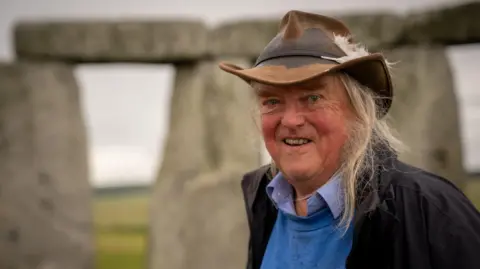
Tony Jolliffe/BBC News Archaeologist Phil Harding, who used to appear on Channel 4's "Time Team" programme, wearing his trademark hat with two feathers pushed through the headband on his left hand side. His long fair hair is hanging down on each side of his very characterful face. He is wearing a blue shirt and sweatshirt, with a coat that is open over the top. Behind him, out of focus, the outer circle of Stonehenge is visible and beyond that the grass of Salisbury plain. Tony Jolliffe/BBC News

Phil Harding says discovering the structure has been a career high

The huge stones at Stonehenge are precisely placed to line up with the Sun.

If you stand in middle of the circle at sunrise on the summer solstice, you will see the Sun come up over a stone called the heel stone to the north east of the circle.

On midwinter, if standing in the centre of the circle, you would see the sun set over an alter stone to the south west of the site.
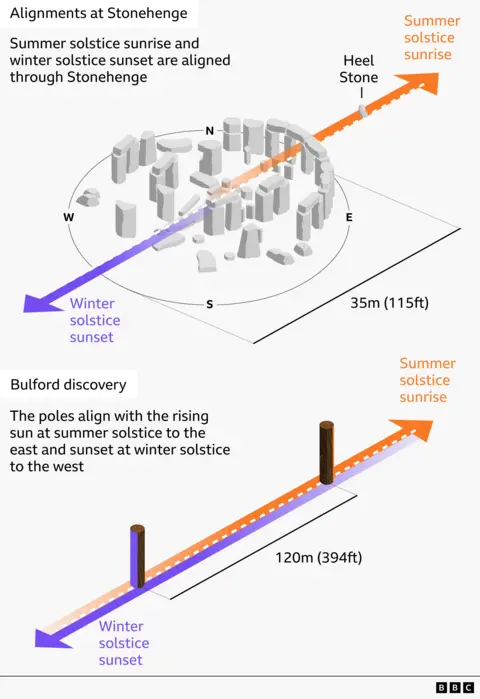
A graphic visual sketch showing how Stonehenge (in the top) and the structure at Bulford (bottom) line up with the summer solstice sunrise and winter solstice sunset. Orange arrows point to the right on both structures showing where the sunrise would be seen from and purple arrows pointing left showing where the sunset would be seen. The caption on the Stonehenge image reads "Summer solstice sunrise and winter solstice sunset are aligned through Stonehenge", the caption on the Bulford discovery image reads "the poles align with the rising sun at summer solstice to the east and sunset at winter solstice to the west".

The structure, discovered in the village of Bulford, was a much more simple construction made up of just two wooden posts, which have long since rotted away.

They were positioned 120m (394ft) apart and estimated to be between 2m and 4m high.

When Harding uncovered the intriguing holes, he noticed that they seemed to line up with the Sun, just like Stonehenge located a few miles away.

"I got my pencil and ruler, and I joined them up, and I was aware that they were kind of pointing in the general direction of the sunrise on midsummer," he said.
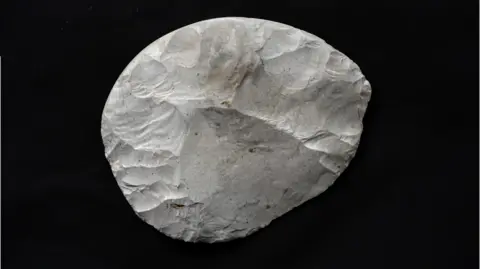
Tony Jolliffe/BBC News A rounded piece of flint that has been carefully worked to create a knife. It is white, with some brown and grey marks, and is set against a black background. The areas where pieces of the flint have been struck off using another stone are clearly visible. It is not a perfect circle but its sides are rounded. Tony Jolliffe/BBC News

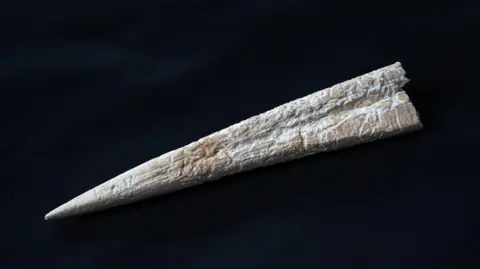
Tony Jolliffe/BBC News A small piece of bone that has been carved to a sharp point at one end. It may have been used to make holes when working leather. The pointed end is on the left and the wider end on the right. It is white and light brown and is set against a black background. There is a slight groove running about half way along its length from the wider end. Tony Jolliffe/BBC News

A number of artefacts were found at the site, including this rounded flint knife

Dating of items like this carved bone show the site is 5,000 years old

The traces of the earlier structure were found a decade ago in Bulford when the ground was cleared for new army housing.

But it is only now that a detailed analysis of the alignment has been carried out, which involved turning back the celestial clock.

"The sky - the positions of the Sun, Moon, planets and stars - they change very slowly throughout the centuries. We don't really notice it during our lifetimes," said Dr Fabio Silva, an archaeoastronomer from Bournemouth University and the Skyscape Academy.

"So we basically need to reconstruct the sky, what it looked like exactly 5,000 years ago, where the Sun was rising and what time it was rising in those places.

"If you take into account the width of the posts… then the alignment is exactly, exactly right. It's accurately aligned to summer solstice sunrise and winter solstice sunset."
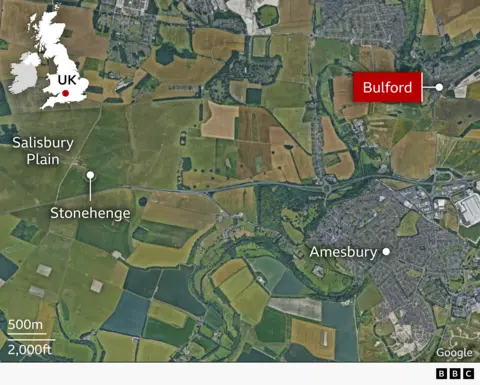
Map showing the UK outline in the top left corner in white. The main larger image is a satellite picture of Salisbury Plain with Stonehenge and Bulford marked on the map. Bulford is highlighted in red with white writing.

The pits that held these posts were not the only discovery during the excavation, surrounding them were dozens of other holes containing artefacts belonging to the prehistoric people of Bulford village.

These objects have helped to establish the age of the site. The team used radiocarbon dating, which looks at how a special form of carbon changes over time, to work out that the structure was 5,000 years old.

The artefacts included an antler that would have been used for digging, and other carved animal bones, as well as finely decorated fragments of pottery.

Tools made of flint were also uncovered, including a rare Neolithic knife that has been rounded into a disc-shape (discoidal).

"It was, I think, our star find," said Harding of Wessex Archaeology.

"What is so special about it is the workmanship that's gone into it. That is the work of real craftsmanship."

He said the knife was found in an upright position, like it had been carefully placed, and he wonders if it had a symbolic significance.

"Maybe that discoidal shape is some sort of reference to the Sun, who knows?," he said.
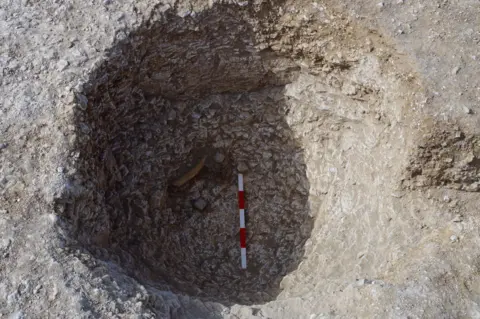
Wessex Archaeology The hole in the ground shows a light rock with a hole in shadow dug into it. At the bottom is a red and white measuring pole, with three blocks of white and two blocks of red visible in between. It's difficult to see how deep it is but at the bottom there is an artefact protruding at the bottom on the left hand side of the hole. It is in the shadowed area and is something that looks light brown in colour and slightly curved. Wessex Archaeology

Each hole was about half a metre wide and the two were separated by 120m (400ft)

The monument at Bulford dates to the same time as the earliest phase of activity at Stonehenge, when the first earthworks were built half a Millennium before the stones were placed.

"The discovery of Bulford actually suggests that maybe the people who built the first stages of Stonehenge were based or living there, or at least gathering seasonally to do the construction work at Stonehenge," said Dr Jennifer Wexler, curator of history at English Heritage.

But why were these prehistoric people so fascinated with the Sun?

"The people who built Stonehenge and the people who were at Bulford were early farmers, and their livelihoods really were connected to the seasons and the Sun doing its job," explained Wexler.

Today, the summer solstice at Stonehenge is the biggest draw, when thousands of people come to witness sunrise at the monument.

But Wexler says 5,000 years ago, the winter solstice - the shortest day of the year -held more significance for the ancient communities.

"Winter might have been particularly important because it's a time of year when the light is literally dying, and maybe you need to do something to evoke that return or mark it, because then it's a return of the spring, when hopefully your crops and your animals will thrive."