










 Anadolu via Getty Images
More than 100 days after US and Israeli bombs began falling on Iran, both sides are claiming victory - a sign of how much each needed a way out.
A deal has officially ended the fighting, but the harder negotiations are just beginning.
Both sides have sold the deal to their public as a win but, as our analysts here explain, neither has fully convinced them and domestic critics on both sides argue that too many concessions were made.
 Anadolu via Getty Images
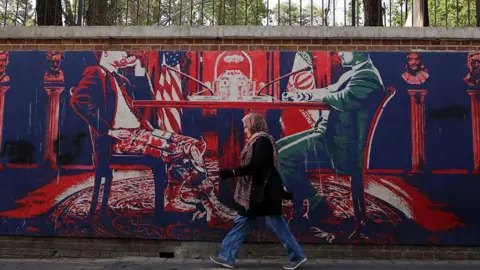
For Iran, the deal with the US offers something just as important as a ceasefire: a way to claim that it has not just survived the war without surrendering but has emerged from it stronger.
From the start, Tehran's core objective was not necessarily to defeat the US and Israel in conventional military terms. It was to come out of the conflict with the Islamic Republic intact, its leadership still functioning and its negotiating position not completely broken.
The Memorandum of Understanding (MOU) – as the deal is known - allows Iran to say it has achieved that.
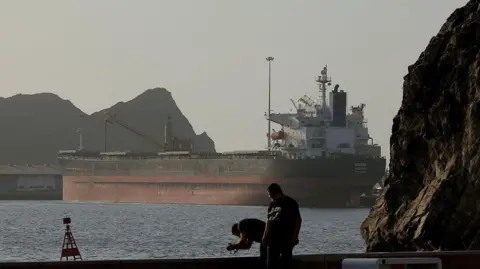
The document, signed separately by US President Donald Trump and Iranian President Masoud Pezeshkian, sets out a 60-day framework for negotiations over Iran's nuclear programme but it also confirms an immediate halt to military operations on all fronts, including Lebanon, mutual respect for sovereignty, the reopening of the Strait of Hormuz and the lifting of the US naval blockade on Iranian shipping.
Iran's immediate obligations are significant, but relatively limited. Tehran has agreed to help ensure safe commercial passage through Hormuz, something that had long been the status quo before the war, reaffirm that it will not pursue nuclear weapons, and enter talks on the future of its highly enriched uranium and enrichment programme.
The US commitments appear broader. According to the MoU, Washington will begin removing its naval blockade, issue waivers for Iranian oil exports, make frozen or restricted Iranian assets available, work towards easing sanctions and pursue with regional partners a reconstruction and economic development plan for Iran worth at least $300bn (£224bn).
That helps explain why the reaction from Iranian critics has so far been muted. The MoU gives the leadership enough to present the deal as a victory: Iran's sovereignty is recognised, the blockade is due to be lifted, sanctions relief is on the table and reconstruction funding is explicitly mentioned.
But that silence is unlikely to last. Even the first response of Iran's supreme leader, Mojtaba Khamenei, was carefully balanced: he allowed the deal to proceed, while making clear that it had been accepted on Iran's Supreme National Security Council responsibility.
The most difficult issues have been deferred, not resolved. The future of Iran's highly enriched uranium, the scale of its enrichment industry and the rebuilding of damaged nuclear facilities will now be negotiated under intense pressure.
That creates a problem for Tehran's leadership. State media, the Revolutionary Guards, parliament and hardline figures have spent weeks telling their base that Iran defeated the US and Israel. Expectations are now high. Any compromise over enriched uranium or nuclear infrastructure could be portrayed by critics as a concession made after victory had already been declared.
But no compromise could be just as dangerous. If Tehran refuses to move on highly enriched uranium or the future shape of its nuclear programme, the process could collapse and the ceasefire itself may come under pressure. That would strengthen those in Washington and Israel who already argue that Iran has only used the MoU to buy time and could push both sides back towards war.
Mohammad Bagher Ghalibaf, the speaker of parliament and head of Iran's negotiating team, has tried to frame the talks in defiant terms. "I am not a diplomat," he said on state TV, "but I know well how to make America understand."
Khamenei's reaction has made that task even harder. He said he held "another view in principle" but had authorised the MoU after Pezeshkian, as head of the Supreme National Security Council, accepted responsibility for defending Iran's rights and those of Iran's allies.
That wording keeps him close enough to the deal to allow it to proceed, but distant enough to avoid full ownership if it fails. For Iran's negotiators, that may narrow the room for compromise. They must satisfy Washington without appearing to have crossed lines the leader himself has not fully embraced.
Ghalibaf's language is aimed as much at Iran's domestic audience as at Washington. The former Revolutionary Guards commander has to sell the deal to a hardline base deeply suspicious of compromise with the US.
The comparison with the 2015 nuclear agreement is unavoidable. In Washington, some may present the MoU as worse than the Joint Comprehensive Plan of Action, as the earlier agreement was known, arguing that Trump has accepted a framework that gives Iran sanctions relief and economic benefits while postponing the hardest nuclear questions.
In Tehran, however, the danger is different. Hardliners may accuse the government and negotiating team of repeating what they saw as the betrayal of 2015, when President Hassan Rouhani came under attack by MPs, conservative media and political rivals who accused him of making too many concessions over Iran's nuclear programme.
For Pezeshkian and Ghalibaf, the challenge is to turn a ceasefire framework into a political success before that backlash gathers force.
Iran has gained time, relief from immediate military pressure and the prospect of major economic concessions. It has also avoided the outcome Washington demanded most publicly: total surrender.
But it has not yet secured the final deal. The MoU strengthens Iran's hand in the short term because the system has survived and Washington has made visible commitments. The risk for Tehran is that the next 60 days expose the gap between the image of victory sold at home and the compromises required to keep the war from returning.
Iran has come out of the war's first chapter stronger than many expected, but its next challenge may be harder: keeping its own political base behind the process long enough to reach a final deal, without allowing compromise to look like a concession or even a defeat.
Trump hails deal as 'major win' but critics say concessions too great
 Reuters
Bernd Debusmann JrWhite House reporter
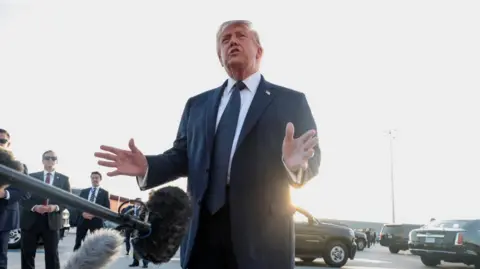
Donald Trump has hailed the agreement as a "major win" for the United States that ultimately accomplishes his overarching war aim of preventing Iran from acquiring a nuclear weapon.
In the near term, however, a much more immediate "victory" is the re-opening of the global economy as a result of the Strait of Hormuz opening.
As the conflict wore on and the Strait of Hormuz remained essentially closed, polls consistently suggested that the American public was growing exasperated with the high price of petrol and what the war meant for them at home.
Dissatisfaction with the economy was among the primary reasons voters sent Trump back to the White House in 2024, and a perception that the war the president chose to initiate was hurting their pocketbook had become politically damaging for Trump.
And while he may himself not be on the ballot in the November midterm elections, that unease came at a difficult time for fellow Republicans, many of whom have faced increasingly angry constituents, and would-be voters who were growing more and more vocal about the prospect of a long-running, frozen conflict.
With that in mind, the deal gives Trump breathing room and, his political allies hope, the ability to portray himself as the figure who brought the conflict to a relatively quick close and avoided the sort of seemingly endless foreign entanglements of the forever wars that he campaigned against.
However, critics of the agreement - including some from within the Republican Party - have already accused Trump of giving too much as far as concessions go.
At the heart of this argument is the pledge that Iran will benefit from the $300bn reconstruction fund.
"There is no 300 billion dollar payment to Iran by the US. That's fake news," Trump wrote on Truth Social. "All there is for the US is success, lower oil prices, and victory."
While Trump and other administration officials too have made clear that none of this money will come directly from the US, it has some within the party feeling uneasy.
"History teaches us that giving billions of dollars to theocratic lunatics who want to murder us is not a good idea," Texas Senator Ted Cruz - an otherwise reliable ally of Trump - told The Hill. "I think the president is receiving some very poor advice."
Conservative commentator Tucker Carlson who, despite recent criticism of the administration remains a powerful figure among the Maga base, put it more bluntly.
"This is a pretty humiliating loss for the United States," he said on his show on X. "This is a loss."
Notably, the administration has also been forced to acknowledge that several of its war aims have seemingly become non-priorities that go unmentioned in the MoU.
Early on in the conflict, for example, Trump vowed that the US military would "destroy their missiles and raze their missile industry to the ground", leaving it "obliterated".
Similarly, the MoU contains no references to Iran's ties with regional proxy groups, despite Trump's March promise that the US was working to ensure "the Iranian regime cannot continue to arm, fund and direct armies outside of their borders".
The administration has now backed away from that aim, with Vice-President JD Vance telling reporters that the US "expects" that Hezbollah will refrain from firing on Israelis.
Ceasefires, he added, are a "little messy" and "flare-ups" can be expected to take place.
That alone will make the deal unpopular among those Republicans who view US commitment to Israel's security as an ironclad aspect of US politics.