

惯性聚合 高效追踪和阅读你感兴趣的博客、新闻、科技资讯
阅读原文 在惯性聚合中打开

推荐订阅源

博客园_首页
MongoDB | Blog
MongoDB | Blog
Google DeepMind News
M
MIT News - Artificial intelligence
D
Docker
云风的 BLOG
云风的 BLOG
B
Blog
让小产品的独立变现更简单 - ezindie.com
G
Google Developers Blog
GbyAI
GbyAI
T
Tailwind CSS Blog
罗磊的独立博客
博客园 - 三生石上(FineUI控件)
V
Visual Studio Blog
C
Check Point Blog
I
InfoQ
Microsoft Azure Blog
Cyber Security Advisories - MS-ISAC
阮一峰的网络日志
阮一峰的网络日志
小众软件
小众软件
N
Netflix TechBlog - Medium
B
Blog RSS Feed
腾讯CDC
aimingoo的专栏
aimingoo的专栏

Lobsters

CIFSwitch: a non-universal Linux local root vulnerability RIPE NCC session fixation: poaching logins with an Atlas probe GNOME 2.20 but its Web Components Agentic Search for Context Engineering – Leonie Monigatti Garnix is shutting down [not OC] akashina.tngl.sh/jjc Concerning Emacs (and Jazz) Nitpicking the shell history scene in ‘Tron: Legacy’ What's cooking on SourceHut? Q2 2026 The tenth OpenPGP email summit Package managers that package package managers Clojure on Fennel part three: parsing WordPress at 23 Finding Miscompiles for Fun, Not Profit GitHub - creusot-rs/creusot: Creusot helps you prove your Rust code is correct. Announcing Rust 1.96.0 | Rust Blog A Love Letter to Neovim sqlite AGENTS.md Am I a Bad Friend? CSS vs. JavaScript • Josh W. Comeau Erlang Ecosystem Foundation - Supporting the BEAM community A brief note about slot access cost in Common Lisp Keyboard latency probe Rethinking the GNOME clipboard issues Back to the Building Blocks’ Building Blocks Tech Notes: Theseus: translating win32 to wasm Fast is better than slow Content-addressed Rust builds (or, what kache actually caches) Intent to Prototype: Embedding API Canada’s Bill C-22 and the security cost of collecting more data
thunderbolt-ibverbs: We have InfiniBand at home
blog.hellas. · 2026-05-28 · via Lobsters

I spent the past few weeks building a linux kernel module that makes ordinary USB4/Thunderbolt ports on AMD mini PCs pretend to be InfiniBand devices. The goal is simple: let existing AI runtimes like vLLM/RCCL split inference or training across multiple boxes at home, without buying enterprise networking gear.

TL;DR. We built experimental RDMA-over-USB4 for 128GB Strix Halo mini PCs. It lets two consumer boxes talk fast enough to run tensor-parallel inference and FSDP workloads across both machines: ~95 Gb/s bidirectional raw RDMA, ~7 µs one-way latency, a MiniMax-M2.7 TP=2 inference run that does not fit on one box, and a Gemma 3 27B LoRA FSDP step falling from 1359 s over Ethernet to 126 s over 4-HCA USB4 RDMA.
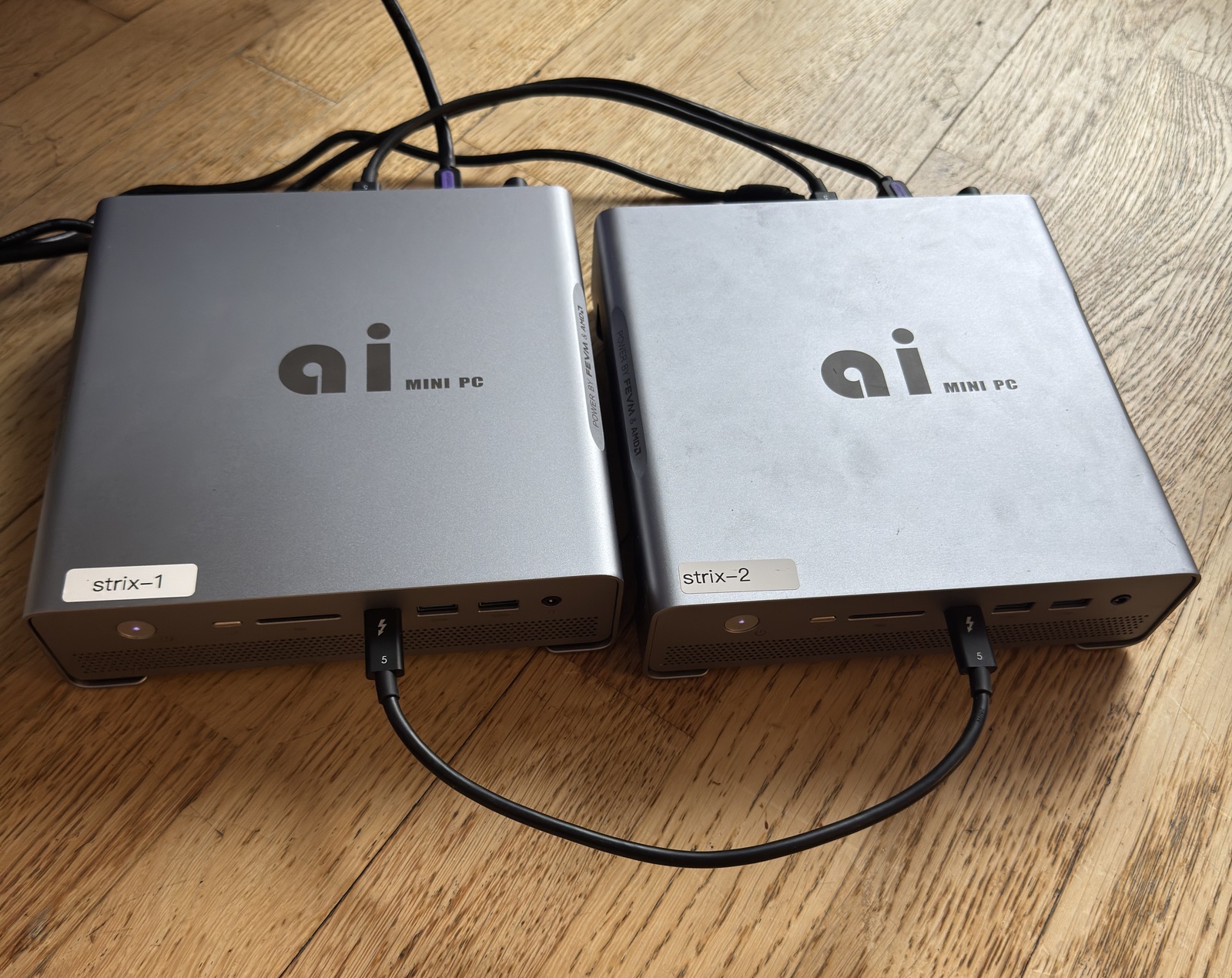
Two Strix Halo mini-PCs (strix-1, strix-2) connected by USB4

  • ~48 Gb/s per direction (~95 Gb/s bidi total) sustained ib_write_bw, 4-HCA aggregate at 1 MiB / 8 QPs with IOMMU off — vs ~2.3 Gb/s over the onboard 2.5 GbE and ~9 Gb/s for soft-RoCE on top of thunderbolt-net at the per-rail level.
  • ~7 µs one-way ib_write_lat at 64 B, single QP — vs ~28 µs over RXE/2.5 GbE and ~65 µs over RXE/TBnet.
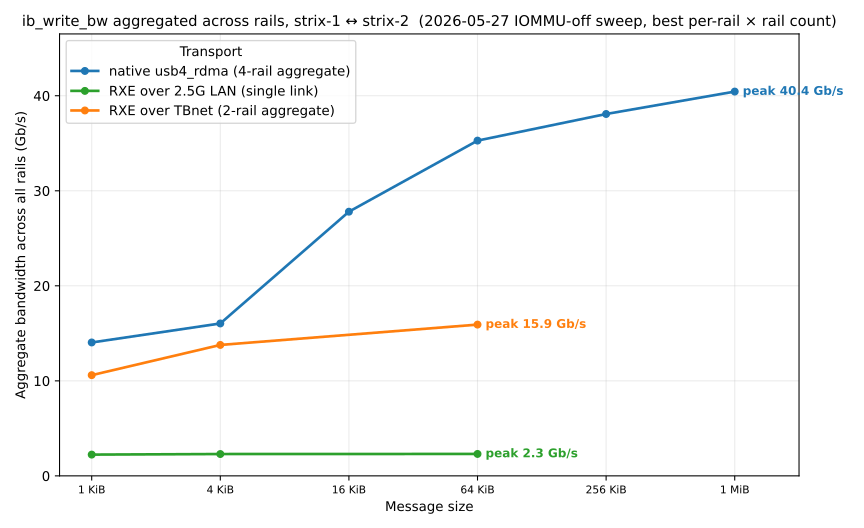
ib_write_bw between strix-1 and strix-2, by transport and QPs

DISCLAIMER: this is research code, most of it AI-generated, and it loads experimental kernel modules on machines I was willing to crash repeatedly. I made an effort to understand enough of it to keep it on-track, but there are almost certainly false assumptions and sharp edges throughout. No warranty, no support promise, not production software.