惯性聚合 高效追踪和阅读你感兴趣的博客、新闻、科技资讯
阅读原文 在惯性聚合中打开

推荐订阅源

cs.CV updates on arXiv.org
博客园 - 【当耐特】
OSCHINA 社区最新新闻
OSCHINA 社区最新新闻
L
LangChain Blog
雷峰网
雷峰网
WordPress大学
WordPress大学
S
Security Affairs
腾讯CDC
freeCodeCamp Programming Tutorials: Python, JavaScript, Git & More
Recent Commits to openclaw:main
Hacker News: Ask HN
Hacker News: Ask HN
T
Tailwind CSS Blog
SecWiki News
SecWiki News
罗磊的独立博客
The Last Watchdog
The Last Watchdog
博客园 - 三生石上(FineUI控件)
N
Netflix TechBlog - Medium
Hugging Face - Blog
Hugging Face - Blog
T
Tor Project blog
V
Vulnerabilities – Threatpost
Microsoft Azure Blog
cs.AI updates on arXiv.org
奇客Solidot–传递最新科技情报
奇客Solidot–传递最新科技情报
GbyAI
GbyAI
M
MIT News - Artificial intelligence
Help Net Security
Help Net Security
MongoDB | Blog
MongoDB | Blog
AWS News Blog
AWS News Blog
L
LINUX DO - 热门话题
P
Palo Alto Networks Blog
Threat Intelligence Blog | Flashpoint
Simon Willison's Weblog
博客园 - Franky
Security Latest
Security Latest
G
GRAHAM CLULEY
C
CERT Recently Published Vulnerability Notes
H
Heimdal Security Blog
Recent Announcements
Apple Machine Learning Research
W
WeLiveSecurity
The Cloudflare Blog
B
Blog RSS Feed
B
Blog
Vercel News
Vercel News
T
Threatpost
小众软件
小众软件
H
Help Net Security
Jina AI
Jina AI
T
Threat Research - Cisco Blogs
Google DeepMind News

Crazyrouter Blog (English)

Ideogram AI Guide 2026: Product Mockups, Text Rendering, and API Automation Akool AI Voice Generator Review 2026: API Alternatives for Developers GLM 4.6 API Guide 2026: Build Chinese-English Agents with Tool Calling Google Veo3 API Guide 2026: Batch Video Generation, QA, and Fallbacks Claude Opus 4.8 vs Opus 4.7: Real API Benchmark Results for Developers Opus 4.8 vs Opus 4.7 Coding Test: What Changed for Developers? Opus 4.8 vs Opus 4.7 for Agents: JSON, Tool Use, and Structured Output Gemini 2.5 Flash-Lite for RAG, Agent Routing, and Cost per Successful Task Gemini 2.5 Flash-Lite for Support Automation and Ticket Triage Gemini 2.5 Flash-Lite Use Cases: The Practical Automation Tier for Developers Claude Jupiter v1-p vs GPT-5.5 Benchmark: Real API Test on Reasoning and Coding Claude Jupiter v1-p vs Claude Opus 4.7 vs Sonnet 4.6: Live API Test Claude Jupiter v1-p vs Claude Opus 4.7 vs Sonnet 4.6: Live API Test Claude Code Pricing 2026: Pro vs Max vs Team vs API Costs Claude Opus 4.7 vs DeepSeek V4 Pro: Real API Compatibility and Coding Benchmark Gemini CLI Complete Guide 2026: Repo Automation, CI Agents, and Multi-Model Routing Ideogram AI Guide 2026: Brand Design Automation, API Workflows, and Alternatives GLM 4.6 API Guide 2026: Agents, RAG, Tool Calling, and Bilingual Apps WAN 2.2 Animate Tutorial 2026: Character Consistency, Shot Control, and API Workflows Google Veo3 API Guide 2026: Production Video Pipelines, Prompts, Pricing, and Fallbacks AI API Pricing Comparison 2026: Text, Image, Video, Caching, and Router Costs Codex CLI Installation Guide 2026: Windows, macOS, Linux, Proxies, and CI Setup How to Get a Claude API Key in 2026: Secure Setup for Teams, CI, and Alternatives Gemini Advanced Review 2026: Is It Worth It for Coding, Research, and API Teams? Claude Code Pricing Guide 2026: Team Agent Budgets, API Fallbacks, and Cost Control Seedance 2.0 Pricing: Convert 46 CNY per Million Tokens to Cost per Second Qwen2.5-Omni Guide 2026: Real-Time Voice, Vision, and Multimodal Agents Kimi K2 Thinking Guide 2026: Reasoning Workflows, Evals, and Cost Control Google Veo3 API Guide 2026: Batch Video Pipelines, Pricing, and Fallbacks Codex CLI Installation Guide 2026: macOS, Linux, WSL, Proxies, and Dev Containers How to Get a Claude API Key in 2026: Safe Production Setup and Alternatives AI API Pricing Comparison 2026: GPT, Claude, Gemini, Video, and Agent Workloads Gemini Advanced Review 2026: Is It Worth It for Developer Teams? Claude Code Pricing Guide 2026: API Fallbacks, Team Seats, and Budget Control Seedream 4.0 API Tutorial 2026: Batch Image Generation, Product Creative, and Pricing Qwen2.5-Omni Guide 2026: Real-Time Voice, Vision, Text Agents, and API Integration Kimi K2 Thinking Guide 2026: Reasoning Agents, Evaluation Workflows, and API Cost Control WAN 2.2 Animate Tutorial 2026: Character Motion, Shot Control, API Pipelines, and Pricing Google Veo3 API Guide 2026: Production Video Workflows, Prompts, Pricing, and Fallbacks AI API Pricing Comparison 2026: OpenAI, Claude, Gemini, DeepSeek, and Router Costs How to Get a Claude API Key in 2026: Setup, Security, Rotation, and Alternatives Codex CLI Installation Guide 2026: macOS, Linux, WSL, Proxies, and Devcontainers Gemini Advanced Review 2026: Is It Worth It for Developers and API Builders? Claude Code Pricing Guide 2026: CI Agents, Team Seats, and API Budget Planning AI API Gateway for Singapore and Malaysia Developers: One Endpoint for GPT, Claude and Gemini AI API Gateway for Thai Developers: Use GPT, Claude and Gemini with One Key One API Key for GPT, Claude and Gemini: A Practical Setup for Central Asia Developers Gemini 3.5 Flash vs Claude Response-Tier Models: Which One Should Developers Use? Gemini 3.5 Flash vs Gemini 3 Flash vs Gemini 2.5 Flash: Real API Benchmark "How to Test Multiple AI Image Models with One API Key" Codex CLI Installation Guide: Setup on macOS, Linux, Windows WSL and CI/CD Seedream 4.0 API Tutorial: ByteDance Image Generation for Production Pipelines Kimi K2 Thinking Model: Complete Developer Guide for Reasoning Workflows Luma Ray 2 Review: AI Video Generation Quality, Speed, and API Guide Pika 2.2 New Features Review: Scene Director, Sound Design, and API Updates Google Veo 3 API Guide: Video Generation with Audio for Developers AI Lip Sync Tools Comparison 2026: Best APIs for Talking Avatars and Video Dubbing Gemini Advanced Review May 2026: Is It Worth $20/Month for AI Power Users? Claude Code Pricing in May 2026: Max Plan, Opus 4, and Real Cost Breakdown Hermes Agent + Crazyrouter: One-Click Setup for 627+ AI Models Text-Embedding-3-Small: Complete Guide to OpenAI's Most Popular Embedding Model (2026) AI Meme Generator & Coloring Book Creator with GPT-image-2 — Fun Projects That Actually Make Money AI Future Baby Prediction with GPT-image-2 — See What Your Child Might Look Like Ghibli Style Photo Transformation with GPT-image-2 — Turn Any Photo Into Anime Art AI Action Figure Generator with GPT-image-2 — Turn Anyone Into a Boxed Toy AI Face Reading & Personal Color Analysis with GPT-image-2 — Two Viral Use Cases in One Guide AI Palm Reading with GPT-image-2 — Generate Professional Palmistry Analysis from a Single Photo Gemini 2.5 Flash-Lite Pricing Explained — The Cheapest Gemini Model for High-Volume Workloads Claude Sonnet 4.6 Pricing Explained — Caching, Tiers, and How to Save 45% with Crazyrouter Gemini Free vs Gemini Advanced: Pricing, Limits, Features, and Is It Worth Paying For? AI Context Window Comparison (2026): GPT, Claude, Gemini Token Limits by Model Claude Sonnet 4.5 Pricing Explained — Caching, Batch API, and How to Save 45% with Crazyrouter Claude Opus 4.7 Pricing Explained — New Tokenizer, Caching, and How to Save 45% with Crazyrouter Claude Opus 4.6 Pricing Explained — Caching, Tiers, and How to Save 45% with Crazyrouter Best AI Models for RAG Applications 2026: Embeddings, Retrieval, and Generation Seedance 2.0 vs Kling 2.1 vs Runway Gen 4 Turbo: Video AI API Comparison 2026 AI Video Generation API Pricing May 2026: Veo3 vs Kling vs Runway vs Sora How to Get Claude API Key in China 2026: Complete Setup Guide AI Coding Tools ROI Calculator: Claude Code vs Codex CLI vs Gemini CLI Cost Analysis 2026 AI API Pricing Comparison May 2026 - Complete Developer Guide Grok 4 API Pricing Complete Guide 2026 DeepSeek R2: The 32B Reasoning Model That Runs on a Single GPU — Complete Guide for Developers "GPT-5.1 Codex Max Pricing Explained — The Code-Specialized Model and How to Save with Crazyrouter" GPT-4o Pricing Explained — The Legacy Flagship That's Still Worth Using GLM-5 Pricing Explained — Zhipu AI's Flagship Model and How to Access via Crazyrouter Gemini 3 Flash Pricing Explained — Balanced Speed and Cost with Crazyrouter Savings "Gemini 3.1 Pro Pricing Explained — Context Tiers, Caching, and How to Save with Crazyrouter" GPT-5.5 Pricing Explained — OpenAI's Latest Flagship, Reasoning Tokens, and How to Save with Crazyrouter AI Model Pricing Guide 2026: What Every Model Costs on Crazyrouter (and How Much You Save) MiniMax M2 Pricing Explained — China's Competitive AI Model and How to Access via Crazyrouter Grok 4.1 Thinking Pricing Explained — Reasoning Tokens, Caching, and How to Save with Crazyrouter Grok 4.1 Pricing Explained — 2M Context, Caching, Tool Costs, and How to Save with Crazyrouter GPT-5 Pricing Explained — Reasoning Tokens, Caching, Batch API, and How to Save with Crazyrouter GPT-5-nano Pricing Explained — The Cheapest GPT Model for High-Throughput Workloads GPT-5-mini Pricing Explained — Ultra-Low Cost AI with Caching and Batch Discounts GPT-5.4 Pricing Explained — Cached Input, Context Tiers, Batch API, and How to Save with Crazyrouter GPT-5.2 Pricing Explained — Caching, Batch API, and How to Save with Crazyrouter OpenRouter vs Crazyrouter (2026): Pricing, Models, and Which API Gateway Fits Developers Better Suno v4 vs v5 vs v4.5: Which Version Sounds Better and Is Worth Using in 2026? How to Use Claude Code with Crazyrouter: Base URL Setup, Model Routing, and Cost Savings
Gemini 2.5 Flash Lite vs GPT-4.1 Nano Vision API Benchmark 2026: User-Centric Image Understanding Comparison
Crazyrouter Team · 2026-06-22 · via Crazyrouter Blog (English)

Gemini 2.5 Flash Lite vs GPT-4.1 Nano Vision API Benchmark 2026: User-Centric Image Understanding Comparison#

Choosing a vision model for production is not only about whether a model "supports images". Developers usually need a route that works for real user workflows: image uploads, screenshots, UI debugging, logo detection, document previews, support tickets, and agent workflows that pass visual context through an OpenAI-compatible API.

This benchmark compares gemini-2.5-flash-lite and gpt-4.1-nano through the Crazyrouter OpenAI-compatible Base URL:

The request format is chat/completions with messages[].content[] containing both text and image_url. Each model was tested on two stable public images, the Python logo and the GitHub logo, with three runs per image.

Test time: 2026-06-21T13:36:32Z. These are measured API results, not copied model-card claims.
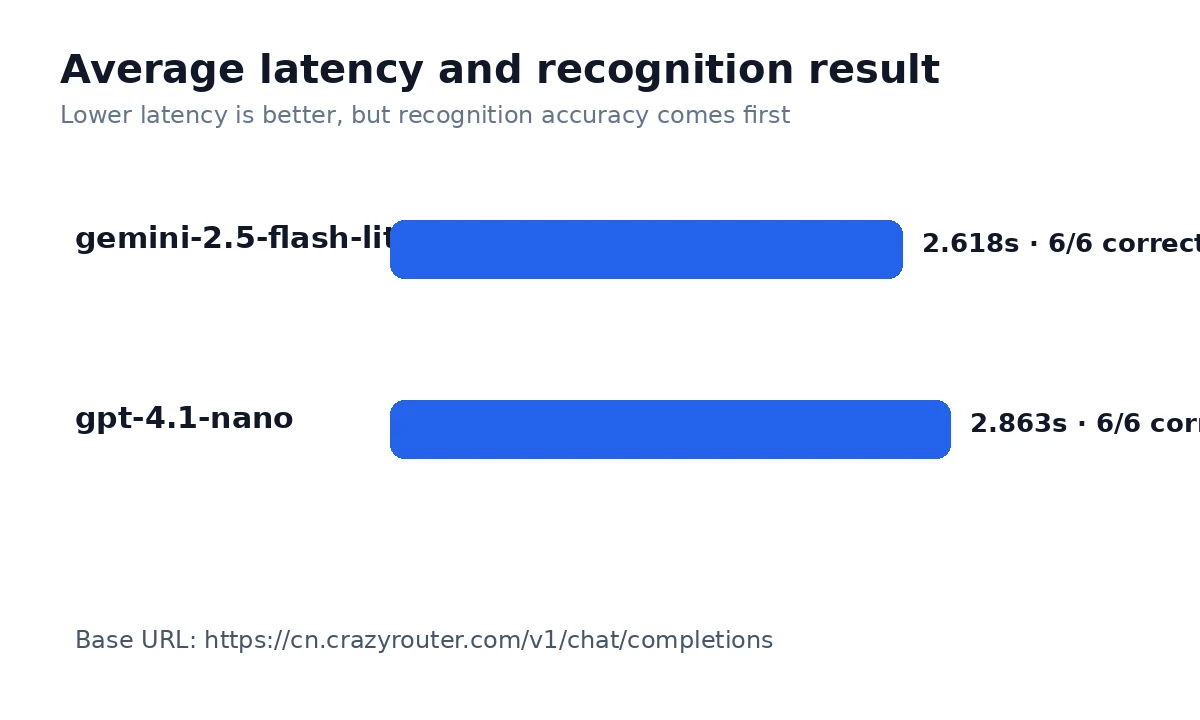
Gemini 2.5 Flash Lite vs GPT-4.1 Nano latency chart

Executive recommendation#

  • For real-time user uploads, prefer gemini-2.5-flash-lite because it was faster in this run.
  • For bulk tagging or logo recognition, prefer gpt-4.1-nano because estimated cost per successful image is lower.
  • For complex screenshots, documents, OCR, or chart reasoning, add a second-stage stronger-model evaluation before making this your default route.

User-centric scorecard#

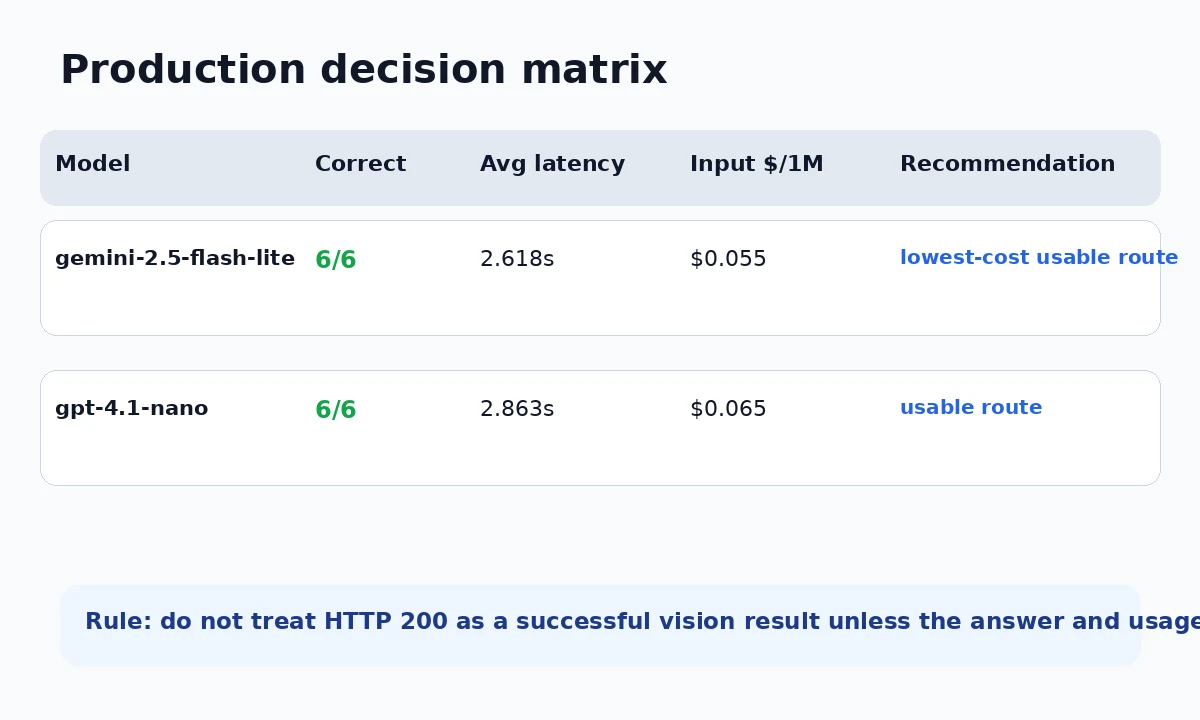
Decision dimensiongemini-2.5-flash-litegpt-4.1-nanoWhy it matters
HTTP success6/66/6Transport success only; it does not prove the model saw the image.
Correct visual recognition6/66/6The most important smoke-test metric for image_url routing.
No-image failure claims00Detects routes that accepted the request but failed to pass image content.
Average latency2.618s2.863sUseful for expected user-facing wait time.
Median latency2.627s2.562sBetter than average for typical request experience.
Slowest request in run4.195s4.213sTail latency is what users notice when the product feels stuck.
Input price / 1M tokens$0.055$0.065Matters for image tagging, OCR pre-filtering, and bulk classification.
Output price / 1M tokens$0.22$0.26Matters when prompts ask for longer visual descriptions.
Estimated cost / 10k test-style calls$0.5466$0.1666More practical than raw token price because it includes observed usage.
Usage / image signalimage token fields are zero/missing; verify visual smoke tests instead of trusting HTTP status aloneimage token fields are zero/missing; verify visual smoke tests instead of trusting HTTP status aloneUsage metadata can reveal a broken vision path even when HTTP is 200.

Gemini 2.5 Flash Lite vs GPT-4.1 Nano decision matrix

What this benchmark is good for#

This test is intentionally a vision API smoke test. It is useful for answering:

  • Does the image_url request path work through an OpenAI-compatible API?
  • Does the model actually identify simple visual content instead of only reading the text prompt?
  • Which model is faster for a small user-facing image request?
  • Which route is cheaper for large volumes of simple image classification?
  • Does the usage metadata look consistent with an image being processed?

It is not a complete benchmark for OCR, chart reasoning, handwriting, medical images, dense document extraction, or multi-image reasoning. For those workflows, use this as the first routing check, then add task-specific evaluations.

Raw benchmark data#

Metricgemini-2.5-flash-litegpt-4.1-nano
HTTP success6/66/6
Correct recognition6/66/6
No-image replies00
Average latency2.618s2.863s
Median latency2.627s2.562s
Fastest request1.302s2.256s
Slowest request4.195s4.213s
Avg prompt tokens observed970.5227.0
Avg completion tokens observed5.87.3

Sample outputs#

TaskModelSample outputLatencyPrompt tokens
logo_pythongemini-2.5-flash-liteThe Python programming language logo.2.616s1109
logo_pythongpt-4.1-nanoPython programming language logo.4.213s227
logo_githubgemini-2.5-flash-liteThe GitHub logo.2.638s1109
logo_githubgpt-4.1-nanoGitHub Octocat logo silhouette.2.512s227

Production routing guidance#

1. Real-time user image uploads#

For chat apps, customer support tools, and user-facing image upload flows, latency and reliability dominate. A cheaper model is not cheaper if users retry, abandon the flow, or trigger a fallback on every request. Use the faster route as the first candidate only if it also passes the visual smoke test.

2. Bulk logo, icon, and screenshot tagging#

For high-volume classification, cost per successful image matters more than raw model prestige. Use the lower-cost route when the task is simple and the answer format can be validated. Add a fallback only for empty answers, no-image claims, or low-confidence classifications.

3. OCR and document workflows#

This benchmark does not prove OCR quality. If your workflow involves invoices, tables, forms, receipts, or screenshots with dense text, add a second benchmark with real documents. A model that can identify a logo may still be weak at layout extraction.

4. Agent workflows with visual context#

Agents need predictable inputs. If a route sometimes drops image content while returning HTTP 200, the agent may make confident but wrong decisions. For agent use, monitor both answer correctness and usage signals, and fail closed when the image path looks suspicious.

5. Gateway media behavior#

image_url support can mean different things: client accepts a URL, gateway fetches and converts the media, or the upstream provider receives the original URL. These are operationally different. They affect bandwidth, privacy, SSRF controls, latency, and billing. Treat media behavior as part of model routing, not an implementation detail.

Why HTTP 200 is not enough#

A valid HTTP response only proves that the API returned something. It does not prove the image reached the model. In vision API monitoring, send a tiny deterministic test image, ask a question with a known answer, and verify both the text response and usage metadata.

This is especially important for routes where usage suggests that image tokens are missing or where the model says no image was provided. Those are not model-quality failures; they may be adapter, media-fetch, payload-conversion, or routing failures.

API example#

Code endpoints should not include UTM parameters. Human-facing links can use UTM, for example Crazyrouter Pricing.

Final takeaway#

The best vision API route depends on the user workflow. For real-time interactions, prioritize correct recognition plus low latency. For bulk classification, prioritize cost per successful image. For agents and document workflows, prioritize reliability, usage signals, and fallback design.

In other words: do not choose a vision model by model name alone. Choose it by task, failure mode, media path, latency, and cost per useful result.